
By
Nathalia Duarte
February 25, 2026
Updated
February 25, 2026
The nuclear energy sector is seeing renewed hiring momentum, driven by life extensions of existing plants and new builds. According to the IAEA projections, global nuclear power capacity could double by 2050, reaching between 561 GW and 992 GW.
While salaries remain competitive, the GETI 2026 report shows that pay growth across transitional energy (nuclear and power sectors) is slowing. Skills shortages remain acute, especially in engineering and technical operations, while willingness to relocate has fallen to a new low. At the same time, AI adoption has surged, increasing by 180% since 2024.
Below are the key employment trends shaping nuclear and transitional energy, including the power sector.

Nuclear energy professionals are optimistic about salary
The U.S. Energy & Employment Report found that three of the top five careers by medium salary were in nuclear energy: nuclear engineer ($127,520), nuclear power reactor operator ($122,610), and nuclear technician ($104,240).
Several other careers commonly hired by nuclear power plants (although not nuclear-specific) are also ranked highly on pay, such as power plant operators and electricians.
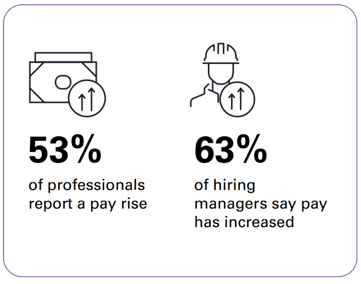
In the 2026 GETI report, pay optimism remains high with over half (53%) of transitional energy professionals reporting a salary increase in the past year, broadly in line with 2025. Looking ahead, 73% of professionals expect their pay to rise in the coming year, although expectations for increases above five per cent have softened.
James Allen, CEO of Airswift, says:
“Against a global backdrop of instability, some organisations are evaluating whether to switch to performance-based pay, which could change the spread of increases next year.”
Learn more about these insights by downloading the 2026 GETI report
An aging workforce and difficulties in recruiting
More than 80% of U.S. employers across nuclear construction, manufacturing, wholesale trade, professional and business services, and utilities report experiencing some level of hiring difficulty.
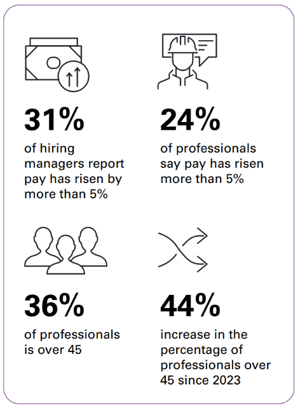
As a significant share of the workforce approaches retirement, demand for new and specialised talent continues to grow. According to NucNet, 60% of professionals are currently aged between 30 and 54, while the 2026 GETI report shows the workforce is ageing overall. The proportion of transitional energy professionals under 35 fell year-on-year, from 37% in 2025 to 34% in 2026.
Céline Gerson, Group Director Americas at Fugro, notes:
“As the workforce ages the risk of critical knowledge loss is increasing. Skills heatmaps can help organisations to identify risk and ensure that skills are intentionally transferred to the next generation through a mix of technology and structured human interaction - for example, by pairing newer team members with veteran employees for mentoring and coaching”.
The report also highlights a slight increase in talent activity, with transitional energy professionals approached an average of 6.26 times for new roles. Career mobility remains high, with 85% open to changing roles, largely driven by opportunities for career progression.
Global mobility hits new low for transitional energy
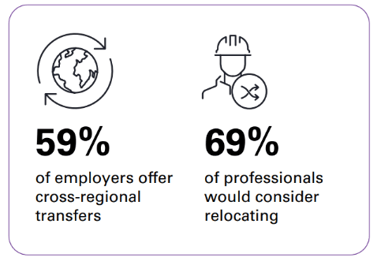
Despite strong demand for nuclear energy, the 2026 GETI Report shows a continued decline in international mobility. The share of transitional energy professionals willing to relocate has fallen to a new low of 69%, down from 74% in 2025 and 87% in 2021.
Europe remains the most attractive destination among those open to moving (32%), followed by the Middle East (17%). In contrast, interest in North America has dropped sharply, falling from 19% to 14%.
Céline Gerson also comments:
“Nuclear power is making a comeback, approvals of new gas-fired power is rising, and record investments are being made in grids and storage; the demand for transitional energy talent is at an all-time-high. These are highly complex projects, and a smaller, globally mobile talent pool could create talent scarcity leading to increased time to hire and higher compensation or at worst, delayed project timelines.”
Learn more about these insights by downloading the 2026 GETI report
AI adoption reaches 180% in the transitional energy sector, including nuclear
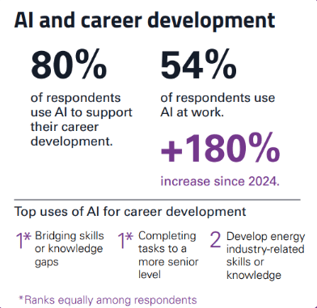
AI continues to have a growing impact across the transitional energy workforce. Over half (54%) of transitional energy professionals now use AI in their role, representing a 180% increase since 2024. Further 10% expect to begin using it within the next six months.
From an employer perspective, 49% of hiring managers say they are deploying AI and automation to ensure their organisations have the skills they need, while 46% are investing in improved learning and development programmes.
However, skills shortages remain acute, particularly in engineering and technical operations roles, cited by 53% of hiring managers as the most challenging positions to fill.
Find out more in the 2026 GETI report
Learn more about the top energy recruitment trends for 2026 and beyond. Click below to download your copy of the GETI report.