
By
Jordan Mason
March 2, 2026
Updated
March 2, 2026
The power sector is undergoing strong employment growth, driven by ageing infrastructure upgrades, renewable energy integration, and expanding grid demands.
According to the tenth annual Global Energy Talent Index (GETI) 2026, salaries in transitional energy (nuclear and power, especially within Transmission & Distribution) remain positive. However, the sector is also under increasing pressure as global mobility declines, and more than half of professionals report having no career development plan.
See the key employment trends shaping the power sector.

Salary expectations for the power sector in 2026
Rising demand and skills shortages in Transmission and Distribution (T&D) are driving upward salary pressure across many markets.
Pay levels vary widely by country, reflecting differences in economic development and cost of living. Electrical engineers are the highest paid in Australasia, followed by Europe, Asia and North America. Salaries are typically lower in developing regions, particularly in Latin America.
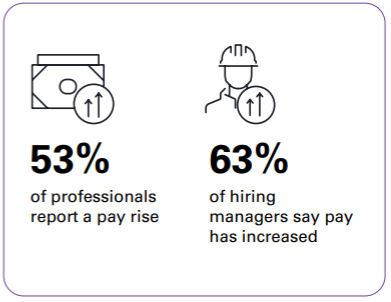
The 2026 GETI reports pay optimism remains strong. In the past year, 53% of transitional energy professionals received a pay rise, in line with 2025. Looking ahead, 73% expect further increases, although expectations for rises above 5% have eased.
Ageing workforce and declining mobility
The power sector is under increasing strain from demographic pressures. Its workforce is significantly older than average, with a wave of retirements approaching. According to the International Energy Agency (IEA), in T&D, for every new worker under 25 entering grid roles, around 1.4 experienced professionals are nearing retirement.
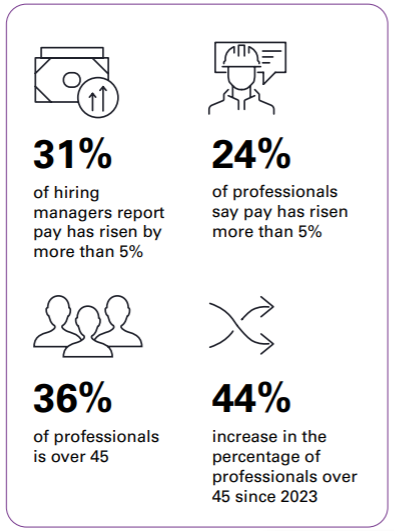
This shift is reflected in the GETI data. Since 2023, the proportion of professionals aged over 45 has risen by 44%, while the share of those under 35 fell from 37% in 2025 to 34% this year.
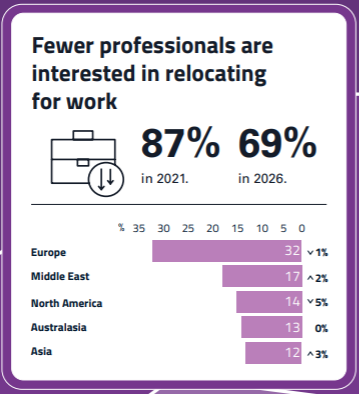
Another pain point is global mobility. The 2026 GETI report shows that willingness to relocate internationally has fallen to a record low. Just 69% of professionals would consider moving abroad, down from 74% in 2025 and 87% in 2021.
Europe remains the most attractive destination (32%), followed by the Middle East (17%). Interest in North America continues to decline, falling from 19% to 14%.
Attracting and retaining power professionals in 2026
The impact of the skills gap is already clear. In the IEA’s latest industry survey, more than half of energy companies reported critical hiring bottlenecks for technical roles. These shortages are driving project delays, longer lead times, cost overruns and upward pressure on wages.
This intensifying competition for talent is reflected in GETI 2026 data. Professionals were approached an average of 6.26 times about new roles, up from 6.08 in 2025. Only 18% reported no approaches, while 13% were contacted 16 times or more. Around a third (35%) of approaches came from outside the energy sector, in line with last year.
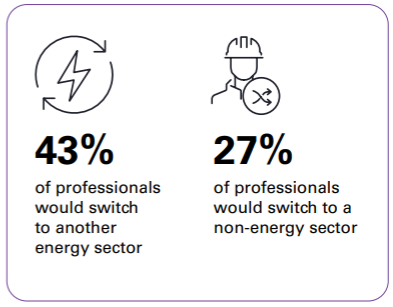
Most professionals (85%) would consider changing roles, with career progression cited as the main driver.
James Allen, CEO of Airswift, comments:
With competition for talent high, organisations are switched on to the link between a strong company culture and employee retention. Pairing long-standing employees with new recruits and embedding them into teams quickly not only supports knowledge transfer and skills building but it also helps new joiners to absorb the organisation’s cultural DNA and become part of the fabric.
Only half of professionals have a career development plan
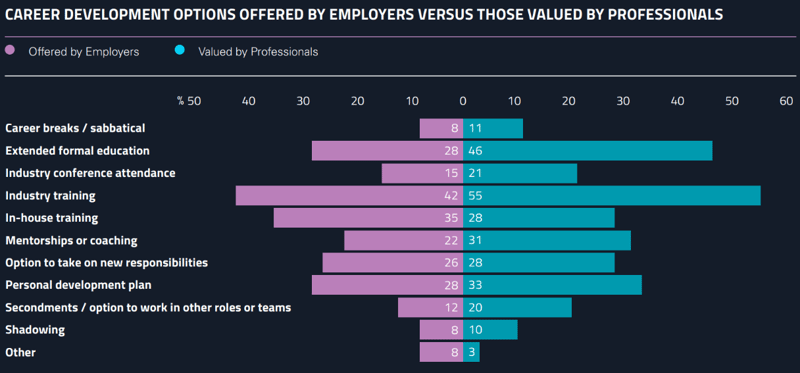
The 2026 GETI report shows that only 52% of transitional energy professionals have a career development plan. A further 24% need to create one independently, 7% need to develop one with their employer, and 6% are still waiting for employer guidance.
Industry training is the most valued development option (55%) and also the most commonly offered by employers (42%). However, while 46% of professionals value extended formal training, such as certificates or degrees, only 28% of employers provide it.
Céline Gerson, Group Director Americas at Fugro, notes:
Higher education can be a helpful component of any upskilling strategy but for it to be investable it needs to be part of a continuous and purposeful roadmap of learning that is closely tied to the organisation’s specific needs.
AI adoption accelerates across transitional energy
AI adoption among transitional energy professionals has risen by 180% since 2024. Fewer than 20% were using AI in 2024; by 2026, that figure has climbed to 54% across areas such as power and grid management. Use cases range from automating routine tasks to optimising complex engineering challenges, with a further 10% expecting to adopt AI within the next six months.
From an employer perspective, 49% of hiring managers are using AI and automation to address skills gaps, while 46% are investing in improved learning and development programmes.
Gerson also comments:
The reality is that technological changes are outstripping the pace of skills development and AI tools are only as good as the change management that supports them. Hiring or nominating digital evangelists who act as the bridge between AI and technical expertise can accelerate adoption and ensure tools deliver value where it is needed most.
Download the full 2026 GETI report
Would you like to learn more about power employment trends expected to shape the sector in 2026?
Get all the latest insights and information on trends across the rest of the energy industry in the 2026 GETI report. Download it today.