
By
Nathalia Duarte
June 24, 2026
Updated
June 24, 2026
Understanding the difference between work permits and visas is essential for anyone looking to work abroad or hire international talent. These documents determine the type of work you can do, how long you can stay, and the requirements you must meet.
A visa allows you to enter a country, while a work permit gives you the legal right to work there. However, requirements vary by country, making the process complex. Below, we break down the differences between visas and work permits, along with the legal requirements for each.

What’s the difference between a work permit and a visa? It’s all about the paperwork
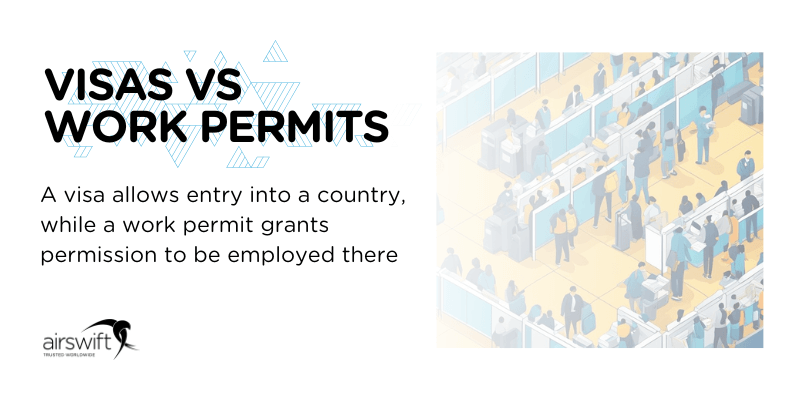
Visas and work permits are both legal documents required for working abroad, but they have key differences in purpose, requirements, and application processes. Understanding these distinctions is crucial for anyone planning to travel or work abroad.
What is a visa?
A visa is an official document issued by a foreign country that allows a person to enter and stay in that country for a specific period of time.
There are many different types of visas, including tourist, student, business and work visas. Visas are typically granted for a limited period of time and can be either single-entry or multiple-entry, which allows the holder to enter and leave the country multiple times during the visa's validity period.
The requirements for obtaining a visa vary depending on the country you are entering and the type of visa you are applying for. In general, you will need to provide documentation such as a valid passport, proof of financial support, and a travel itinerary. If you are applying for a work visa, you may also need to provide a job offer letter or other documentation related to your employment.
Visa categories and types
Visa categories vary widely. Common types include:
- Tourist visas
- Business visas
- Student visas
- Temporary work visas
What is a work permit?
Work permits, also called Employment Authorisation Documents (EADs) in some places, are typically required for foreign nationals in addition to a visa and are necessary for legal employment in a foreign country.
They often require:
- Job offer or contract from an employer
- Proof of qualifications
- Documentation such as a valid passport
- Health checks
- Background checks
You may also need to undergo a medical exam and provide a criminal background check. In some cases, the employer may need to provide additional documentation or sponsor the work permit application.
It's important to note that the requirements and regulations surrounding visas and work permits can be complex and vary widely depending on the country and type of work you will be doing.
Getting a work permit can be harder than getting a visa, as countries often want to protect local workers.
Main differences between visas and work permits
|
VISA |
WORK PERMIT |
|---|---|
|
Permission to enter, leave, or transit inside a country for different reasons such as tourism, training, or work for short periods. |
Authorisation to legally work inside a country for longer periods of time. |
|
Commonly a document or stamp on the passport. |
Commonly a card or a document. |
|
In most cases, the application has to be made before entering the country. |
In most cases, applications can be made while already in the country. |
|
Can be issued by an embassy or consulate. |
Issued by the government of the country or the immigration service. |
Geographical and jurisdictional variances
Rules for visas and work permits differ by country. What works in one place might not work in another.
- The EU has a common system for many visas. But work permits are still controlled by each country.
- In the USA, states can't issue visas. But some can give work permits to certain groups.
Visa policies often reflect international relations, with countries adjusting entry requirements based on diplomatic ties. Work permit regulations also respond to local job markets, as countries facing skill shortages may welcome foreign workers in those fields.
It's crucial to check the specific rules for your destination. What applied on your last trip might have changed.
Work visa vs work permit: Different types of employment authorisation
Although often used interchangeably, work visas and work permits serve different roles in employment authorisation.
A work permit is a legal authorisation that allows a foreign national to work in a specific role within a country, usually alongside a visa. A work visa, on the other hand, allows a foreign national to enter and stay in a country for employment purposes, often including the right to work.
Work visas typically require:
- Valid passport
- Visa application form
- Job offer or employment contract
- Sponsorship or employer approval documents
- Proof of qualifications
- Curriculum Vitae (CV) or resume
Some examples of work visas in the US:
- The H-1B visa is for skilled workers in speciality occupations. It's popular in tech and other fields needing experts.
- The TN visa is for Canadian and Mexican professionals under NAFTA. It covers specific jobs, such as engineers and teachers.
- R visas are for religious workers. They let clergy and other religious staff work in the US temporarily.
Other visas may offer limited work rights rather than full employment authorisation:
- Student visas: Often allow part-time or on-campus work, with restrictions on hours and employer type
- Exchange visitor visas (J‑1): Allow work only if it is directly linked to the approved exchange programme
Commom types of work visas explained
Different countries have their own work visa systems. Here are some common types:
-
Skilled worker visas: For jobs needing specific qualifications (for example, in engineering and technology)
-
Seasonal worker visas: For temporary jobs in agriculture or tourism
-
Investor visas: For those starting businesses or making large investments
-
Intra-company transfer visas: For international employees moving within a multinational firm
The right category depends on your situation and the host country's rules.
Work visas often have time limits. They may be tied to a specific job or employer. Some lead to permanent residency, while others are strictly temporary.
What's the employer's role in the visa or work permit application process?
Employers play a crucial role in hiring international workers. They must navigate complex immigration laws and support foreign employees through visa and work permit processes.
Sponsorship and obligations
Employers must sponsor foreign workers for visas by providing a valid job offer, submitting paperwork, paying fees, and proving the need for foreign talent.
This comes with legal responsibilities, including compliance with labour laws, ensuring fair wages, and reporting employment changes.
Failure to meet these obligations can result in fines or loss of sponsorship privileges.
Supporting international employment
Employers hiring foreign workers may be responsible for visa assistance, relocation, cultural orientation, and language training.
Some use an Employer of Record (EOR) service to simplify compliance and manage payroll. Balancing talent needs with immigration regulations requires careful planning and support.
Employers must balance their need for talent with immigration regulations. This requires careful planning and ongoing support for international staff.
Visa and work permit considerations for specific groups
Visas and work permits have unique implications for families, students, and dependents. Different rules apply based on a person's status and goals.
Family and dependent matters
Dependents often face special visa rules. Spouses and children may need separate visas to join a family member abroad. These visas can affect:
-
Right to work
-
Access to education
-
Length of stay
Some countries offer family reunification visas. These let relatives join a person working overseas. Rules vary by nation and visa type.
Dependent visas may limit work options. Spouses might need their own work permit to take a job, and visa status can also affect children's schooling.
Transitioning to permanent residence
Work permits can be a step towards settling down long-term. Many countries offer paths from temporary visas to permanent status.
Requirements often require years of residence, stable employment, and passing language and cultural tests. The process can take years and rules change based on skills and country needs.
Permanent residents usually have more rights than people on visas, but it's not the same as citizenship, which often requires more time and steps.

Understanding compliance and penalties
Following immigration and employment laws is crucial when hiring foreign nationals. Employers face serious consequences for non-compliance.
Adherence to employment laws
Employers must follow strict rules when hiring foreign workers. They must check if workers have valid visas or work permits, which ensures the worker has the right to work in the country.
Companies should verify workers' documents, keep records of checks and ensure visas match job roles.
Some countries allow short-term work without permits. For example, some EU nations allow workers to stay briefly without extra paperwork, but employers must still follow local laws.
Consequences of non-compliance
Breaking immigration rules can lead to harsh penalties. Fines are common for hiring illegal workers, and employers might face criminal charges in serious cases.
Potential consequences include:
-
Large fines
-
Business closure
-
Jail time for company leaders
Prosecution rates and fines vary by country. Some nations focus on educating employers, while others take a stricter approach and impose heavy punishments.
Companies should train staff on compliance. This helps avoid costly mistakes. Regular audits can spot issues before they become serious problems.
Global immigration trends
The world of work is changing fast. More people are working abroad or for foreign companies. Rules for visas and work permits are shifting to keep up.
Working remotely for international employers
Remote work has opened new doors for global employment. Many firms now hire talent from anywhere, and this trend is reshaping visa policies.
-
Some countries offer special visas for remote workers
-
Digital nomad visas let people work from abroad for short periods
-
Tax laws are adapting to cope with cross-border remote work
Remote work brings challenges too. Employers must navigate different labour laws. Workers may face double taxation. But the benefits often outweigh these hurdles.
Globalisation and workforce mobility
As borders blur, people move more for work. This shift affects how countries manage immigration.
-
Skill-based visas are becoming more common
-
Many nations now fast-track visas for tech workers
-
Some countries use point systems to select immigrants
Work permits are changing too. They're often easier to get than full visas. This helps firms fill short-term gaps.
The trend towards more open borders isn't universal. Some nations are tightening rules. But overall, the world is more open to skilled workers than ever before.
Expand into new markets with Airswift
Expanding into new markets comes with complex hiring, compliance, and operational challenges. Getting it right is critical to scaling successfully.
Airswift supports businesses across 60+ countries with tailored workforce solutions, from talent acquisition to Employer of Record and HR consulting, helping you hire and expand quickly and compliantly.
If this looks like you, get in touch with a workforce solutions specialist today.