
By
Nathalia Duarte
August 27, 2026
Updated
September 2, 2026
According to the U.S. Bureau of Labor Statistics, women accounted for just 16% of the engineering workforce in 2024. This is lower than the share of women graduating in engineering, manufacturing, and construction, where 20.4% of graduates were women.
While progress has been made, engineering remains a largely male-dominated profession. Gender stereotypes, low representation and workplace barriers continue to affect both participation and long-term retention.
In this article, we examine the current state of women in engineering, explore why the gender gap persists, and discuss what employers and individuals can do to help create a more inclusive profession.

Women in engineering today: key facts and statistics
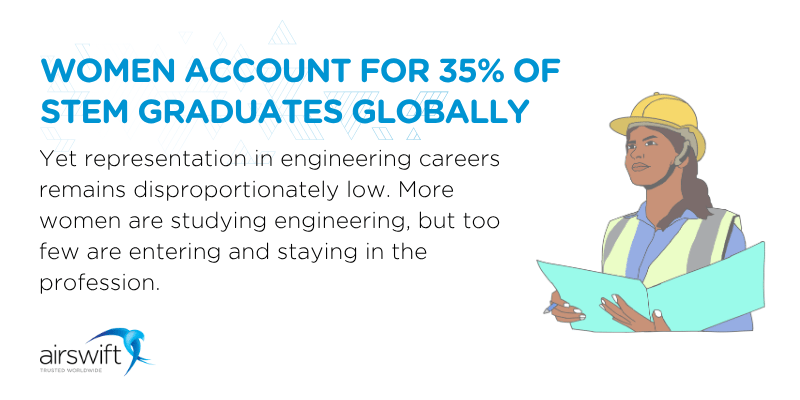
Women remain underrepresented across engineering and STEM professions worldwide. The latest data highlights both the gains made and the challenges that remain.
- UNESCO reports that women account for 35% of STEM graduates globally.
- According to the World Economic Forum, women made up just 28.2% of the global STEM workforce in 2024, compared with 47.3% of workers in non-STEM fields.
- Women make up just 17% of the engineering and technology workforce, compared with 56% of workers in other occupations, according to EngineeringUK.
- In Australia, women make up more than 18% of engineering graduates, yet only 8% go on to work in engineering roles after graduation.
- According to the Future Skills Centre, women accounted for 25% of engineering undergraduate students in Canada in 2022, up from 14% in 1992. While progress has been made, representation has increased by only 11 percentage points over the past three decades.
Progress has been made, but the gender gap remains
Over the past few decades, initiatives from governments, educational institutions and employers have helped increase awareness of gender diversity in engineering. More women are pursuing STEM qualifications, entering technical professions and taking on leadership roles across the industry.
However, engineering remains one of the most male-dominated professions worldwide. Women continue to face barriers at different stages of their careers, from entering engineering education to progressing into senior roles. While representation has improved, achieving greater gender equality in the profession remains an ongoing challenge.
Why are women still underrepresented in engineering?
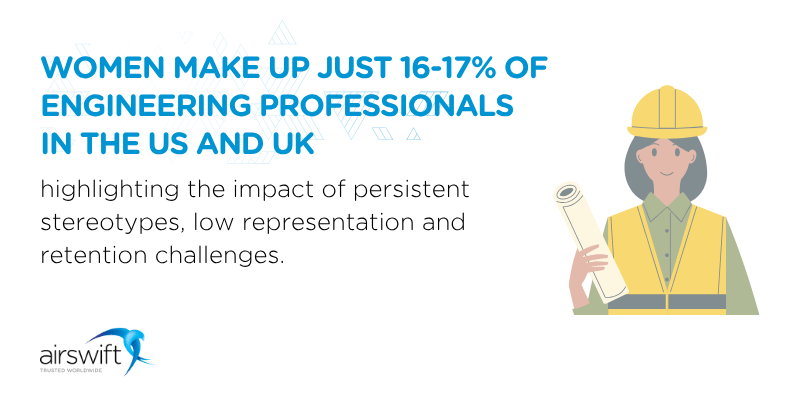
Despite decades of efforts to improve gender diversity, women remain significantly underrepresented in engineering. In the UK, they make up just 17% of the engineering and technology workforce, while in the United States, they account for only 16% of engineering occupations.
The reasons behind this imbalance are complex and often begin long before women enter the workforce. One contributing factor is the persistent perception of engineering as a male-dominated profession, which can discourage girls from pursuing engineering-related subjects and qualifications.
The gap emerges early. According to Engineering UK, girls account for just 12% of engineering and technology T Level students and only 20% of engineering and technology apprenticeship starts.
Low representation can also create challenges once women enter the profession. With fewer female engineers in the workplace, it can be harder to find role models, mentors and professional networks that support career development and progression.
This can have a lasting impact on retention. Research from the Society of Women Engineers found that only 26.8% of women engineering graduates remained in engineering roles 11 to 15 years after graduating, compared with 41% of men.
Why closing the gender gap matters?
Underrepresentation of women in engineering have bigger impact than we can usually imagine. Beyond the gender equality aspects, organisations thrive with diversity because different backgrounds help teams achieve new ideas, fresh problem-solving skills, and make better choices.
In the engineering side of things, women underrepresentation can impact design, utility and safety of products and services, which are often created by the male point of view, losing creativity and a wider approach.
Further, engineering is facing growing demand for skilled professionals as industries invest in digitalisation, infrastructure and the energy transition. At the same time, many employers report ongoing skills shortages and difficulties attracting qualified talent.
Increasing the participation and retention of women in engineering is about improving diversity, but not only that. It is also an opportunity to strengthen the talent pipeline, address skills gaps and build a workforce better equipped to meet future challenges.
The future of women in engineering
As industries invest in energy transition, digital transformation and emerging technologies, demand for engineering talent continues to grow. For women, this creates opportunities to enter and shape some of the world's fastest-growing sectors.
1. Energy transition
The shift to cleaner energy is creating demand for engineers across renewable power, hydrogen, carbon capture, energy storage, and grid infrastructure. As companies invest in the technologies needed to support a lower-carbon future, women have an opportunity to play a greater role in shaping the next generation of energy systems.
2. Digital transformation
Engineering is becoming increasingly digital. Technologies such as digital twins, advanced modelling, and connected systems are changing how assets are designed, built, and maintained. As organisations modernise their operations, engineers with strong technical and digital skills will be in high demand.
3. AI and automation
Artificial intelligence and automation are transforming engineering workflows, helping professionals analyse data, improve efficiency, and make better decisions. As adoption grows, employers will increasingly value engineers who can combine technical expertise with digital and analytical capabilities.
4. Infrastructure growth
Governments and businesses worldwide are investing in major infrastructure projects, from transport networks and utilities to data centres and manufacturing facilities. These investments are expected to drive long-term demand across a wide range of engineering disciplines.
5. Emerging engineering disciplines
Engineering continues to expand into new areas, including renewable energy, robotics, advanced manufacturing, cybersecurity, and sustainable infrastructure. As these fields develop, organisations have an opportunity to build more inclusive talent pipelines while women have more pathways than ever to pursue engineering careers.
As the profession evolves, attracting and retaining more women will be key to strengthening the engineering workforce. Greater diversity can help organisations address skills shortages, encourage innovation, and build teams equipped to tackle future challenges.
What type of skills do I need to become an engineer?
Technical knowledge is an important part of engineering, but employers also look for professionals who can adapt, collaborate, and solve problems effectively.
At Airswift, we help engineering professionals develop the soft skills needed to succeed in an evolving industry. Some of the key qualities employers look for include:
- A commitment to continuous learning
- Curiosity
- Creativity
- Innovation
- Imagination
- Passion
- Resilience
- Adaptability
- Collaboration and teamwork
Communication is equally important. According to Harvard Business Review, communication and collaboration tools are among the most important factors enabling employees to work effectively in today's workplace.
Engineers need to do more than develop technical solutions. They must be able to communicate ideas, collaborate with diverse teams and work across disciplines, cultures and locations.
Many professionals develop these skills through industry associations, mentorship programmes and professional networks. Organisations such as the Women's Engineering Society (WES) also provide opportunities to build connections, share experiences and support career development.
How employers can support women in engineering
Closing the gender gap in engineering requires action to improve both representation and retention. Employers play a key role in creating an inclusive environment where women can thrive. Some ways to achieve this include:
- Offer flexible working arrangements: Flexible schedules can help employees balance their professional responsibilities with family, caregiving or educational commitments.
- Increase pay transparency: Clear salary ranges and objective compensation criteria can help reduce pay disparities and build trust across the workforce.
- Provide mentorship programmes: Mentorship can help women build confidence, develop new skills and access guidance from experienced professionals. It can also foster a stronger sense of belonging within the organisation.
- Introduce sponsorship programmes: Sponsors actively advocate for employees, helping them gain visibility, access high-profile projects and progress into leadership roles.
- Implement inclusive hiring practices: Removing bias from recruitment processes can help attract a broader range of candidates and create a more diverse workforce.
- Support employees returning to work: Return-to-work initiatives can help employees transition back into the workplace after maternity leave or career breaks, improving retention and supporting long-term career development.
By investing in these initiatives, employers can create a more inclusive workplace while strengthening their talent pipeline and improving employee retention.
How can you support gender equality in engineering?
While progress has been made, improving gender equality in engineering requires ongoing effort from employers, educators, and industry professionals. Here are some ways organisations can help create a more inclusive profession.
Encourage girls to explore STEM careers
Introducing girls to STEM at an early age can help challenge stereotypes and broaden career aspirations. Supporting outreach programmes, school events, coding camps and university initiatives can help inspire the next generation of engineers.
Support mentorship and sponsorship
Mentorship and sponsorship programmes can help women build professional networks, gain career guidance and access new opportunities. These initiatives also benefit organisations by supporting employee development and retention.
Increase representation in leadership roles
Women should be encouraged to pursue leadership opportunities across engineering teams, projects and client-facing roles. Diverse leadership teams bring different perspectives and experiences that can strengthen decision-making and innovation.
However, representation alone is not enough. Once women reach leadership positions, organisations must provide the support, development opportunities and inclusive culture needed to help them succeed. The most meaningful progress comes when commitments are backed by action.
Grow your engineering career with Airswift
At Airswift, we have over 40 years of experience helping engineers find their dream roles in some of the world’s biggest organisations.
Ready to be part of the future of engineering? Join Airswift Digital to explore the latest engineering vacancies and connect with opportunities.