
By
Leanna Seah
March 1, 2023
Updated
July 30, 2026
Overview
With a population of 5,46 million people, Ireland offers a talented and diverse workforce with over 50% holding a third-level degree, making it one of Europe’s most highly educated countries. This, combined with its modern and flexible employment law framework, creates an attractive business climate for both local and international companies.
It has a thriving technology sector and is home to many of the world's leading tech companies, including Meta, Google, and Apple. The country's reputation for innovation and favourable business climate has helped establish it as a hub for technology and pharmaceuticals, two of its top industries.
Ireland's well-developed and sophisticated financial services industry combined with its favourable business climate and highly educated workforce has helped to establish it as a hub for international business and finance.
| Capital | Dublin |
| Languages spoken | English Irish Irish Sign Language |
| Population size | 5,46 million |
| Payroll frequency | Weekly/monthly |
| Currency | Republic of Ireland – Euro (€) |
| VAT | Ireland's standard VAT rate is 23%, with reduced rates of 13,5%, 9%, 4,8% (livestock) and 0% (zero-rated goods). |
Payroll and taxes
Employer contributions
In Ireland, employers are responsible for making several mandatory contributions as part of the payroll process. These include Employer PRSI (Pay-Related Social Insurance) contribution.
This contribution is a percentage of the employee's gross earnings and funds the country's social insurance program. The rate varies depending on the employment type and the employer’s size.
In Ireland, there are different PRSI classes for employers, and the specific rate that applies to an employer will depend on the type of business and the number of employees.
For example, the PRSI rate for Class A1 employers is 11,25%. In comparison, the PRSI rate for Class J employers (with reckonable pay of less than €38 per week and others) is 0,70%, rising to 0,85% from October 2026.
PRSI rates are subject to change, and employers should regularly check the Irish government's Revenue website for the most up-to-date information on PRSI rates and requirements.
Following are the summarised PRSI rates according to different work classes:
Employed by organisation
.png?width=1257&height=1855&name=PRSI%201%20(1).png)
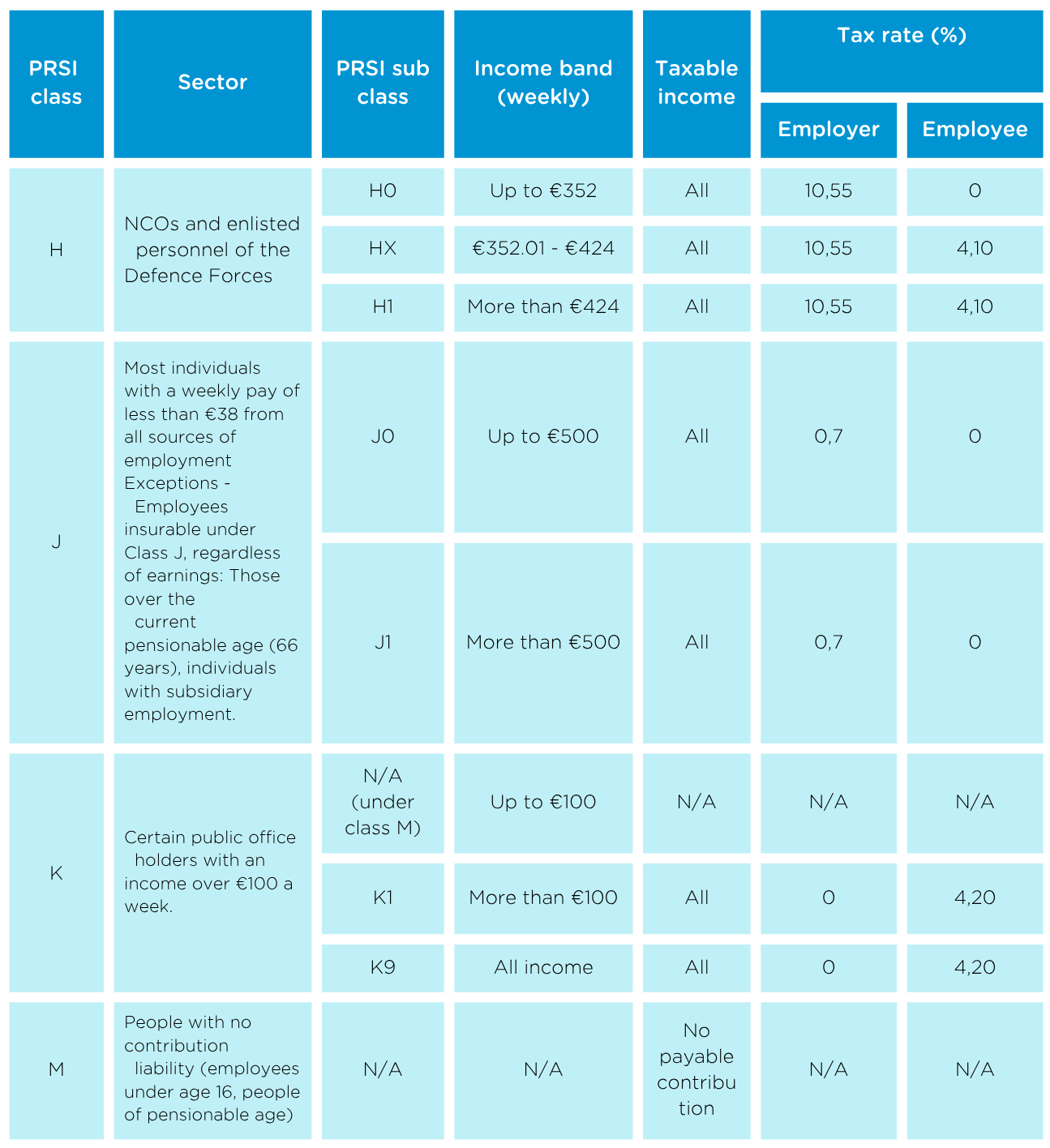
Table 1 & 2: PRSI classes for those employed by organisations
Self-employed
|
PRSI class |
Sector |
Taxable income |
Tax rate (%) |
|---|---|---|---|
|
P |
Individuals classified as self-employed share fishermen and fisherwomen who are already contributing to PRSI under Class S and have chosen to pay an additional fee to access benefits. |
First €2,500 per year |
4,2 |
|
PRSI class |
Sector |
PRSI sub class |
Taxable income |
Tax rate (%) |
|---|---|---|---|---|
|
S |
Self-employed people |
S0 |
All |
4,2 |
|
S |
Self-employed people |
S1 |
All |
4,2 |
Table 3 & 4: PRSI classes for those who are self-employed
Pension contributions
Employers in Ireland must ensure that employees have access to a workplace pension arrangement and comply with any applicable pension legislation.
Since 1 January 2026, Ireland's My Future Fund auto-enrolment retirement savings system has applied to eligible employees who are not already participating in a qualifying workplace pension scheme. Under this system, employers are required to enrol eligible employees and make matching pension contributions on their behalf.
For the first three years of the scheme, contribution rates are:
|
Contribution source
|
Rate |
|---|---|
|
Employee |
1,5% |
|
Employer |
1,5% |
|
State contribution |
Equivalent to 0.5% (provided as a top-up) |
Table 5: Pension schemes in My Future Fund
Contribution rates will gradually increase over time, reaching 6% from both the employee and employer after 10 years.
Employers may also offer other pension arrangements, including:
-
Defined Benefit (DB) schemes, where retirement benefits are based on factors such as salary and length of service;
-
Defined Contribution (DC) schemes, where retirement benefits depend on the contributions made and investment performance; and
-
Group Personal Pension (GPP) schemes, which are personal pension arrangements offered through the workplace.
Contribution levels for occupational pension schemes vary by employer and scheme design. Employers may choose to contribute above the statutory minimum requirements where applicable.
Income tax
Employers are also responsible for deducting income tax from their employees’ pay and for remitting this tax to the government on behalf of their employees. The income tax deducted depends on the employee's income level and is calculated based on a progressive tax system, which will be explained in the next section.
Employee contributions
Employees have several payroll and tax obligations as part of the employment process. These obligations include:
Employee PRSI (Pay-Related Social Insurance) contribution
This contribution is a percentage of the employee's gross earnings and funds the country's social insurance program. Please take a look at the PRSI tables in the previous section for more details.
Income tax
Employees in Ireland are required to pay income tax on their earnings. The tax amount depends on their income level and is calculated using a progressive tax system.
|
Income tax rates and bands |
At 20%, first |
At 40% |
|---|---|---|
|
Single person |
44,000 |
Balance |
|
Married couple (one income) |
53,000 |
Balance |
|
Married couple (two incomes) |
88,000 |
Balance |
|
One parent/widowed parent |
48,000 |
Balance |
Table 6: Income tax rates
Universal Social Charge (USC)
The USC is a tax on an individual's income calculated based on a progressive tax system, and its rate depends on their income level. For incomes of €13,000 or less, there is no Universal Social Charge (USC).
Standard rates of USC (2023)
|
Rate |
Income band |
|---|---|
|
0.5% |
First €12,012 |
|
2% |
Next €16,688 |
|
3% |
Next €41,344 |
|
8% |
Balance over €70,044 |
|
11% |
Self-employed income over €100,000 |
Table 7: Standard USC rates
Reduced rate of USC (2023)
|
Rate |
Income band |
|---|---|
|
0.5% |
Income up to €12,012 |
|
2% |
All income over €12,012 |
Table 8: Reduced USC rates
Reduced rates of USC apply to:
- People aged 70 or over whose total income for the year is €60,000 or less
- Medical card holders aged under 70 whose total income for the year is €60,000 or less
Total income for USC purposes does not include payments from the Department of Social Protection.

Working hours
|
Entitlement/Restriction |
Details |
|---|---|
|
Maximum Working Hours |
48 hours per week, averaged over a 4-month reference period |
|
Rest Periods |
- Minimum of 11 consecutive hours of rest per 24-hour period - Minimum of 24 hours of rest per week - Uninterrupted break of 15 minutes after every 4.5 hours worked - Minimum of one day off per week |
|
Overtime Restrictions |
Maximum 48-hour maximum average working week |
Table 9: Working hours in Ireland
Minimum wage
In Ireland, the minimum wage is reviewed annually by the government, and it is currently set at €14,15 per hour for all employees aged 20 and over to ensure fair compensation. Employers must pay their employees at least the minimum wage and can face penalties and fines if they fail to do so. Employees can claim underpayment through the Workplace Relations Commission.
Overtime pay in Ireland is typically higher than the employee's standard hourly rate and varies based on the employee’s employment contract terms. Some common overtime rates in Ireland are time and a half (1.5 times the employee's standard hourly rate) or double time (2 times the employee's normal hourly rate).
Employee benefits
Mandatory benefits
Employers must provide several mandatory employee benefits as part of the employment relationship. These benefits include:
Paid annual leave
Employees in Ireland are entitled to a minimum of four working weeks of paid annual leave per year, although some employers may offer more generous leave entitlements as part of the employment contract.
Statutory sick pay
- From 1st January 2023, employees in Ireland are entitled to five days of sick pay per year.
- The sick pay provided by the employer is 70% of the employee's normal pay.
- The maximum amount paid per day is €110.
- Employees must have worked for their employer for at least 13 weeks before they can receive statutory sick pay.
- Employers can provide a more generous sick pay scheme, but they cannot provide less than the statutory amount.
Pensions
Employers must provide their employees with access to a pension scheme. However, the specific pension scheme and the level of contributions will depend on the terms of the employee's employment contract.
Supplementary/optional benefits
In addition to the mandatory benefits outlined above, many employers in Ireland provide their employees with a range of supplementary or optional benefits. These benefits can include the following:
Health insurance
Some employers offer health insurance as a benefit to their employees, which can help cover medical treatments and procedures costs.
Life insurance
Can provide financial protection for employees and their families in the event of the employee's death.
Private health care
Some employers offer private health care as a benefit to their employees, which can provide access to private hospitals and medical treatments.
Employee discounts
Many employers offer their employees discounts on products or services, including gym membership, travel, and more.
Bonus schemes
Some employers offer bonus schemes to their employees, which can provide additional financial rewards for meeting specific performance targets or working certain hours.
Types of leave available
Annual leave
- In Ireland, full-time employees are entitled to a minimum of four weeks of paid annual leave.
- This entitlement is based on the employee's normal working hours and includes any regular overtime that the employee works.
- Part-time employees are entitled to a pro-rata annual leave based on their hours worked.
- Employers can set the timing of annual leave but must consider the employee's preferences and business needs.
- If an employee leaves their job, they are entitled to be paid for any annual leave they have not taken.
Note: Entitlement is based on standard working hours and includes regular overtime. Part-time entitlement is based on hours worked.
Public holidays
|
Date |
Holiday |
|---|---|
|
January 1 |
New Year's Day |
|
February |
First monday - St Brigid's Day |
|
March 17 |
St Patrick's Day |
|
April |
Easter Monday |
|
May |
First monday - May Day/Labour Day |
|
June |
First monday - Bank Holiday |
|
August |
First monday - Bank Holiday |
|
October |
Last monday - Bank Holiday |
|
December 25 |
Christmas Day |
|
December 26 |
St. Stephen's Day |
Table 10: Public holidays in Ireland
Note: The above list is subject to change and may be affected by government announcements.
Illness benefit
Employees who are unable to work due to illness for more than five days may qualify for Illness Benefit from the Department of Social Protection, subject to meeting the relevant PRSI contribution and eligibility requirements.
|
Illness benefit entitlement |
Length |
|---|---|
|
Employee must have at least 260 weeks of social insurance contributions paid since first started work |
Two years |
|
Employee must have between 104 and 259 weeks of social insurance contributions paid since first started work |
One year |
Table 11: Sick leave entitlement
Some employers may offer more generous sick leave entitlements as part of their employee benefits package. Reviewing the terms of your employment contract or company policies is essential to determine the sick leave entitlement that applies.
Maternity/paternity leave
|
Type of leave |
Duration |
Paid/Unpaid |
|---|---|---|
|
Maternity leave |
26 weeks |
Paid |
|
Additional maternity leave |
16 weeks |
Unpaid |
|
Paternity leave |
Two weeks |
Paid |
|
Parental leave |
Up to 26 weeks per child |
Unpaid |
|
Additional employer benefits |
Varies |
Varies |
Table 12: Maternity/paternity leave
Parents who apply for additional unpaid parental leave are entitled to up to 26 weeks of leave per child until the child is 12 or 16 years old if the child has a disability.Parent's leave
In addition to maternity, paternity, and parental leave, employees in Ireland may be entitled to Parent's Leave, which allows parents to take time off during the early years of a child's life.
Each parent is entitled to nine weeks of Parent's Leave for a child born or adopted on or after 1 November 2019. The leave must be taken within the first two years of the child's birth or placement for adoption.
Eligible employees may receive Parent's Benefit from the Department of Social Protection during this period, subject to meeting the relevant PRSI contribution requirements. In 2026, the benefit is €299 per week.
Employers may offer additional benefits beyond the statutory requirements, so employees should check with their employer to see if additional benefits are available.
Background checks
Background checks are optional in Ireland for all employees, but some employers may conduct them for specific circumstances. For example, employers in particular industries like finance, healthcare, or education may require background checks for employees in sensitive positions.
In Ireland, background checks can include various information such as criminal record checks, employment history checks, and credit checks. Employers must ensure that background checks are legal and fair and comply with data protection legislation, such as the General Data Protection Regulation (GDPR).
Attracting talent
Job opportunities and a growing economy
Ireland is a hub for international business, with many global companies choosing to establish their European headquarters in the country. This has led to a growing economy and abundant job opportunities across various sectors. The technology, finance, and healthcare industries are thriving, offering a range of positions at different levels of expertise.
High-quality education and a skilled workforce
Ireland has a strong reputation for high-quality education, with many of its universities ranked among the best in the world. The country is also home to a highly skilled workforce, with many graduates staying in Ireland to work or going on to secure jobs in other countries.
Network of international businesses and organisations
Ireland's strong economy and business-friendly environment have attracted many global companies to set up their European headquarters there. This has created a vast network of international businesses and organisations, providing professionals ample opportunities to connect and network.
High standards of living and quality of life
Offering a high standard of living, a well-developed healthcare system, a safe environment, and a range of leisure and cultural activities, Ireland is the ideal place for employment. The country's natural beauty and landscapes also attract outdoor enthusiasts and nature lovers, while the country's vibrant cities provide a range of entertainment options for urban dwellers.
The list above is considered some of the high-attraction factors that would attract and retain employees in Ireland. Organisations can also go one step forward in ensuring they stand out as the best employers by prioritising a positive work culture and offering competitive compensation and benefits packages.
Termination of employment
In Ireland, the termination of employment is governed by several rules and requirements, including severance pay, probationary periods, and notice periods. The following provides more specific details on each of these:
Severance pay
Under Irish law, employees who have worked for an employer for at least 104 weeks are entitled to severance pay if the employer terminates their employment. The amount of severance pay an employee is entitled to equal two weeks' pay for each year of service plus one additional week's pay, with a weekly earnings ceiling of €600.
Probationary period
The probationary period for employees in Ireland cannot exceed six months, although they may be extended up to 12 months in limited circumstances. During this period, the employer can assess the employee's suitability for the role and terminate the employment without providing a reason.
Notice period
|
Lenght of service |
Notice period |
|---|---|
|
Thirteen weeks to two years |
One week |
|
Two to five years |
Two weeks |
|
Five to ten years |
Four weeks |
|
Ten to 15 years |
Six weeks |
|
More than 15 years |
Eight weeks |
Table 13: Notice period in Ireland
What are my options for hiring?
Airswift provides various solutions to help businesses in Ireland in talent acquisition, ensuring compliance with local regulations. With our profound expertise and knowledge, we can mitigate the risks of hiring and onboarding top-notch professionals in Ireland.
By entrusting us with administrative tasks, you can concentrate on growing your business.

Talent acquisition
Growing a company comes with inherent risks, which is why having experienced and knowledgeable employees are crucial. Airswift offers the services of a local talent acquisition specialist to assist in finding top-notch candidates in a competitive market
We also provide contract hiring for short-term projects and flexible staffing solutions, ensuring that you don't have to compromise quality for urgent hiring needs. Our extensive database of highly skilled contractors guarantees that you'll find the best fit for your company.
If you're looking for a more permanent staffing solution, our professional recruitment services can connect you with the top talent in Ireland that meets your specific requirements.
Employer of record
If you are considering hiring employees remotely and don't want to go through the process of setting up a physical office, an alternative solution is to use an employer of record (EOR).
By using a third-party employer of record, you can avoid the complexities of establishing a local office and focus on running your business. The EOR takes care of responsibilities such as paying employees' wages and providing them with mandatory benefits.
*Although the information provided has been produced from sources believed to be reliable, no warranty, express or implied, is made regarding the accuracy, adequacy, completeness, legality or reliability of any information. For the latest information and specific queries regarding particular cases, please contact our team.