
By
Nana Terra
September 24, 2025
Updated
July 3, 2026
According to the Office of Energy Efficiency and Renewable Energy (EERE), the U.S. Department of Energy’s 2025 commitments focus on seven key priorities to reach net-zero carbon emissions by 2050. No small task for the world's second-largest emitter of greenhouse gases.
Green hydrogen, produced using renewable energy and offering a clean alternative to fossil fuels, is central to reshaping the U.S. energy landscape. Companies across industries are investing in its development and deployment.
Before diving into hydrogen and its major projects, let’s take a look at the key drivers behind the U.S. energy transition.

Seven key priorities
1. Increase adoption of clean energy nationwide
Accelerate deployment of technologies that meet cost and performance targets.
Support DOE’s Energy Earthshots™, which focus on economy-wide clean energy solutions.
2. Advance emerging technologies for clean electricity
Invest in offshore wind and geothermal energy.
Promote innovation in clean electricity generation.
3. Prepare the power system for increased demand
Ensure affordability, reliability, and resilience.
Expand programs like R-STEP to help communities plan large-scale renewable and storage projects.
4. Boost industrial energy efficiency
Fund R&D for decarbonising industrial processes.
Support domestic manufacturing of clean energy technologies.
5. Expand clean transportation options
Promote the electrification of transport and the development of sustainable fuels.
6. Strengthen the clean energy workforce
Invest in workforce development and training programs.
Address talent gaps in clean energy sectors.
7. Ensure equitable energy access
Focus on underserved communities.
Bridge the innovation gap to ensure no one is left behind in the energy transition.
US power industry: emissions and energy mix
In 2024, the U.S. power sector emitted an estimated 1,427 million metric tons of CO2, with reports showing emissions have declined by 35% between 2005 and 2021.
Despite rapid growth in renewables over the past decade, fossil fuels still generated over 60% of electricity in 2023, with natural gas leading the mix. Renewable capacity has expanded significantly, with wind and hydropower making up 75% of new additions in 2023.
.png?width=1024&height=768&name=Branded%20Graphic_Electricity%20Generation%20in%20the%20US%20(2).png)
Why is it so important to decarbonise the electricity sector?
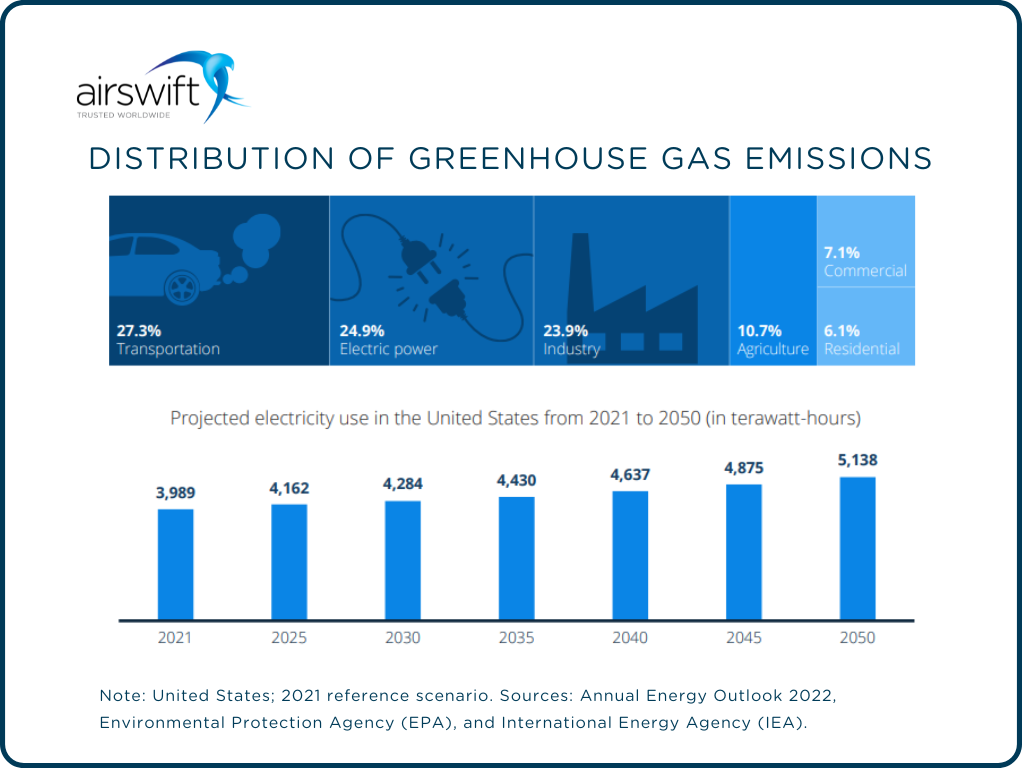
The power sector accounts for about 25% of U.S. carbon emissions, second only to transportation. While alternative fuels and technologies are advancing, electricity remains essential for decarbonising both road transportation and industry.
U.S. electricity demand is projected to grow 30% by 2050, surpassing 5,000 terawatt-hours. Cleaning up the power sector will be critical to achieving national climate goals.
Green hydrogen: A pathway to net zero in the USA
Global energy transition efforts have focused on solar, wind, storage, and electric vehicles. Now, green hydrogen is becoming a key part of the U.S. strategy to reach net-zero emissions.
As a clean fuel, hydrogen can decarbonise hard-to-abate sectors like refining, steel, chemicals, and transportation, replacing fossil fuels in critical industrial processes.
Since rejoining the Paris Agreement in 2021, the U.S. has accelerated hydrogen innovation through the Energy Earthshot initiative, which aims to cut clean hydrogen costs by 80% within a decade.
However, the initiative faces uncertainty. On January 20, 2025, President Trump signed Executive Order 14162 to withdraw the U.S. from the Paris Agreement. The withdrawal is expected to take effect in January 2026, raising concerns about future funding and policy support for clean hydrogen.
Want to understand the American Energy Transition? Download our whitepaper and get in touch!

7 green hydrogen projects starting in 2025
Over the next five years, 76 green hydrogen projects are planned in the U.S., backed by $36 billion in investment. States like Texas, Louisiana, Alabama and California are leading the charge in hydrogen development.
In 2025, several major facilities are set to begin operations, marking a significant step forward in the country’s clean energy transition. Discover the seven hydrogen plants currently under construction and the companies driving them.
- St. Gabriel Green Hydrogen Plant
- Sauk Valley Green Hydrogen Plant
- Douglas County Green Hydrogen Project
- Intermountain Power Project
- Advanced Clean Energy Storage Project
- Niagara Falls Green Hydrogen Project
-
DeBary Green Hydrogen Demonstration Plant
1. St. Gabriel Green Hydrogen Plant
- Location: Louisiana
- Details: A joint venture between Plug Power Inc. and Olin Corporation, known as Hidrogenii, this facility produces 15 tons of green hydrogen daily for the fuel cell market. Olin provides operational support, while Plug Power handles distribution. Construction created 215 jobs, with over 25 permanent roles. By the end of 2025, Plug Power aims to scale production to 500 tons per day, helping prevent 4.3 million metric tons of CO₂ emissions across North America.
-
Commercial operations started in April 2025.
2. Sauk Valley Green Hydrogen Plant
- Location: Illinois
- Details: The first green hydrogen project operated by Invenergy, this facility produces green hydrogen using power from a co-located solar plant and Ohmium International's low-carbon electrolyser technology. The plant has a capacity of 52 tons per year and stores 400 kg of hydrogen on-site.
-
Commercial operations started in March 2025.
3. Douglas County Green Hydrogen Project
- Location: Washington
- Details: Developed by the Douglas County Public Utility District, the 5MW green hydrogen facility utilises excess hydropower from the Wells Dam River to produce hydrogen via electrolyser. With an annual production capacity of 730 tonnes per year, the plant stores and distributes green hydrogen for fuel cell vehicles and industrial applications.
- Commercial operations started in June 2025.
4. Intermountain Power Project
- Location: Utah
- Details: The Intermountain Power Project has partnered with Mitsubishi Power on a coal-fired power plant conversion to a natural gas and hydrogen-fired facility. It aims to operate on a 30% hydrogen blend by 2025, progressing to 100% hydrogen by 2045. The Intermountain Power Project has partnered with Mitsubishi Power.
- Operations begin in 2025 and progress to 100% hydrogen by 2045.
5. Advanced Clean Energy Storage Project
- Location: Delta, Utah
- Details: One of the world’s largest green hydrogen production and storage facilities, this site can produce up to 100 metric tons of green hydrogen daily. Operated by Chevron and Mitsubishi Corporation, it stores hydrogen in underground salt caverns for use in power generation, industrial processes, and transportation. It’s the first project to integrate utility and industrial-scale hydrogen production, storage, and transmission.
- Operations begin in 2025 and expand to 100% green hydrogen by 2045.
6. Niagara Falls Green Hydrogen Project
- Location: New York
- Details: Built, owned and operated by Linde, this project features a 35MW proton exchange membrane (PEM) electrolyser powered by hydropower to produce liquid green hydrogen. The output will serve high-demand sectors including aerospace, electronics and manufacturing. Once operational, the facility will more than double the company’s green liquid hydrogen production capacity in the U.S.
- Operations begin: 2025
7. DeBary Green Hydrogen Demonstration Plant
- Location: Florida
- Details: Duke Energy Corp is developing a fully integrated green hydrogen demonstration facility powered by its DeBary solar plant. The project includes two 1MW electrolyser units for hydrogen production, along with storage and combustion systems. Designed to supply clean energy during peak demand periods, it will mark Duke Energy’s first initiative to both generate hydrogen and operate a 100% hydrogen-fired turbine.
- Operations begin: 2025
7 green hydrogen projects starting in 2026 and beyond
From 2026 and beyond, seven green hydrogen facilities are expected to begin operations, advancing decarbonization across transportation, logistics, and industrial sectors. Explore the upcoming projects and companies that will shape the future of hydrogen production in the U.S.
- Casa Grande Green Hydrogen Plant
- Southern California Green Hydrogen Project
- Richmond Waste-to-Green Hydrogen Project
- Genesee County Green Hydrogen Project
- Graham County Green Hydrogen Project
- Donaldsonville Green Hydrogen Project
1. Casa Grande Green Hydrogen Plant
- Location: Casa Grande, Arizona
- Details: Owned and operated by Air Products, Casa Grande Hydrogen Plant will produce 10 metric tons of green hydrogen daily for the hydrogen mobility market in California and other locations. The facility will run entirely on zero-carbon renewable power and use ThyssenKrupp Nucera electrolyzers to produce gaseous hydrogen, converted to liquid hydrogen with proprietary technology.
- Operations begin: 2026
2. Southern California Green Hydrogen Project
- Location: California
- Details: Avina Clean Hydrogen is developing a $20 million integrated green hydrogen production and refueling facility in Vernon, Southern California. Once operational, the plant will generate approximately 1,460 tonnes of green hydrogen annually, enough to fuel nearly 100 fuel cell trucks and buses each day.
- Operations begin: 2026
3. Richmond Waste-to-Green Hydrogen Project
- Location: California
- Details: Operated by Raven SR and Chevron, this project will convert organic waste from the West Contra Costa Sanitary Landfill into green hydrogen using a steam/CO2 reformation process. Powered by 6MW of energy, the facility will process up to 100 tonnes of organic waste per day to produce 2,000 tonnes of green hydrogen annually. Chevron will distribute the output through regional fueling stations, while RavenSR will market through strategic partners and investors.
- Operations begin: 2026
4. Genesee County Green Hydrogen Project
- Location: New York
- Details: The 120MW green hydrogen project in Genesee County, operated by Plug Power, could become North America’s largest green liquid hydrogen production facility. Powered by hydroelectricity from the Niagara Power Project, it will produce 74 tonnes of green hydrogen per day. The project includes the construction of a 450MW substation and is expected to create up to 68 jobs.
- Operations begin: 2026
5. Graham County Green Hydrogen Project
- Location: Texas
- Details: Another project operated by Plug Power, this one will develop green hydrogen using a 150MW proton exchange membrane (PEM) electrolyser powered by the Young County Wind Project. The project is expected to produce approximately 16,425 tonnes of green hydrogen annually. The output will supply hydrogen in both gas and liquid forms to support equipment such as forklifts and tugs in logistics and warehouse operations.
- Operation being: 2027
6. Donaldsonville Green Hydrogen Project
- Location: Donaldsonville, Louisiana
- Details: This project will build a 20MW alkaline electrolysis plant integrated with CF Industries’ ammonia synthesis loops to produce 20,000 tons of green ammonia annually. Powered entirely by renewable energy from grid-connected sources, the facility will also develop a 300MW green hydrogen production site. In partnership with ThyssenKrupp, it will become the largest installation of its kind in North America.
- Operations begin: 2029
7. AES Corporation's Green Hydrogen Facility
- Location: Texas
- Details: This $4 billion green hydrogen facility is designed to produce over 200 metric tons of hydrogen daily, primarily for transportation. Powered by approximately 1.4 GW of wind and solar, it includes large-scale electrolyzer capacity, making it the largest green hydrogen project in the U.S. The development is expected to create over 1,300 construction jobs, 115 permanent operations roles, and around 200 positions in transportation and distribution.
- Operations Begin: 2030
Challenges in North America’s hydrogen economy
North America is on track to lead the global hydrogen economy, with market projections reaching $170.88 billion by 2033. The U.S. currently produces 10 million metric tons of hydrogen annually, mainly for refining and ammonia. By 2032, the green hydrogen market could grow to $37.2 billion, driven by clean energy investments and industrial demand.
Despite its potential to decarbonise energy, progress is slowed by high costs, limited infrastructure, and low demand incentives. Scaling production is key to reducing costs.
Advances in electricity pricing, electrolyser efficiency, and project lifespans will help shift from pilots to commercial-scale ventures, supporting net-zero goals.
Companies are investing in technology and innovation to tap into this opportunity. As industries pursue carbon neutrality, green hydrogen is becoming a strategic enabler.
Jobs in demand
The Department of Energy (DOE) estimates that the hydrogen value chain will create 700,000 new jobs by 2030 and 3.4 million jobs by 2050. The American Energy Transition: Reshaping the Economy and Creating Good Jobs whitepaper highlights a job-rich and clean future.
Airswift is a world-leading renewable energy recruitment agency that partners with companies in the hydrogen market. Below are some of the roles and skillsets in demand.
- Business Development Manager
- Project Development Manager
- Hydrogen Expert
- Solution Expert
- Process Engineer
- Project Manager
- Commercial Director
- Sales Director
- Electrolysis Specialist
- Product Manager
- Senior Engineer

How can Airswift help companies build a talent pipeline to reach net-zero in the USA?
Airswift supports the energy transition by investing in and training teams with green skills. With over 40 years of experience and 60 offices worldwide, we help clients across the full project lifecycle.
Our database of 1.5 million STEM professionals enables companies to build strong workforce plans by identifying, attracting, and retaining top green tech talent from local markets.
After establishing ourselves as Houston’s leading staffing agency, we’ve expanded our U.S. presence. Today, we support strategic projects from offices in Houston, Denver, Midland, and Anchorage.