
By
Nana Terra
June 30, 2022
Updated
October 2, 2026
Europe remains one of the world’s most established offshore wind markets and has played a pioneering role in the sector for decades. According to WindEurope, Europe had approximately 39 GW of offshore wind capacity installed at the end of 2025, after connecting 2 GW of new offshore capacity during the year. A further 2.3 GW of offshore wind capacity was connected in the first half of 2026, taking Europe’s total offshore wind capacity to approximately 40.9 GW.
Europe is no longer responsible for the majority of global offshore wind capacity, with China now accounting for the largest share of the global market. However, European countries continue to pursue ambitious offshore wind expansion. The European Commission’s offshore renewable energy strategy established objectives of at least 60 GW of offshore wind by 2030 and 300 GW by 2050. Delivering this growth will require continued investment in grid infrastructure, ports, manufacturing, supply chains and the offshore wind workforce.

Key Offshore Wind Projects in Europe
Below, we explore 10 significant offshore wind projects across Europe, including operational wind farms and major developments currently under construction or planning.
- Hornsea 2
- Dogger Bank
- Moray East
- Triton Knoll
- Ijmuiden Ver
- Hollandse Kust
- Baltic Eagle
- Arklow Bank
- Fécamp
- St Brieuc
Click the project names above to jump to a summary of each. Looking for a brief overview of the European offshore wind industry? Read on.
European offshore wind developers remain key players globally
Europe is home to many of the world’s most established offshore wind developers and operators. Major companies active across the region include Ørsted, RWE, Vattenfall, SSE Renewables, Equinor and Iberdrola, alongside developers such as Ocean Winds, EDF power solutions and EnBW. European companies have also expanded internationally, including through offshore wind projects in Asia.
The European offshore wind supply chain is supported by major turbine manufacturers including Vestas and Siemens Gamesa, while GE Vernova is also supplying turbines to major European developments such as Dogger Bank.
Europe’s offshore wind market continues to expand, although deployment faces challenges including higher financing costs, supply-chain pressures and grid constraints. These factors will influence how quickly planned capacity moves from development into construction and operation.
Public financing also continues to support the European wind supply chain. In 2025, the European Investment Bank increased its counter-guarantee scheme for wind manufacturers from €5 billion to €6.5 billion, alongside additional support for grid infrastructure and clean-energy investment.
National offshore wind ambitions remain significant. The UK’s Clean Power 2030 framework identifies a pathway of approximately 43–50 GW of fixed and floating offshore wind by 2030, while Germany is targeting at least 30 GW by 2030, 40 GW by 2035 and 70 GW by 2045.
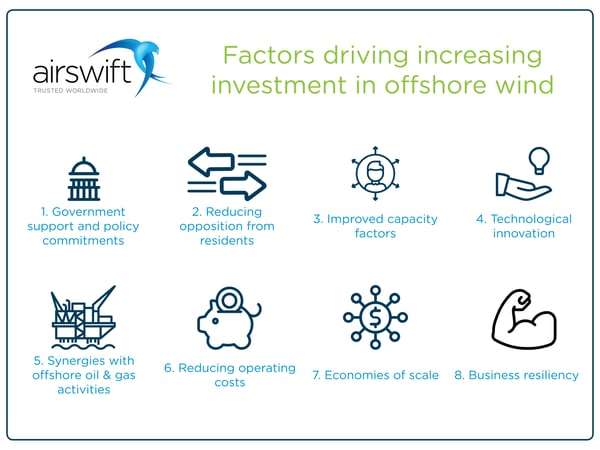
Figure 2: Factors driving increased investment in offshore wind
Which offshore wind developers are active in the UK?
The UK is home to some of Europe’s largest offshore wind developments. Major developers and operators active in the market include Ørsted, RWE, SSE Renewables, Equinor, Ocean Winds and Vattenfall, alongside a wider network of infrastructure investors and supply-chain partners.
Which offshore wind jobs are in demand in Europe?
Growth in offshore wind is creating demand for specialist talent across project development, engineering, construction, commissioning, and operations.
Europe’s wider wind industry employs approximately 478,000 people, including around 225,000 in direct roles and 253,000 in indirect roles.
Workforce research has also identified shortages in areas such as field engineering, turbine and assembly technicians, pre-assembly technicians, and welding, highlighting the need for skilled workers as offshore wind capacity expands.
Demand spans a range of roles and skill sets, including:
-
Project Engineers, including cable and foundation installation
-
Electrical and Cable Engineers
-
Project Planners and Project Controls professionals
-
High-voltage specialists
-
Project Managers
-
Coatings and Inspection Specialists
-
Contracts Managers
-
Structural Engineers
-
Supply Chain and Procurement professionals
-
Offshore Construction professionals
-
Commissioning specialists
-
Operations and Maintenance professionals
-
Engineers with floating offshore wind experience
Professionals with experience in conventional energy, offshore construction, engineering, and maritime industries may also have transferable skills that can support a move into offshore wind.
10 major European offshore wind projects shaping the market in 2026
UK

Hornsea 2
Hornsea Two Offshore Wind Farm is located approximately 89 km off the Yorkshire coast in the North Sea, adjacent to Hornsea One.
The 1.32 GW offshore wind farm became fully operational in August 2022 and consists of 165 Siemens Gamesa 8 MW turbines. Operated by Ørsted, Hornsea 2 can generate enough renewable electricity to power more than 1.4 million UK homes.
Hornsea 2 was the world’s largest offshore wind farm when it became operational and remains one of the UK’s largest offshore wind projects.
Dogger Bank
Dogger Bank consists of three offshore wind developments — Dogger Bank A, B and C — located off the northeast coast of England.
Each phase has a planned capacity of 1.2 GW, giving the completed project a combined capacity of 3.6 GW. Dogger Bank is owned by SSE (40%), Equinor (40%) and Vårgrønn (20%). SSE is leading construction, while Equinor will operate the wind farm once completed.
Across the three phases, the project will use 277 GE Vernova Haliade-X turbines, with 13 MW turbines at Dogger Bank A and B and 14 MW turbines at Dogger Bank C.
By 2026, turbine installation at Dogger Bank A had been completed and work was continuing at Dogger Bank B. Offshore turbine installation at Dogger Bank C is expected to begin in 2027, with completion of the overall project expected around mid-2028.
With a planned combined capacity of 3.6 GW, Dogger Bank is currently the world’s largest offshore wind farm under construction.
Moray East
Moray East is an operational 950 MW offshore wind farm located in the Moray Firth off the northeast coast of Scotland.
The wind farm consists of 100 Vestas V164-9.5 MW turbines and has been operational since 2022. It is operated by Ocean Winds, which owns 40% of the project alongside Diamond Green Limited and Equitix-managed funds.
Moray East can generate enough renewable electricity to meet the needs of more than one million homes and is expected to avoid approximately 1.7 million tonnes of CO₂ emissions annually.
Triton Knoll
Triton Knoll Offshore Wind Farm is an operational 857 MW offshore wind farm located approximately 32 km off the Lincolnshire coast.
The project consists of 90 Vestas V164-9.5 MW turbines, with turbine commissioning completed in January 2022.
Triton Knoll is owned by RWE (59%), J-Power (25%) and Kansai Electric Power (16%). RWE led the project’s construction and continues to operate and maintain the wind farm on behalf of the partnership.
The wind farm can generate enough renewable electricity to meet the annual needs of at least 935,000 average UK households.
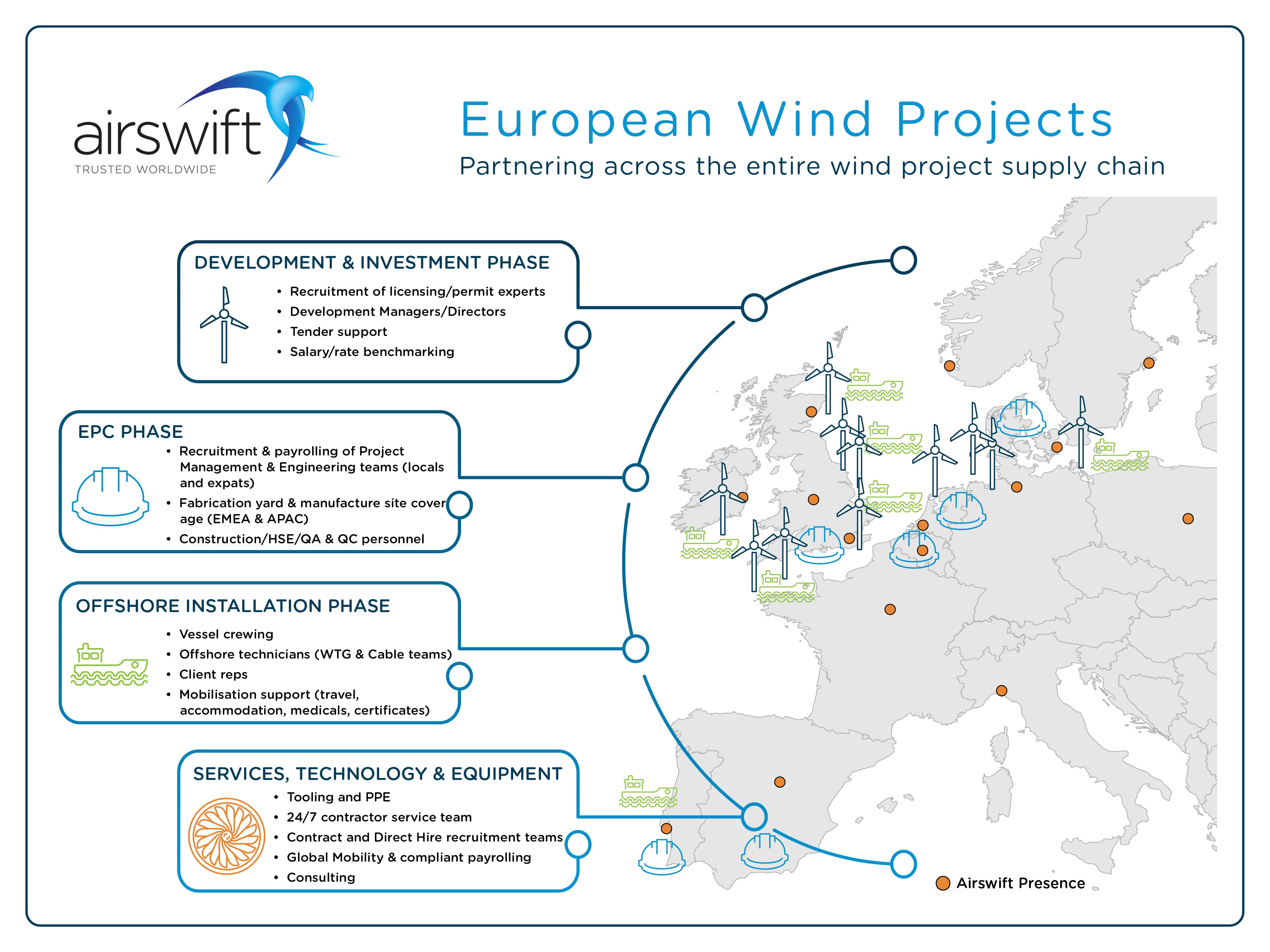 Airswift partners with companies and professionals throughout the offshore wind supply chain.
NETHERLANDS
IJmuiden Ver
Located off the west coast of the Netherlands, IJmuiden Ver is a major offshore wind development zone planned to accommodate approximately 6 GW of capacity.
The zone includes several separate development areas. IJmuiden Ver Alpha and Beta each have planned capacities of approximately 2 GW. The Alpha permit was awarded to Noordzeker, a partnership involving SSE Renewables and APG, while the Beta permit was awarded to Zeevonk II, a partnership between Vattenfall and Copenhagen Infrastructure Partners.
Further capacity is planned through the IJmuiden Ver Gamma sites, which form part of the Netherlands’ longer-term offshore wind expansion.
Transmission system operator TenneT is responsible for connecting the IJmuiden Ver projects to the Dutch electricity grid, using high-voltage direct-current infrastructure designed for large-scale offshore wind generation.
Hollandse Kust
Hollandse Kust refers to several separate offshore wind developments off the Dutch coast, including Hollandse Kust Noord, Zuid and West.
Hollandse Kust Noord
Hollandse Kust Noord is a 759 MW operational offshore wind farm located approximately 18.5 km off the Dutch coast.
Developed by CrossWind, a joint venture between Shell and Eneco, the project consists of 69 11 MW turbines and was completed in 2023.
The project also incorporates technologies designed to improve the integration of offshore wind into the wider energy system, including energy storage and other flexibility solutions.
Hollandse Kust Zuid
Hollandse Kust Zuid is an operational offshore wind farm with approximately 1.5 GW of installed capacity.
Located between approximately 18 and 36 km off the Dutch coast, the project consists of 139 Siemens Gamesa 11 MW turbines. It is owned by Vattenfall, BASF and Allianz, with Vattenfall responsible for its development and operation.
The wind farm was inaugurated in 2023 and is now an established part of the Netherlands’ offshore wind capacity.
Hollandse Kust West
Hollandse Kust West includes separate offshore wind developments at Sites VI and VII.
Site VI is being developed as the 760 MW Ecowende offshore wind farm. The project uses 52 Vestas 15 MW turbines and produced its first power in 2026, with full commercial operation expected by the end of the year.
Site VII is being developed as the 795 MW OranjeWind project, owned by RWE and TotalEnergies. The project is designed to support greater integration between offshore wind generation and the wider Dutch energy system, with full commissioning expected in 2028.
GERMANY

Baltic Eagle
Baltic Eagle is a 476 MW operational offshore wind farm located in the Baltic Sea, approximately 30 km northeast of the island of Rügen, Germany. The project was developed by Iberdrola and entered operation in October 2024.
The wind farm consists of 50 Vestas V174-9.5 MW turbines. Iberdrola owns 51% of the project, while Masdar holds the remaining 49%, with Iberdrola responsible for operating and maintaining the wind farm.
German transmission system operator 50Hertz provides the grid connection for Baltic Eagle, connecting the offshore wind farm to the German electricity network.
IRELAND

Arklow Bank
Arklow Bank Wind Park 2 is a proposed offshore wind farm of approximately 800 MW, located off the coasts of County Wicklow and north County Wexford in Ireland. Developed by SSE Renewables, the current proposal includes up to 53 offshore wind turbines.
The project remains in the development and consenting stage, with its construction and operational timeline subject to planning approval, commercial arrangements and a final investment decision.
The development is located near the original 25 MW Arklow Bank Phase 1 project, which was commissioned in 2004. The current Arklow Bank Wind Park 2 proposal represents a significantly larger development than the earlier 495 MW project design.
FRANCE

Fécamp
Fécamp is an operational offshore wind farm located in the English Channel, approximately 13 km off the Normandy coast. The project has an installed capacity of around 500 MW and consists of 71 turbines supported by 71 gravity-based foundations.
The wind farm was commissioned in 2024 and is owned by a consortium involving EDF Renewables, Enbridge and Skyborn Renewables.
Saint-Brieuc
Located off the coast of Brittany, the Saint-Brieuc offshore wind farm is one of France’s major operational offshore wind projects and the first large-scale offshore wind farm in Brittany.
Developed through Ailes Marines and owned by Iberdrola, the project represents an investment of approximately €2.4 billion. It has a total installed capacity of 496 MW from 62 Siemens Gamesa 8 MW turbines.
All 62 turbines were commissioned in May 2024. The wind farm is expected to generate approximately 1,820 GWh of electricity annually, equivalent to the electricity consumption of around 835,000 people.

This is one of the articles of the series on Wind Energy Projects in Europe. Read also: