By
Diyaa Mani
March 2, 2026
Updated
May 7, 2026
If there’s one thing the 2026 Global Energy Talent Index (GETI) makes clear, it is the fact that the energy workforce is more active, more curious, and more open to change than ever.
This year’s report shows that 84% of professionals would consider switching roles, and an impressive 81% have been approached about a new job. Even in a cooling global economy, energy talent remains in high demand, and workers know it.
So, what’s pushing people to explore new opportunities? And what can employers do to attract and keep the talent they need?
Read our article to learn more.
Why energy professionals are exploring new job opportunities
Career progression continues to be the biggest motivator behind job moves, with 31% of professionals citing it as their top reason for exploring new roles. And it doesn’t stop there:
- 14% want to move into different parts of the industry
- 9% are excited by new technology
- 8% are motivated by remuneration
- 8% are thinking about job security
- 8% want more flexible working options
Most energy professionals aren’t necessarily planning to leave the industry, but they are willing to move around:
- 60% would switch roles within their current sector
- 39% would move into another energy sector
- And 20% would step outside of energy altogether
People want growth, and if they don’t see the pathway within your organisation, they will look elsewhere.
Learn more about these insights by downloading the 2026 GETI report
The growing career development gap in the energy sector
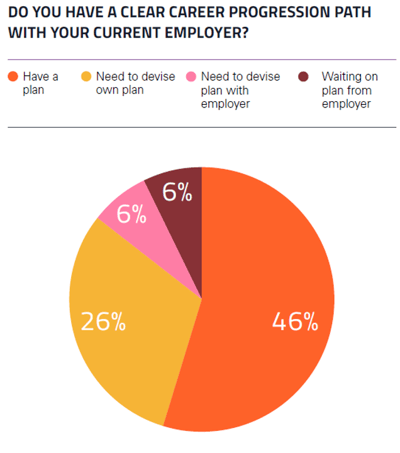
Here’s one of the most eye‑opening insights from GETI 2026:
Only 46% of energy professionals have a career development plan.
That means over half of the industry is either building their plan on their own, waiting for one, or operating without one entirely. When we dig into what professionals say they actually want, the gap becomes clearer:
What energy employees value most in their career development:
- 57% value industry‑specific training
- 41% want extended formal education
- 33% want to take on new responsibilities
- 33% want structured personal development plans
The disconnect between what employers offer and what employees need:
- Only 43% offer industry‑specific training
- Only 23% provide formal education pathways
This mismatch fuels turnover not because employees are disengaged, but because they want more than their current employer is offering.
Learn more about these insights by downloading the 2026 GETI report
How AI adoption is transforming skills, careers, and expectations
One of the biggest changes in this year’s report is how central AI and emerging technologies have become to the energy workforce.
45% of traditional energy professionals now use AI in their roles, a huge increase of 187% since 2024. And they’re using AI for real, practical development:
- 32% use it to complete tasks at a higher level
- 32% use it to bridge skills gaps
- 26% use it to learn industry‑specific knowledge
- 25% use it for personalised career advice
- 24% use it to help secure new jobs
If your organisation isn’t integrating modern tools into its workflow or development frameworks, talent will look toward companies that do.
Relocation is losing its appeal and that’s reshaping global energy recruitment
Relocation used to be part of the energy industry’s DNA. But that’s changing fast.
In 2021, 87% of professionals were open to relocating.
In 2026, that number has dropped to 69–71%.
Why the drop?
The #1 reason, cited by 40 to 42% of respondents, is proximity to family.
Still, when professionals do consider relocating, the top motivator stays consistent; career progression (45ton50%).
Learn more about these insights by downloading the 2026 GETI report
Where energy professionals want to relocate and why
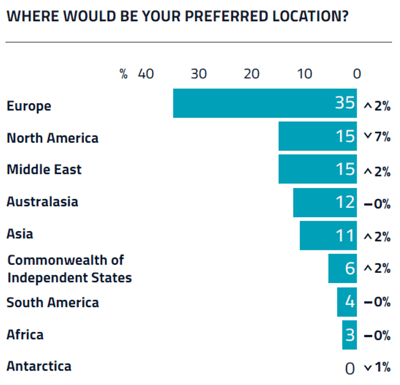
- Europe leads (32–35%)
- The Middle East follows
- Asia is rising
- North America has slipped in attractiveness
This decline in mobility means companies can no longer rely on relocation alone to fill skills gaps. They need stronger local development pipelines and more flexible workforce planning.
What employers are doing to compete for scarce energy talent
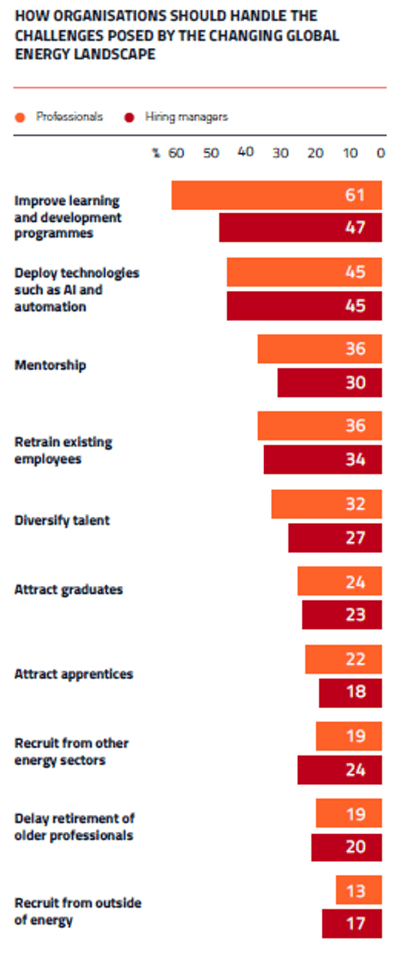
The GETI 2026 report gives a clear picture of how organisations are responding to talent scarcity and what high‑performing companies are prioritising.
Here’s what employers are investing in:
- 47% are improving learning and development
- 45% are using AI/automation to enhance workforce capability
- 36% are retraining existing employees
- 36% are offering mentorship opportunities
- 30% are increasing graduate recruitment
- 30% are doing more outreach with schools and colleges
- 29% are revamping recruitment processes
- 27% are revising role requirements
- 27% are building centres of excellence
- 25% are expanding apprenticeship schemes
- 33% are recruiting from outside the energy sector
- 27% are diversifying the workforce
- 20% are delaying retirements to retain critical expertise
If you’re looking to strengthen your people strategy this year, this list is a great place to start.
Learn more about these insights by downloading the 2026 GETI report
Strategies high‑performing energy companies are prioritising in 2026
Top organisations are doubling down on:
- Upskilling
- AI integration
- Clearer role structures
- Stronger early‑career paths
- Future‑ready internal mobility programs
The energy workforce is aging and the talent pipeline is shrinking
The GETI 2026 report shows a workforce that’s aging faster than many organisations are preparing for:
- 48% of the energy workforce is now over 45
- The 25–34 cohort is shrinking
- Only one-third of hiring managers are actively recruiting graduates
This isn’t just a talent issue; it’s a pipeline crisis. Companies that don’t invest in early‑career talent risk long‑term capability loss.
What this means for energy employers
The message from GETI 2026 is simple:
- Talent moves toward opportunity.
- Talent stays where it feels supported.
- Talent grows where it sees a future.
And in a workforce where 84% would consider switching roles, that future needs to be built intentionally.
Learn more about these insights by downloading the 2026 GETI report
How employers can attract and retain top energy talent
To attract and retain the people who will power the next era of energy, companies need to:
- Create clear, personalised career pathways
- Invest meaningfully in learning and development
- Integrate AI and emerging tech into everyday work
- Support internal mobility and flexible progression
- Build graduate, apprenticeship, and mid‑career conversion routes
- Reflect real human needs, including family proximity and work‑life balance
Do that, and you’re not just competing for talent. You’re building the kind of workplace people want to stay in.
Download the GETI 2026 report for full workforce insights
Dive into the full picture of what’s shaping the energy workforce today.
Download the GETI 2026 report to explore sector‑specific trends, mobility patterns, salary expectations, and the evolving skills landscape.