
By
Nathalia Duarte
May 11, 2026
Updated
May 11, 2026
An unprecedented 35 GW of data center capacity is currently under construction across North America, according to JLL. The top five hyperscalers continue to dominate the market, accounting for almost 65% of demand and setting the pace for 2026 with an estimated $710 billion in planned capital expenditure.
With demand surging and vacancy rates hovering near 1%, data center development is driving job growth across construction and operations. See below for the U.S. market outlook and the major projects fueling growth across the country.

The U.S. data center market is evolving beyond bubble concerns
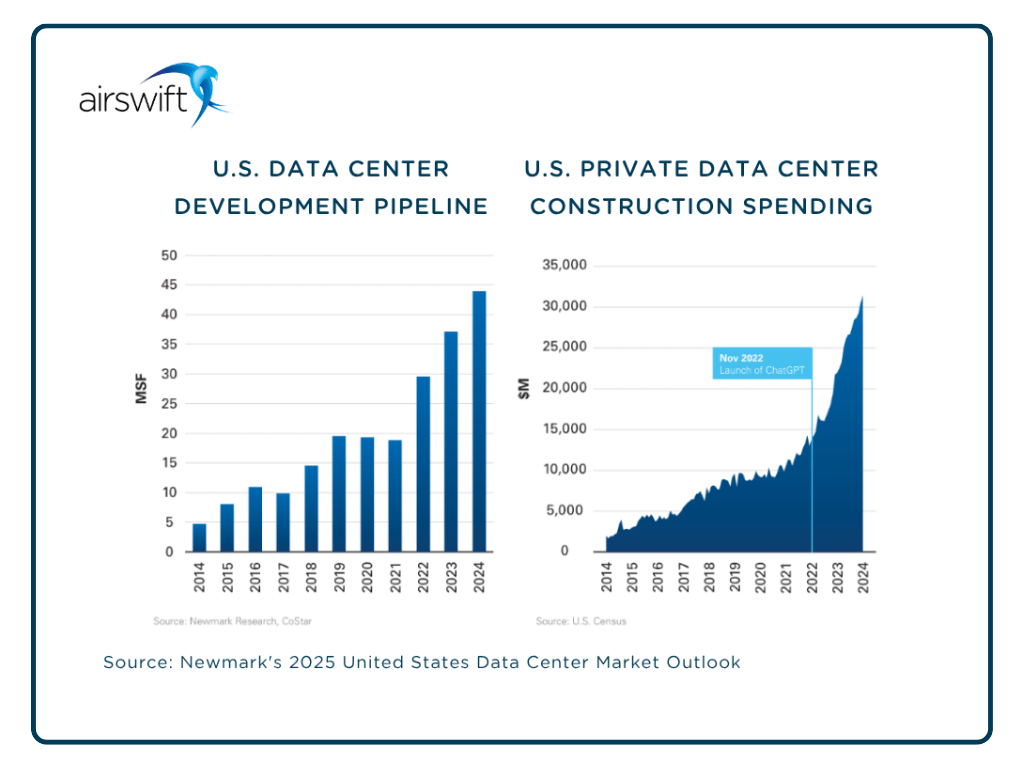
Demand for data center capacity has surged since the launch of ChatGPT, accelerating enterprise and hyperscaler investment as AI becomes embedded in search, customer engagement, and real‑time digital services.
As AI adoption scales, infrastructure requirements are shifting toward highly scalable, low‑latency environments designed to support globally distributed inference workloads.
McKinsey & Company report shows that by 2030, companies will invest almost $7 trillion in capital expenditures on data center infrastructure. More than 40% of this spending will be invested in the United States, and $600 billions will be deployed into labour.
For the second year in a row, vacancy rates in the most established data center hubs have fallen to 1%, reports JLL. With capacity extremely limited, 92% of space in facilities currently under construction has already been pre‑committed, placing sustained upward pressure on pricing per kilowatt.
-1.png?width=1024&height=768&name=North%20America%20data%20center%20vacancy%20(%25)-1.png) More than 35 GW of data center capacity is under development, with nearly 60% already leased and the remaining 40% set to be owner‑occupied by hyperscalers. Notably, 64% of this new capacity is concentrated in less established markets, including West Texas, Tennessee, Wisconsin, and Ohio.
More than 35 GW of data center capacity is under development, with nearly 60% already leased and the remaining 40% set to be owner‑occupied by hyperscalers. Notably, 64% of this new capacity is concentrated in less established markets, including West Texas, Tennessee, Wisconsin, and Ohio.
By 2030, Texas has the potential to surpass Northern Virginia as the world’s largest data center market, supported by strong energy resources, available land, and pro‑business policies.
Discover how to become a data center technician, certifications needed and salary range
Where are most of the U.S. data centers located?
According to Wood Mackenzie, the primary U.S. data center markets include Northern Virginia; Phoenix, Arizona; Dallas, Texas; Chicago, Illinois; Portland and Eastern Oregon; and Silicon Valley, California.
These hubs developed first due to strong infrastructure fundamentals, including dense fiber networks, available substation capacity, lower power costs, experience delivering high‑density facilities, and access to large land parcels close to customers.
As capacity in these core markets tightens, operators are increasingly expanding builds into exurban and rural areas with access to transmission, water, incentives, and more favourable permitting environments. Emerging locations include Pennsylvania, Ohio, Indiana, and Iowa. %20(1).png?width=1024&height=768&name=2025%20year-end%20leased%20data%20center%20+%20hyper-owned%20capacity%20(GW)%20(1).png)
What are the top data center projects in the USA driving job creation?
Employment in U.S. data centers grew by 60% between 2016 and 2023, according to the U.S. Census Bureau, driven by a surge in new facility construction to meet rising global demand. In the U.S. alone, an estimated 500.000 additional workers will be needed to support ongoing and planned construction activity.
Data centers are creating jobs across construction, engineering, operations, IT, AI infrastructure, energy, security, and commercial functions, blending traditional industrial skills with advanced digital and power systems expertise.
Below are eight major data center projects in the United States creating new opportunities.
1. Project Matador
Also known as Amarillo Data Center Project, Project Matador, developed by Fermi America, claims to be the largest data center project in the USA and the world’s largest private HyperGrid campus. The facility located in Texas will deliver 17GW private power with 6GW already permitted and with more than $700 million financially committed. Although the project deadline aims to get first power online in 2026, reports show that construction is delayed and the developer faces instability.
2. PORTS Technology Campus - Phase 2
PORTS Technology Campus - Phase 2 is a $30 billion facility that will be located in Pike, Ohio, developed by SB Energy at a former uranium enrichment site. At full build‑out, the campus is expected to accommodate up to 10 GW of data center capacity, designed to support hyperscale and AI‑driven workloads. To meet these demands, Phase 2 also includes plans for up to 10 GW of new power generation, anchored by a 9.2 GW natural‑gas‑fired power plant.
3. GW Ranch
Developed by Pacifico Energy, GW Ranch is a planned data center that will be located on 8.000 acres of land in Pecos, Texas. The facility will have a capacity of 7.65 GW and is expected to come online in 2027, with purpose-built for hyperscale data centers.
A defining feature of GW Ranch is its off‑grid energy strategy, which integrates data center infrastructure directly with dedicated power generation. The project will combine natural gas turbines, solar energy, and battery storage to deliver up to 5 GW of energy capacity
4. Nexus Data Centers Hubbard Data Center
The 600 MW AI-focused data center is under development by Nexus Data Centers and is located in Hill, Texas. The campus will be located on a 2.000-acre site in Hill County, outside the city of Hubbard, and has progressed from early planning into active development
The Hubbard Data Center will operate behind the meter, powered by onsite natural gas turbines. A key differentiator of the project is its approach to water sustainability, with plans to deploy AirJoule Technologies’ waste‑heat‑to‑water systems, converting excess thermal energy into water for cooling and other operational needs.
5. Project Stargate
Stargate is an initiative to build AI‑focused data center infrastructure across the United States. Developed by OpenAI in partnership with Oracle and SoftBank, the project includes an operational flagship facility in Abilene, Texas, along with five additional sites planned for Shackelford County, Texas; Doña Ana County, New Mexico; Wisconsin; Lordstown, Ohio; and Milam County, Texas.
Together, these developments are part of Stargate’s broader goal to deliver up to 10 gigawatts of AI computing capacity backed by a $500 billion investment commitment. The initiative is expected to generate more than 25.000 onsite jobs, with new sites beginning phased operations from 2026 onward.
6. Meta’s 2GW Data Center in Richland Parish
Announced in December 2024, Meta’s 2GW data center is designed to accelerate the company’s AI development within a four-million-square-foot facility in Richland Parish, Louisiana. The project represents an investment of more than $10 billion and is expected to create over 5.000 construction jobs at peak and more than 500 operational roles after operations start.
Meta has partnered with Entergy to provide at least 1.500MW of renewable energy and has committed to using on-site cooling designs that prioritise water efficiency.
7. Google’s Hyperscale Campus in Kansas City
Also known as Project Mica, Google started building five new hyperscale data centers across a 500-acre campus in Northland, Kansas City. The project was publicly announced in 2026 to help drive the company’s artificial intelligence and cloud business efforts and is backed up by $10 billion in investment, supported by taxable revenue bonds by Port KC.
It is expected to generate a significant number of jobs across construction, operations, logistics, and warehousing, with renewable power supplied through a long-term agreement with Evergy.
8. Crusoe and Tallgrass Data Center in Wyoming
Crusoe and Tallgrass have announced plans to develop a 1.8GW AI data center campus in southeast Wyoming, with the site designed to scale up to 10 GW over time. Publicly announced in July 2025, the project will support large‑scale artificial intelligence computing and expand Crusoe’s growing pipeline of AI infrastructure developments.
The campus will leverage natural gas–based power alongside future renewable energy integration, supported by Tallgrass’s existing energy, water, and carbon‑sequestration infrastructure in the region.

Frequently asked questions on data center projects
Why are data center projects expanding so rapidly across the U.S.?
Growth in cloud computing, generative AI and digital connectivity is accelerating investments in data centers in the U.S., with major technology companies expected to deploy $7 trillion globally until 2030 – 40% only in the U.S.
Which industries rely most on data center infrastructure?
Industries that rely the most on data centers are technology, cloud computing, artificial intelligence, financial services, e‑commerce, healthcare, telecommunications, and media. Government services, defense, and research institutions also depend on data center infrastructure to support secure communications, analytics, and mission‑critical operations.
Why are developers moving data center projects to frontier and rural markets?
As traditional data center hubs approach capacity limits, developers are increasingly turning to frontier and rural markets where land is more available, power is easier to secure, and permitting can be faster. These regions often offer closer proximity to power generation, lower development costs, and incentives from local authorities, making them well‑suited for large, hyperscale campuses.
Why is power availability a key constraint for new data center projects?
Modern data centers, especially those supporting AI workloads, require massive, continuous amounts of electricity. In many established markets, power grids are already constrained, with long lead times for new generation and transmission infrastructure. Securing reliable, scalable power has therefore become one of the most critical and limiting factors in planning and delivering new data center projects.
Why is skilled labour in short supply for data center projects?
Data center construction and operations demand highly specialised skills, including electrical engineering, mechanical systems, HVAC, power systems, network infrastructure, and automation. The rapid pace of project development, combined with competition from other infrastructure and energy projects, led to labour shortages across both construction and long‑term operations.
Hire for data centers with Airswift's recruitment solutions
As data center construction accelerates across the U.S., securing skilled talent is becoming increasingly challenging. Partnering with a trusted workforce solutions provider can reduce time to hire and improve retention.
Airswift delivers scalable, end‑to‑end workforce solutions tailored to data center projects worldwide, acting as a single, trusted partner for data center recruitment and workforce management.
Ready to optimise your hiring approach? Get in touch today.