
By
Diyaa Mani
October 8, 2026
Updated
October 8, 2026
Why does LinkedIn personal branding matter for business leaders?
Business leaders are often closely associated with the organisations they represent. A considered LinkedIn presence can provide context around your experience, demonstrate how you think, and strengthen trust with employees, candidates, clients, investors, and industry peers.
It can also support your organisation’s employer brand. When leaders communicate openly and thoughtfully, people gain a clearer view of the expertise, priorities, and culture behind the business.
Your personal brand already exists in some form. The practical question is whether it accurately reflects the leadership qualities and specialist knowledge for which you want to be known.
Six ways to optimise your LinkedIn profile
Here are six strategies to optimise your LinkedIn profile.
1. Decide what you want to be known for
Before rewriting your profile or planning posts, define your position. A useful executive brand usually sits at the intersection of four elements:
- Expertise: What do you understand through direct experience?
- Audience: Who would benefit from that knowledge?
- Point of view: What do you believe that is useful, distinctive, or under-discussed?
- Business context: Which issues are relevant to your role, organisation, and industry?
Try completing this sentence:
I help [audience] understand or address [business issue] by sharing experience in [area of expertise].
A renewable energy executive might focus on the relationship between project delivery, workforce capability, and the energy transition. A technology leader might discuss responsible AI adoption, governance, and organisational change.
Choose two or three connected themes rather than commenting on every trending topic. A focused body of work makes your expertise easier for people and search systems to understand.
2. Turn your LinkedIn profile into evidence of your expertise
Your profile should quickly answer three questions:
- Who are you?
- What do you know?
- Why should someone trust your perspective?
Write a specific headline
A job title establishes your position, but it rarely explains your full value. Combine your role with your specialist area, market, or the outcome you help create.
For example:
Chief Operating Officer | Scaling global engineering workforces and complex project delivery
Use language that clients, peers, and candidates genuinely recognise. Avoid inflated claims and repetitive keywords.
Make your About section useful
Write in the first person and begin with your present focus, not a chronological career history.
Explain:
- The business challenges you're working on
- The experience that informs your perspective
- The sectors, regions, or disciplines you understand
- The principles that guide your leadership; and
- The topics you're open to discussing.
Specificity creates credibility. “I have led multidisciplinary infrastructure teams across Southeast Asia” says more than “I am a passionate, results-driven leader.”
Show outcomes in your Experience section
Don't just reproduce a job description. Explain the scope of your responsibilities, the projects or transformations you led, the capabilities you developed, and the outcomes you helped achieve.
Where appropriate, include:
- Markets or regions covered
- Team or project scope
- Organisational changes led
- Capabilities built
- Measurable business outcomes
Only publish figures that are accurate, approved, and not commercially sensitive.
Curate proof in the Featured section
LinkedIn’s Featured section can display selected posts, articles, documents, external links, and other work samples. LinkedIn positions it as a way to showcase evidence of a member’s skills and experience, although Featured content itself is not discoverable through LinkedIn search.
Consider featuring:
- An original article or research report
- A conference talk or panel discussion
- An authorised case study
- A practical framework or presentation
- A post that clearly represents your perspective
Treat Featured as a curated evidence layer, not an archive. Review it periodically so it supports your current priorities.
Check your public visibility
If discoverability beyond LinkedIn matters, review your public profile settings. LinkedIn allows members to control which profile sections may be displayed to people who are not signed in or through search tools such as Google
Keep your name, headline, experience, and areas of expertise accurate and consistent with your organisation’s website and other credible professional profiles.
3. Build an expertise-led content strategy
The most valuable executive content offers something a corporate announcement cannot: informed interpretation.
Do not simply repeat industry news. Explain:
- Why a development matters
- What decision-makers may be overlooking
- Where your experience supports or challenges conventional thinking
- What you learned from applying an idea
- What leaders should consider doing next
Useful content themes include:
- Industry interpretation: What does a market, policy, technology, or workforce change mean in practice?
- Lessons from experience: What did a project, decision, or setback teach you?
- Leadership principles: How do you approach change, culture, accountability, or talent?
- Practical frameworks: Which questions or criteria help you make better decisions?
- Evidence-led viewpoints: What does credible research suggest, and how does it compare with your experience?
- People and organisational insight: What are you learning from teams, customers, candidates, or professional communities?
A useful post normally contains one clear idea, enough context to understand it, supporting evidence or experience, and a practical implication.
That structure respects busy readers. It also creates passages that can stand alone when surfaced in search results or AI-generated answers.
If you're just getting started with using LinkedIn for personal branding, read our LinkedIn Profile Tips blog for more suggestions on how to optimise your page.
4. Choose a sustainable cadence and the right format
There is no universal posting frequency for every executive. Choose a rhythm you can realistically maintain without lowering the quality of your ideas.
For one leader, that may be one original post each week. Another may publish less often but contribute thoughtful comments several times a week.
Match the format to the idea:
- Use a short post for one observation, lesson, or question.
- Use a document or diagram when a framework benefits from visual explanation.
- Use video when delivery, personality, or demonstration adds meaning.
- Use an article for analysis that needs more context.
- Start a newsletter only when you have a clear subject and a sustainable publishing plan.
LinkedIn newsletters are recurring articles on a defined topic, and subscribers can receive notifications when a new edition is published. A focused monthly newsletter is more credible than an ambitious weekly publication that quickly becomes repetitive.
Consistency should mean a recognisable standard and perspective, not posting simply because the calendar says you should.
5. Treat engagement and networking as leadership activities
Personal branding is not one-way broadcasting. A thoughtful comment can demonstrate expertise when it adds context, asks a considered question, or introduces another perspective. Responding to substantive comments also shows that you are willing to participate in a conversation rather than collect attention.
Build your network with the same care. LinkedIn distinguishes between connecting and following: a connection establishes a two-way professional relationship, whereas following lets you see someone’s public content without joining their network.
Follow people whose thinking you want to learn from and connect when there is genuine professional context, such as:
- Working together
- Meeting at an event
- Belonging to the same professional community
- Collaborating on an industry initiative
- Continuing a useful discussion
Avoid mass outreach, automated engagement, and sales pitches disguised as connection requests. A smaller, relevant network is more useful than a large audience with little connection to your work.
6. Protect trust and use AI with judgment
You're accountable for what you publish. Before posting, ask:
- Is this information accurate and current?
- Am I authorised to share it?
- Could it expose confidential, personal, or commercially sensitive information?
- Does it distinguish my personal view from an official company position where necessary?
- Have I credited the original research, quotation, or idea?
- Would I be comfortable with employees, clients, regulators, or journalists reading it?
Correct errors promptly. Do not exaggerate achievements or manufacture certainty around complex issues.
Use AI as an assistant, not a substitute for expertise
AI can help organise notes, tighten structure, or improve clarity. It should not invent your experience or remove your point of view.
LinkedIn advises members to review and approve AI-assisted content and ensure it still reflects their own voice, perspective, and expertise. It describes generic, repetitive, low-substance material as “AI slop.”
A practical process is to:
- Start with your own argument, example, or evidence
- Use AI to organise or edit, not to fabricate insight
- Verify every factual claim
- Remove language you would not naturally use
- Add the implication that only your experience can provide
- Consider disclosure if AI played a substantial role in producing the content
7. Measure relevance, not vanity
Impressions and follower counts provide context, but they do not show whether your personal brand is achieving its purpose.
LinkedIn post analytics can include impressions, members reached, profile activity, followers gained, reactions, comments, reposts, saves, sends, link visits, and audience demographics. LinkedIn notes that some figures are estimates.
Choose measures that relate to your objective:
| Objective | Useful metrics to measure |
|---|---|
|
Build recognition |
Relevant follower growth, profile views, search appearances |
|
Share expertise |
Saves, sends, substantive comments, repeat engagement |
|
Reach a target audience |
Viewer job titles, seniority, industries, companies, and locations |
|
Start conversations |
Relevant messages, introductions, meeting requests |
|
Support the businesses |
Candidate interest, partnership discussions, invitations, qualified inquiries |
Examples of effective personal branding
Satya Nadella (Microsoft)
Satya Nadella, CEO of Microsoft, exemplifies effective personal branding by focusing on digital transformation.
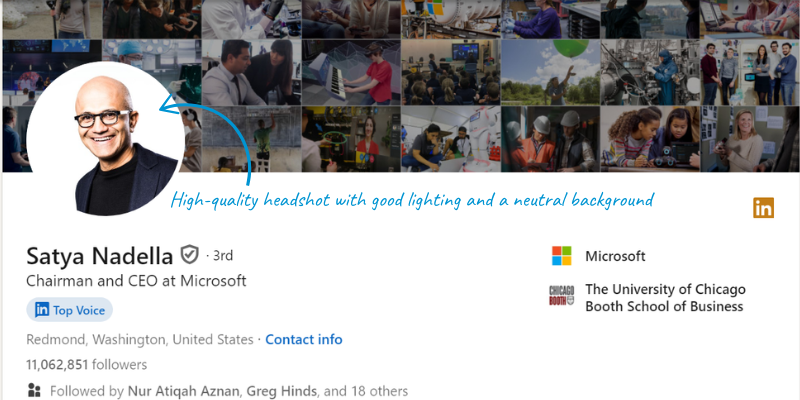
His posts are insightful, and he leverages LinkedIn to share insights that position him as a thought leader.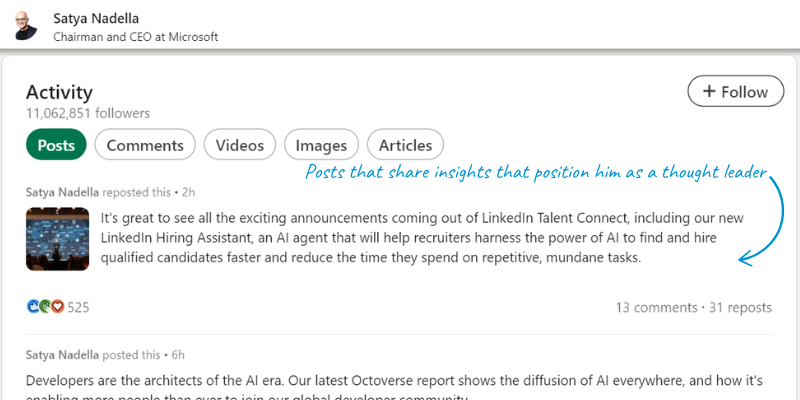
He emphasises organisations' need to integrate technology into their operations to thrive in a rapidly changing landscape, enhancing his credibility and aligning Microsoft's brand with innovation.
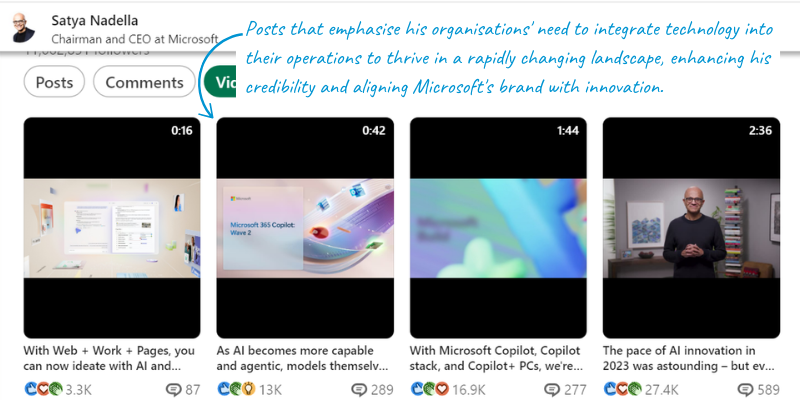
Through his strategic use of LinkedIn, Nadella engages a broad audience, reinforcing his pivotal role in shaping the future of technology.
Richard Branson (Virgin Group)
Richard Branson, founder of the Virgin Group, has effectively used storytelling to connect with his audience and enhance his brand. .png?width=800&height=400&name=RB1%20(1).png "Richard Branson’s LinkedIn profile with a visually striking banner that reads 'Dyslexic Thinking +' alongside logos for Virgin, LinkedIn, and Dictionary.com, symbolizing Branson’s advocacy for dyslexia awareness. His profile picture shows Branson smiling, reinforcing his approachable, friendly brand. The banner reflects his personal branding as a proponent of creative thinking and industry innovation, as well as his leadership at Virgin Group, which he founded. Branson is designated as a LinkedIn 'Top Voice' with a follower count exceeding 18 million.")
By sharing engaging narratives highlighting his entrepreneurial journey and the values behind his ventures, he promotes Virgin's initiatives while fostering a relatable image.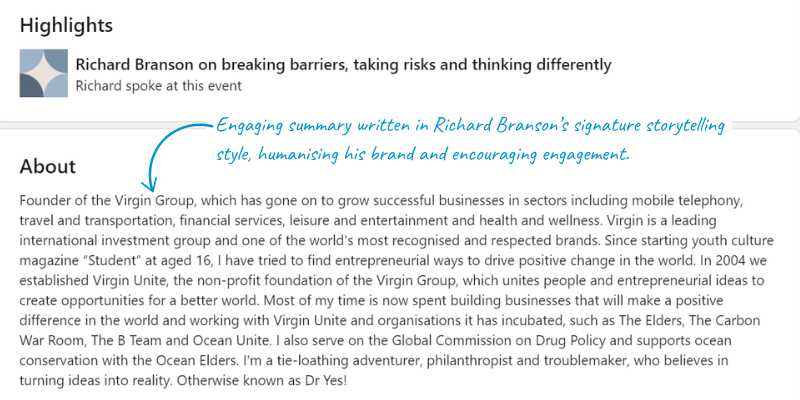
Through personal anecdotes and insights into his philanthropic efforts on LinkedIn, Branson creates inspirational content that resonates with followers, humanising his brand and encouraging engagement.
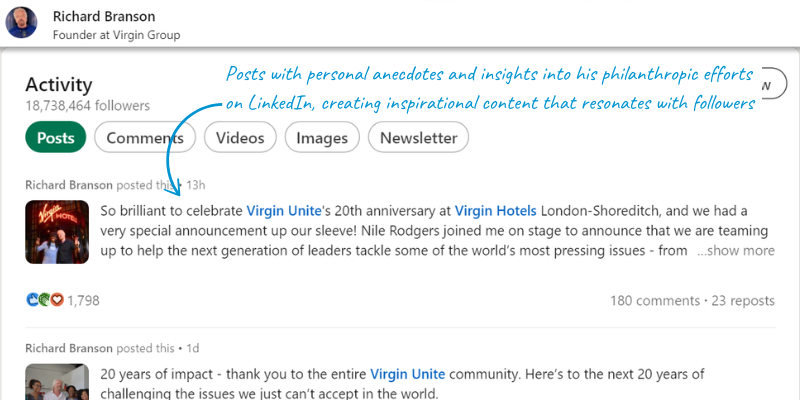
This consistent storytelling approach cultivates emotional connections with his audience, positioning him as an approachable leader committed to making a positive impact.
Arianna Huffington (Thrive Global)
Arianna Huffington, founder of Thrive Global, has successfully transitioned her personal brand from media mogul to well-being advocate by sharing thoughtful content on LinkedIn. 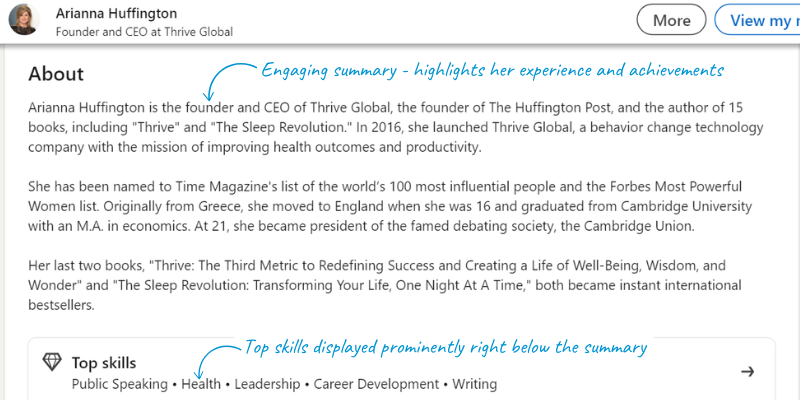
Focusing on mental health, work-life balance, and productivity, she has carved out a niche that resonates with professionals looking to improve their well-being in high-pressure environments.
Her articles blend personal experiences with research-backed insights, reinforcing her authority in wellness and promoting healthier workplace cultures.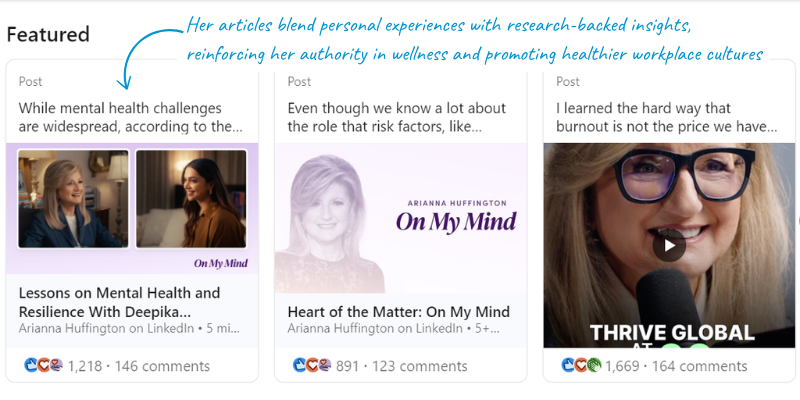
Through consistent messaging and engagement, Huffington has established herself as a leading voice for holistic approaches to success, enhancing her brand and Thrive Global's mission.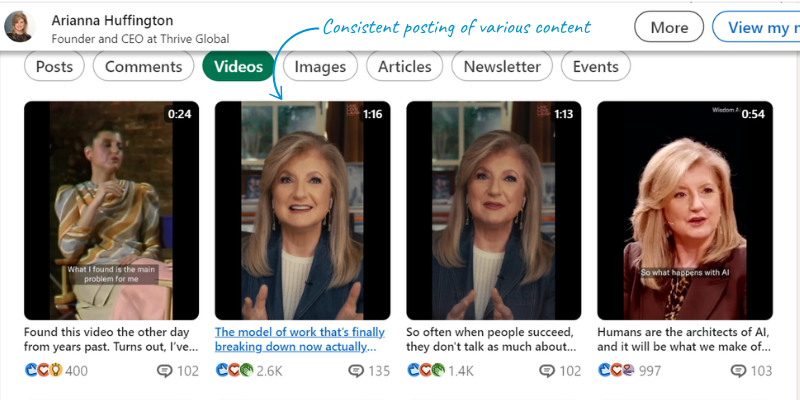
A practical 30-day LinkedIn personal branding plan
Week 1: Clarify
Define your audience, central expertise, two or three content themes, and the outcome you want LinkedIn to support.
Week 2: Strengthen your profile
Rewrite your headline and About section. Update your Experience section, review public visibility, and add credible work to Featured.
Week 3: Participate
Publish one evidence-led post, contribute useful comments, follow relevant industry voices, and reconnect with trusted contacts.
Week 4: Learn
Review audience relevance, saves, sends, profile activity, and the quality of conversations. Use those signals to plan the next month.
Frequently asked questions about LinkedIn personal branding
What is LinkedIn personal branding?
LinkedIn personal branding is the intentional communication of your expertise, values, experience, and perspective through your profile, content, network, and interactions.
How often should business leaders post on LinkedIn?
There is no universal ideal frequency. Choose a sustainable cadence that allows you to publish original, accurate, and useful content. Relevance and consistency matter more than volume.
What should executives post about on LinkedIn?
Focus on subjects you understand through direct experience: industry developments, leadership lessons, market interpretation, organisational change, practical frameworks, and evidence-led viewpoints.
Should business leaders write their own LinkedIn posts?
The ideas, experiences, and final judgment should come from the leader. Communications teams can support research, structure, and editing, provided the finished post accurately reflects the leader’s voice and views.
Can executives use AI to write LinkedIn content?
Yes, but AI should support rather than replace original thinking. Review every draft, verify claims, protect confidential information, and add the experience and implications that only you can provide.
How can leaders improve their LinkedIn discoverability?
Use a clear headline, describe your expertise specifically, maintain accurate profile sections, review public visibility, and publish consistently around recognisable themes. Avoid keyword stuffing.
Which LinkedIn metrics matter most for executives?
The right metrics depend on your goal. Audience relevance, profile activity, saves, sends, meaningful comments, introductions, and relevant business conversations are usually more informative than impressions alone.
Find your next leadership role with Airswift
A credible LinkedIn personal brand is not built through constant self-promotion. It grows when leaders repeatedly make their knowledge useful: explaining change, sharing evidence, acknowledging uncertainty, and participating constructively in professional conversations.
For leaders in energy, engineering, technology, infrastructure, mining, and other STEM sectors, that visibility can help demonstrate expertise, strengthen professional connections, and open the door to new opportunities.
Ready for your next leadership challenge? Explore Airswift Digital to discover leadership roles with STEM companies around the world.