
By
Diyaa Mani
October 21, 2026
Updated
October 21, 2026
Staying motivated while job hunting is easier when you treat motivation as a system rather than a mood.
Focus on actions you can control, such as submitting targeted applications, building a consistent routine, developing new skills, and strengthening your network.
While hiring decisions are ultimately out of your hands, maintaining structured habits and realistic expectations can help you stay productive, protect your confidence, and make steady progress throughout your job search.

Key takeaways
- Treat rejection as information, not a judgement of your worth.
- Focus on actions you can control rather than hiring decisions you cannot.
- Create a routine with clear boundaries to avoid burnout.
- Stop comparing your behind-the-scenes experience with other people's highlights.
- Use learning, networking and small wins to maintain momentum.
- Build a system that keeps you moving forward even when motivation is low.
Why staying motivated while job hunting is so difficult
Job hunting has a special talent for turning rational adults into amateur detectives. During my search, I analysed recruiter response times, punctuation, and application updates as if they were clues in a corporate crime drama.
A full stop instead of an exclamation mark? Clearly significant. No reply after four days? Obviously a conspiracy.
I began with a simple plan: update my CV, apply for suitable roles, impress several hiring managers, and choose the best offer. In this extremely optimistic version, the process was efficient, dignified, and accompanied by excellent coffee.
However, the reality was that I spent hours tailoring applications, researching employers, and preparing for interviews, often without receiving any visible return. Some weeks produced promising conversations. Others made me feel as though my CV had entered a digital black hole.
Eventually, I stopped trying to manufacture constant positivity. I built a system that helped me continue when I felt confident, discouraged, or simply tired of writing “I am excited to apply.” That shift taught me how to stay motivated while job hunting without allowing the search to consume my identity.
Below are some strategies to stay positive during a job hunt.
How to handle job rejection without taking it personally
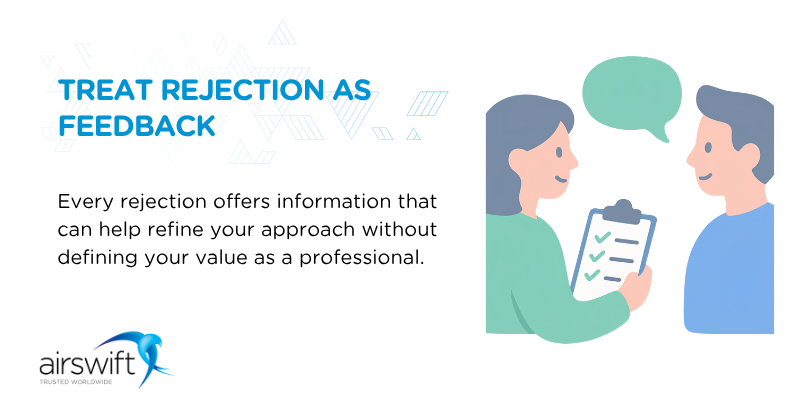
At first, every rejection felt personal. If I did not get an interview, I assumed my CV was weak. If another candidate received the offer, I questioned my experience. If a recruiter disappeared, I briefly considered whether I had somehow offended an entire profession.
Hiring rarely works that neatly. A business may have an internal candidate, change its budget, or decide it needs a different skill set. Someone else may have experience that matches one immediate priority more closely. I might never know the full reason, so inventing the harshest possible explanation is neither accurate nor useful.
Some best practices to handle job rejections are:
-
Treat recruitment as a matching process rather than an examination. An examination implies there is one correct answer and everyone else has failed. A match depends on capability, timing, and compatibility.
-
Review useful feedback, look for patterns, and improve what you can.
Not every rejection contains a life-changing lesson. Sometimes “we selected another candidate” means precisely that. I learned to take the information without accepting an imaginary insult.
Focus on what you can control during your job search
My motivation improved when I separated what I could control from what I could not.
I could not control who applied, whether I was shortlisted, or how quickly a company decided.
What I could control was where I focused my time and effort:
- Tailoring my CV for each application
- Researching prospective employers
- Preparing relevant examples that demonstrated my experience
- Reaching out to people in my network
- Practising interview answers
- Following up professionally after applications and interviews
That distinction changed my definition of a productive day. Instead of asking whether I had secured a job, I asked whether I had completed worthwhile actions:
- Did I submit a strong application?
- Did I contact someone relevant?
- Did I improve an interview example?
- Did I learn something new about the market?
These questions gave me an indication of my progress. That mattered because motivation based entirely on responses is fragile. When every good day requires an interview invitation, silence begins to feel like failure.
I also stopped chasing application numbers. Sending twenty generic applications might create a satisfying spreadsheet, but it did not necessarily improve my prospects. I became more selective and asked three questions before applying:
- Do I understand the role?
- Can I demonstrate relevant value?
- Would I genuinely want the job?
One thoughtful application left me feeling more purposeful than the twenty rushed ones I used to send out daily during my job search. My goal was not to win “Most applications submitted before breakfast”. It was to find work where I could contribute and grow.
Create a job-search routine that prevents burnout
To create more consistency, I developed a routine that separated the different parts of the job search:
Without structure, my job search swung between obsession and avoidance. Some days, I applied late into the evening. On others, I scrolled through vacancies for hours and called it market research, which was a generous description.
- Searching for suitable roles
- Tailoring applications
- Networking and building professional connections
- Preparing for interviews
- Following up on applications and conversations
- Developing new skills and knowledge
I assigned time to each activity instead of allowing job boards to dominate the entire day.
Job hunting takes up a lot of time. Without boundaries, even rest can feel irresponsible.
I learned that exhaustion did not make me a more committed candidate. It made my writing repetitive, my judgment weaker, and my interview preparation less effective. Rest was not something I had to earn by receiving an offer. It was part of producing good work.
A defined stopping point helped me return the next day with more focus. It also reminded me that I was a person conducting a job search, not a full-time application machine with Wi-Fi.
I adjusted my expectations based on the energy I had available that day:
- On energetic days, I focused on demanding applications and interview preparation.
- On more difficult days, I researched employers or reached out to one person in my network.
- Rather than aiming for perfect productivity, I focused on maintaining momentum.
Consistency mattered more than bursts of activity followed by burnout. A sustainable routine kept me moving forward, even when motivation fluctuated.
Stop comparing your job search to everyone else's success
Few things tested my confidence like opening a professional networking platform on Monday morning. My feed appeared to contain an endless parade of promotions, awards, and posts beginning with “I am delighted to share.”
Meanwhile, I was delighted to share that I had refreshed my inbox 43 times and received a discount code from a shop I had visited just once.
Comparison distorted the process because I was measuring my complete experience against other people’s edited outcomes. I saw the new job title, not the rejected applications that came before it. I saw the first-day photograph, not the weeks spent waiting for a decision.
People usually publish the result rather than the uncertainty. Once I internalised that, another person’s success stopped looking like evidence of my failure.
When I noticed comparison affecting my mindset, I focused on a few simple reminders:
- Most people share outcomes, not the setbacks that preceded them.
- Someone else's progress does not reduce your opportunities.
- Visibility is not the same as success.
- A longer job search does not mean a less successful career.
- Progress happens at different speeds for different people.
If scrolling left me discouraged, I closed the application. That was attention management, not avoidance.
Careers do not move according to one shared timetable. Some people change roles quickly. Others take longer, reconsider their direction, or discover an opportunity through an unexpected conversation.
Use learning and networking to build job-search momentum
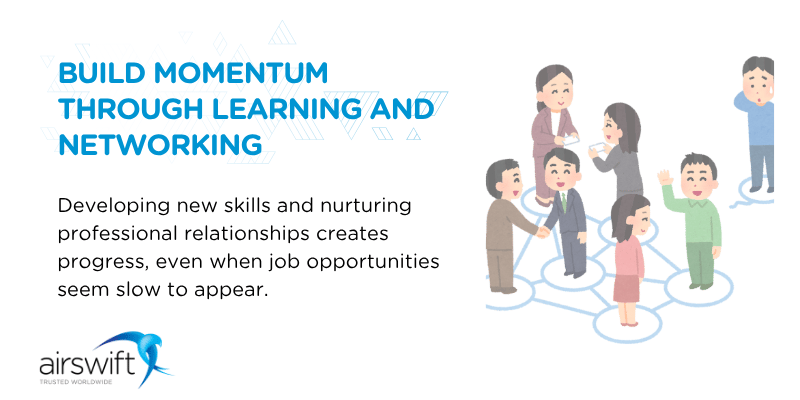
When the search felt stagnant, learning restored movement. I reviewed recurring requirements in job descriptions, read industry material, and strengthened skills that would improve my candidacy.
Even if no recruiter contacted me that week, I understood more than I had the week before. A quiet inbox did not mean a static career.
To keep moving forward, I focused on activities that added value regardless of immediate outcomes:
- Reviewing common requirements across job descriptions
- Reading industry news, trends, and insights
- Strengthening skills relevant to my target roles
- Identifying gaps in my experience and addressing them
People mattered just as much. Job hunting can become isolating because applications disappear into systems, and disappointments are often processed privately. Conversations with friends, former colleagues, and mentors gave me information, perspective, and encouragement.
Some shared opportunities. Others helped me explain my experience or challenge assumptions. Good networking is not a transaction; it is a community exchanging context, introductions, and confidence.
I learned that specific requests often led to more useful conversations:
- Asking for CV feedback
- Seeking insight into a particular sector or company
- Practising interview answers with someone I trusted
- Requesting a relevant introduction where appropriate
Clear requests encouraged meaningful responses.
Those conversations improved my interviews, which I eventually began treating as discussions about mutual fit. I assessed the team, culture, and expectations while the employer assessed me.
Approaching interviews with curiosity changed the quality of those conversations:
- Understanding how the team worked
- Exploring what success looked like in the role
- Discussing challenges I could help solve
- Explaining what I had learned from past experiences
Curiosity made me less performative. Instead of trying to become the mythical candidate who has never made a mistake, I focused on explaining what I had learned, how I solved problems, and what I needed to do good work.
Why motivation during a job search is a system, not a mood
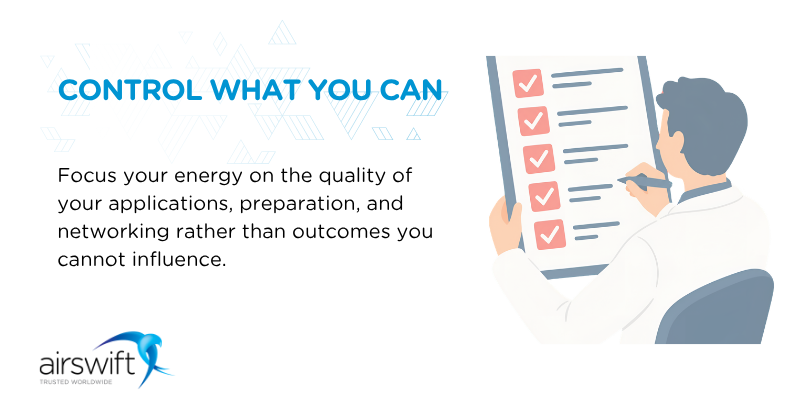
The most important lesson from my job search was that motivation is not a personality trait or a permanent state of enthusiasm. It is a system that makes useful action possible even when confidence fluctuates.
My system was not complicated. I focused on controllable actions, submitted fewer but stronger applications, followed a routine, protected my attention, kept learning, and stayed connected to people. I treated rejection as data rather than identity and allowed rest to support the work.
Some days, I still felt discouraged. Another polite rejection before breakfast could make optimism seem like an unbearable burden to carry. The difference was that a bad mood no longer determined whether I continued.
Would I describe job hunting as enjoyable? Not exactly. I would place it somewhere between assembling DIY furniture without instructions and pulling out a rhino’s tooth.
Yet the experience changed my understanding of confidence. Confidence is not always believing that success is imminent. Sometimes it is continuing to act purposefully while the outcome remains unclear.
If you are wondering how to stay motivated while job hunting, do not demand inspiration from yourself every day. Build a process that still works when inspiration is lacking. Set achievable goals, protect your energy, ask for help, and recognise progress before an offer arrives.
Most importantly, remember that looking for work is something you are doing. It is not a definition of who you are.
The right opportunity may take longer to appear than expected. Until it does, progress still counts, even when it looks like another application, another conversation, a new skill, or simply another day when you chose not to give up manage your mindset for better job search results.
Looking for your next role? Start your job search with Airswift
Job searching can feel overwhelming, but you do not have to navigate it alone. Whether you are looking for your next contract role, a permanent position, or an opportunity in a new industry or location, having access to the right opportunities can make all the difference.
Explore Airswift's candidate portal to search the latest vacancies, upload your CV, and connect with specialist recruiters who can help match your skills, experience, and career goals with employers around the world.