
By
Alicia Edwards
December 1, 2025
Updated
December 1, 2025
What are mock interviews in a nutshell?
Mock interviews are structured sessions that mimic the format of a real interview. They allow you to practise answering common questions, refine your body language, and get feedback on your performance. These sessions are useful for anyone entering the job market, changing careers, or preparing for high-stakes roles.
How to prepare for a mock interview step-by-step (with tips)
A mock interview works best when you treat it like the real thing. Proper preparation helps you identify gaps and build confidence before the actual interview. Here’s how to do it:
#1: Research the company and role thoroughly
Even if it’s a practice session, act as if you’re preparing for the real interview. Read about the company’s values, recent projects, and industry trends. Understand the job description so you can tailor your answers to the role.
#2: Dress professionally to set the tone
Wearing interview-appropriate clothing helps you get into the right mindset. It also allows you to practise feeling comfortable in formal attire, which can reduce nerves on the day.
#3: Prepare answers for common questions
Questions like “Tell me about yourself” or “Why do you want this job?” often set the tone for an interview. Practise concise, structured answers that highlight your skills and enthusiasm. Avoid memorising word-for-word focus on key points instead.
#4: Have examples ready to demonstrate your achievements
Use the STAR method (Situation, Task, Action, Result) to frame examples of your experience. Prepare at least three strong stories that show problem-solving, teamwork, and leadership skills.
#5: Simulate the real experience
Sit in a quiet space, remove distractions, and time your responses. If possible, record the session to review your tone, pace, and body language later.
Mock interview question examples
Typical questions include:
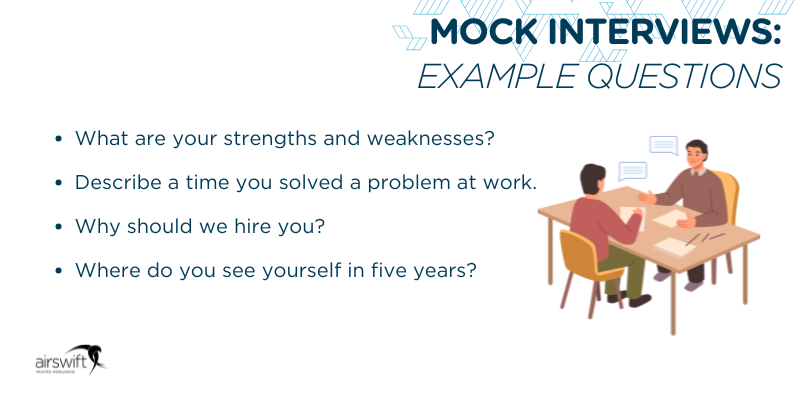
What are your strengths and weaknesses?
This question tests self-awareness and honesty. When answering, highlight strengths that align with the role and frame weaknesses as areas you’re actively improving. For example, “I’m strong in project management, but I’m working on improving my public speaking skills.
Describe a time you solved a problem at work.
Employers want to see problem-solving skills in action. Use the STAR method (Situation, Task, Action, Result) to structure your response. For instance, explain the challenge, what you needed to achieve, the steps you took, and the positive outcome.
Why should we hire you?
This is your chance to sell yourself. Focus on your unique skills, experience, and how they match the company’s needs. Avoid generic answers - make it specific to the role and organisation.
Where do you see yourself in five years?
This question gauges ambition and cultural fit. Show that you have realistic goals and a desire to grow within the industry. Avoid sounding like you’re using the role as a short-term stepping stone.
Here is a light-hearted example of a mock interview
Picture this: you’re sitting across from your friend who’s pretending to be the hiring manager. They ask, “So, why do you want this job?” You take a deep breath and say, “Because I heard your office has the best coffee machine in town.” Cue laughter - but then you quickly follow up with a serious answer about your skills and experience.
That’s the beauty of mock interviews. They give you space to make mistakes, laugh about them, and then practise the polished responses you’ll need when it really counts.
How to do mock interviews by yourself
Not everyone has access to a coach or friend, so how can you do mock interviews by yourself? The good news is that self-practice can still be highly effective if you approach it with discipline and structure. Here’s how:
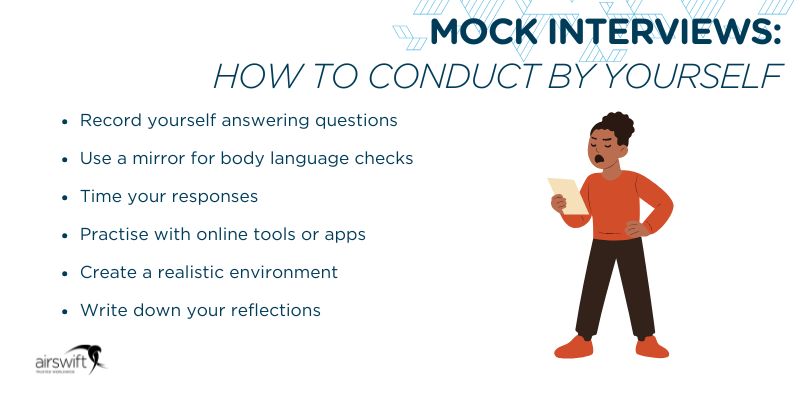
Record yourself answering questions
Use your phone or laptop to record video or audio while you respond to common interview questions. Watching the playback helps you spot issues with tone, clarity, and body language. It’s often surprising how much you can improve just by seeing yourself from an outside perspective.
Use a mirror for body language checks
Stand or sit in front of a mirror and practise maintaining eye contact, smiling naturally, and using open gestures. This helps you become aware of nervous habits like fidgeting or crossing your arms.
Time your responses
Interviews usually expect answers to be clear and concise, around one to two minutes for most questions. Use a timer to practise staying within that range. This prevents rambling and keeps your answers focused.
Practise with online tools or apps
There are free and paid platforms that simulate interviews with realistic questions. Some even provide AI-driven feedback on your tone and pacing. These tools can make solo practice feel more structured and professional.
Create a realistic environment
Sit at a desk, dress as you would for a real interview, and remove distractions. This helps you get into the right mindset and reduces nerves when the actual interview comes around.
Write down your reflections
After each session, note what went well and what needs improvement. This creates a feedback loop so you can track progress over time.
Self-practice might feel awkward at first, but it’s one of the most effective ways to build confidence and polish your answers before the real thing.
Why do mock interviews matter?
Mock interviews build confidence, reduce stress, and improve your ability to articulate skills. They also help you identify gaps in your knowledge or presentation style before the real interview.
Ready to ace your next interview?
At Airswift, we don’t just connect you with global opportunities - we help you prepare to shine. From expert advice to tailored career support, our team ensures you walk into every interview with confidence.