
By
Nathalia Duarte
March 12, 2026
Updated
July 3, 2026
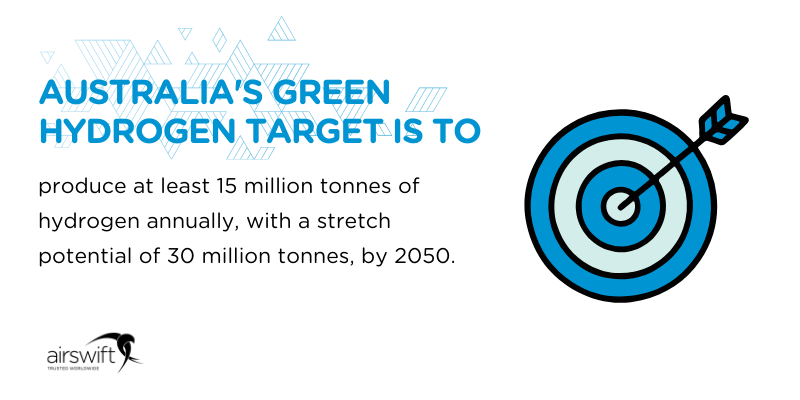
Green hydrogen has been at the centre of the discussion and strategies in the race toward decarbonisation in Australia. The target is to produce at least 15 million tonnes of hydrogen annually, with a stretch potential of 30 million tonnes, by 2050.
As part of the plan, the workforce plays a crucial role in developing this emerging industry. Discover the Australian National Hydrogen Strategy, challenges, jobs in demand and key projects starting in 2026.
Why does the National Hydrogen Strategy matter?
Australia’s National Hydrogen Strategy, first released in 2019 and updated in 2024, positions the country as a global leader in hydrogen production. The strategy focuses on reducing production costs, developing hydrogen hubs, and building a strong domestic market, while supporting exports to Asia and Europe.
To meet its target of at least 15 million tonnes of hydrogen per year by 2050, stretching to 30 million tonnes, the federal government has introduced production incentives to improve the competitiveness of green hydrogen. Two of them are:
- The Hydrogen Production Tax Incentive (HPTI): The $2 per kilogram incentive, which provides time-limited, demand-driven support to eligible producers through the tax system.
- Hydrogen Headstart Program: $2 billion program designed to accelerate large‑scale project development.
Workforce development is also a critical pillar of the strategy, recognising that a skilled labour force will be essential to achieving these ambitions.
Hydrogen jobs in demand
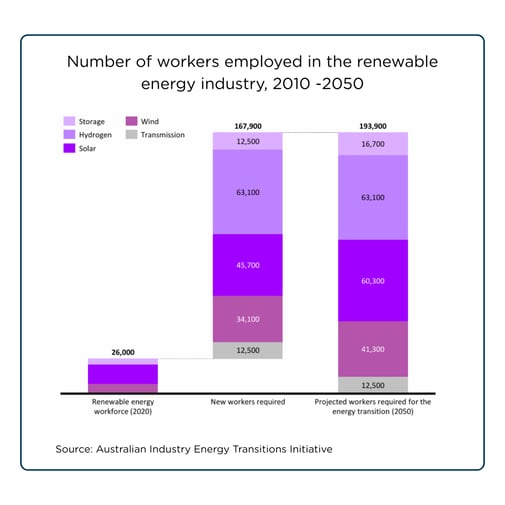
In 2020, the Australian Industry Energy Transitions Initiative estimated that the green energy sector employed around 26,000 people. To meet Australia’s net zero targets by 2050, a further 167,900 workers will need to be upskilled, more than 63,000 of them to support green hydrogen alone.
 Career opportunities in hydrogen will span the full value chain, from design and construction to manufacturing, transport, and export. While many technical roles will require cross‑skilling or upskilling, the industry will also create a wide range of new jobs across the supply chain where this may not be necessary.
For technical professionals aiming to work in green hydrogen facilities, key skills are likely to include:
-
Electrolysis and compressor technology
-
Hydrogen electrolyser maintenance
-
Hydrotesting for transmission pipelines
-
Hydrogen properties
-
Fuel cell design
Across Australia, states are developing workforce roadmaps to address the talent needed to scale the hydrogen industry:
-
Victoria: Establishing a Renewable Hydrogen Worker Training Centre to train, upskill, and retain workers, positioning the state as a leader in clean energy education.
-
New South Wales: Constructing a $25 million Hydrogen Centre of Excellence, expected to train around 8,250 plumbers and gasfitters over five years.
-
Queensland: Expanding the Townsville Trade Training Centre with a Hydrogen and Renewable Energy Training Facility, alongside CQUniversity’s Centre for Hydrogen and Renewable Energy (CHRE).
-
National initiatives: A Clean Energy Skills National Centre of Excellence delivered across TAFE colleges, covering hydrogen, wind, solar, and batteries.
-
Industry training: The Asia Pacific Renewable Energy Training Centre (APRETC) in Victoria offers Global Wind Organisation (GWO) accredited courses and supports hydrogen, solar, and battery training.
Ryan Carroll, Regional Leadership at Airswift for Australia and New Zealand, highlights the importance of a coordinated workforce strategy:
“Workforce roadmaps need to balance short and long‑term initiatives, as competition for talent remains intense. Building a hydrogen workforce will require a multi‑pronged approach, strong employer value propositions, sustained investment in training for both transitioning workers and graduates, and the ability to attract international talent.”

Challenges to the green hydrogen expansion in Australia
Despite Australia’s ambitious green hydrogen targets, several challenges are slowing progress. Two major decisions in 2024 highlighted these risks.
In May, Fortescue Future Industries (FFI) announced it would scale back its green hydrogen ambitions, abandoning plans to produce 15 million tonnes by 2030. Later that year, Origin Energy withdrew from the Hunter Valley Hydrogen Hub (HVHH), a flagship project intended to be a cornerstone of Australia’s hydrogen industry.
According to the Australian Energy Council, several factors are affecting project viability:
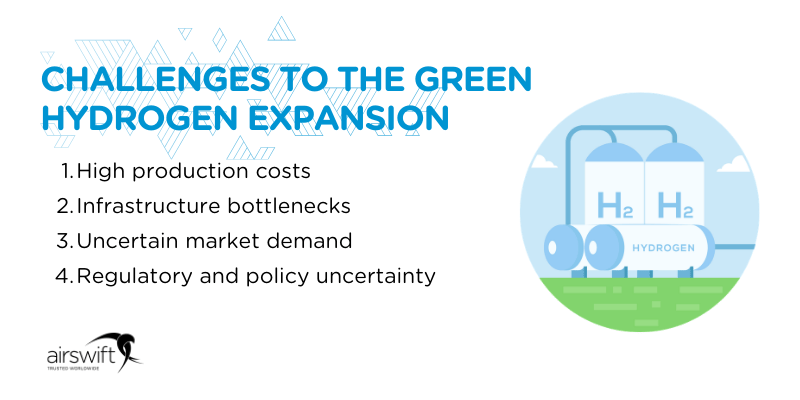
- High production costs: Green hydrogen produced via electrolysis currently costs around AUD $5–6 per kilogram. To be competitive, costs would need to fall below AUD $2.
- Infrastructure bottlenecks: Slower‑than‑expected development of infrastructure is limiting the industry’s ability to scale.
- Uncertain market demand: Many potential buyers are still developing their hydrogen strategies, while global demand remains nascent. This uncertainty makes it harder for Australian producers to justify large‑scale investments based on exports.
- Regulatory and policy uncertainty: A lack of clear regulations for hydrogen blending in gas pipelines, future end‑use clarity, and consistent safety standards for storage and transport continues to weigh on investor confidence.
Five Australian green hydrogen projects starting in 2026
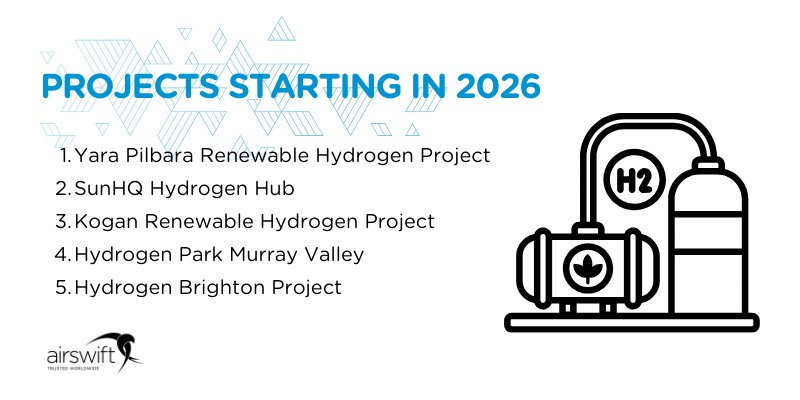
1. Yara Pilbara Renewable Hydrogen Project
This $80 million project will develop a solar-powered green hydrogen facility in the Pilbara region of Western Australia, producing renewable ammonia.
As part of the YURI Roadmap, the project aims to harness Western Australia’s renewable energy to produce green hydrogen and ammonia. These will be used as feedstock for low-carbon chemical production and as renewable fuel for power generation and shipping, serving both domestic and export markets.
The project is expected to start up in 2026.
2. SunHQ Hydrogen Hub
This project involves the development of a green hydrogen production facility in Queensland, co-located with Ark Energy’s Sun Metals 124 MW solar farm and zinc refinery.
The facility will produce up to 140 tonnes per annum of green hydrogen using a 1 MW PEM electrolyser powered by a behind‑the‑meter connection to the solar farm. The hydrogen will be used to fuel hydrogen fuel cell electric trucks (FCETs).
With a total cost of $14 million, the project is currently in the commissioning stage and is expected to start up in 2026.
3. Kogan Renewable Hydrogen Project
This $20 million project will develop a green hydrogen demonstration facility at CS Energy’s Kogan Creek site in Queensland. The facility will include a 2 MW solar farm, a 2 MW / 4 MWh battery, and a 1 MW hydrogen electrolyser.
The project aims to produce renewable hydrogen while providing energy and grid services. It will also build operational expertise across the hydrogen value chain, including production, storage, transport, and handling.
The project is expected to create around 10 jobs during construction and 1–2 roles during operations, with startup planned for 2026.
4. Hydrogen Park Murray Valley
This $65 million facility will develop a 10 MW electrolyser powered by a local wind farm to produce renewable hydrogen. Initial applications include blending up to 10% hydrogen into natural gas pipelines, as well as use in mobility and industrial sectors, with scope to expand into additional end uses as the hydrogen market matures.
Led by Australian Gas Infrastructure Group, the project is expected to support 40–50 local jobs, with operations scheduled to begin in 2026.
5. Hydrogen Brighton Project
Countrywide Renewable Energy will develop a green hydrogen production facility in Brighton, Tasmania. The $42 million project will produce up to 300 tonnes per year of green hydrogen using a 5 MW electrolyser.
The facility will supply the heavy transport sector and industrial applications, with startup expected in 2026.
Need help growing your green hydrogen workforce?
From the offices in Brisbane and Perth, our Renewable Energy division has been the best-performing and fastest-growing division within ANZ since 2019.
Airswift helps overcome talent shortage by connecting top professionals to major renewable energy initiatives. With 60+ offices worldwide, 1,000 employees, and 9,000 contractors, we deliver talent solutions across every stage of the project lifecycle, from engineering and fabrication to commissioning and operations.
If you need expert talent to drive your green hydrogen projects, get in touch with Airswift today.