By
Caroline Bows
August 18, 2026
Updated
August 18, 2026
Sweden has long been recognised as one of Europe's most stable and innovative economies.
Recently however, the country's appeal extends beyond its reputation for quality of life and progressive business culture. International companies are increasingly hiring in Sweden to access highly skilled talent, strengthen their research and development capabilities, and establish a foothold in one of the world's most competitive knowledge economies.
From technology and telecommunications to life sciences, advanced manufacturing, clean energy, and artificial intelligence, organisations across a wide range of STEM industries are expanding their presence in Sweden.
While the specific drivers vary by sector, most employers are attracted by the same underlying advantages: a highly educated workforce, a strong innovation ecosystem, world-class research institutions, and a business environment designed to support long-term growth.
For companies exploring Nordic expansion, Sweden offers a captivating combination of talent, infrastructure, and opportunity.

Sweden's talent landscape in 2026
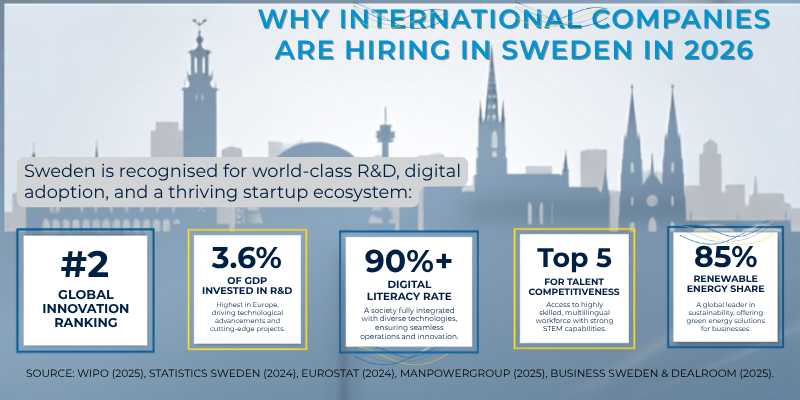
Despite a population of just over 10 million, Sweden consistently ranks among the world's leading economies for innovation, research, and competitiveness.
The country's workforce is highly educated, internationally minded, and increasingly specialised in technical disciplines. At the same time, employers across multiple industries continue to face skills shortages, particularly in engineering, software development, digital technologies, life sciences, and advanced industrial sectors.
As a result, both domestic and international companies are competing for talent.
Several factors are driving hiring activity:
- Continued investment in digital transformation and emerging technologies
- Growth in research-intensive industries
- Expansion of advanced manufacturing and industrial innovation
- Large-scale sustainability and energy transition projects
- Increased demand for highly skilled STEM professionals
- Ongoing international investment into Swedish businesses and startups
For employers, Sweden offers access to talent that can support both local operations and global growth strategies.
The top 5 reasons companies are hiring in Sweden in 2026
1. Access to highly skilled STEM talent
The most common reason companies hire in Sweden is simple: talent.
Sweden has developed one of Europe's strongest pipelines of technical, scientific, and engineering professionals through a combination of high-quality education, strong public investment, and close collaboration between universities and industry.
Leading institutions such as:
- KTH Royal Institute of Technology
- Lund University
- Uppsala University
- Chalmers University of Technology
- Karolinska Institutet
produce graduates and researchers across a wide range of disciplines, including engineering, biotechnology, computer science, telecommunications, data science, and advanced manufacturing.
For international employers, Sweden also offers exceptionally high levels of English proficiency, making it easier to integrate local teams into global organisations.
Whether a company is hiring software developers, process engineers, researchers, project managers, or manufacturing specialists, Sweden provides access to a highly capable workforce with strong international experience.
2. One of the world's most innovative economies
Innovation has become one of Sweden's defining economic strengths.
The country consistently ranks among the world's most innovative nations, supported by strong investment in research and development, a thriving startup ecosystem, and close cooperation between government, academia, and industry.
Sweden has produced globally recognised companies such as:
- Spotify
- Klarna
- Ericsson
- Volvo
- ABB
- SKF
- Saab
These organisations have helped create a culture that values experimentation, entrepreneurship, and continuous improvement.
For employers, this means hiring talent that is comfortable working in fast-changing environments and contributing to innovation-driven businesses.
3. A world-class research and development ecosystem
Companies that rely on innovation rarely look at talent alone. They also evaluate the broader ecosystem that supports research, product development, and commercialisation.
This is where Sweden stands out.
The country invests heavily in research and development and is home to an extensive network of universities, research institutes, innovation centers, and industry partnerships.
Organisations operating in sectors such as:
- Technology
- Telecommunications
- Life sciences
- Biotechnology
- Clean technology
- Industrial automation
- Advanced manufacturing
benefit from access to research expertise, funding opportunities, and collaborative innovation networks.
For businesses building specialised teams, Sweden provides an environment where research and commercial activity work hand in hand.
4. A business environment built for long-term growth
International companies are not just hiring in Sweden because of the workforce. They are also attracted by the country's stable and predictable business environment.
Key advantages include:
- Transparent regulations
- Strong legal protections
- Advanced digital infrastructure
- Reliable public institutions
- High levels of trust in business relationships
These factors make it easier for organisations to plan long-term investments and scale operations with confidence.
Sweden's reputation for stability is particularly attractive to companies establishing regional headquarters, research centers, or specialist teams that require long-term workforce planning.
5. Strategic access to the Nordic region and Europe
Many organisations view Sweden as more than a standalone market.
The country serves as a strategic gateway to the broader Nordic region while also providing access to the wider European market.
For employers considering expansion into Northern Europe, Sweden offers:
- The largest population in the Nordics
- Strong transport and digital infrastructure
- Access to neighboring markets
- A highly international workforce
- Close links between major innovation hubs
This makes Sweden an attractive location for companies looking to establish regional operations while maintaining access to talent across multiple countries.
Why Sweden is an innovation powerhouse
Sweden's ability to attract investment and talent is rooted in a much broader innovation ecosystem.
Rather than relying on a single industry, the country has developed strengths across multiple sectors, creating a diversified and resilient economy.
A culture of innovation and entrepreneurship
Innovation is deeply embedded in Swedish business culture.
Companies are encouraged to experiment, collaborate, and invest in long-term development rather than focusing solely on short-term results.
This mindset has helped create a steady stream of startups, scale-ups, and globally successful businesses.
Many of Sweden's most successful companies have also produced new generations of entrepreneurs and investors, strengthening the country's innovation ecosystem even further.
World-class universities and research institutions
Sweden's research infrastructure is among the strongest in Europe.
Universities and research institutions play a central role in talent development and innovation.
These organisations contribute to advancements across engineering, medicine, biotechnology, artificial intelligence, sustainability, and industrial technology.
Strength across multiple STEM industries
One of Sweden's biggest advantages is the diversity of its innovation economy.
Rather than depending on a single sector, the country has built expertise across multiple high-growth industries.
| Industry | Why companies are hiring |
| Technology & software | Strong startup ecosystem, digital maturity, global scale-ups |
| Telecommunications | Ericsson and decades of communications innovation |
| Artificial intelligence | Growing investment, research capabilities, and talent demand |
| Life sciences | World-class research institutions and pharmaceutical expertise |
| Clean technology | Leadership in sustainability, electrification, and green industry |
| Advanced manufacturing | Strong engineering heritage and industrial innovation |
| Defence & aerospace | Advanced engineering and technology development |
| Energy transition | Investment in renewable energy and industrial decarbonisation |
This diversity gives employers access to talent with a broad range of technical skills and industry experience.
Where hiring demand is growing in Sweden
Technology and software
Sweden remains one of Europe's leading technology hubs.
Demand continues to grow for:
- Software developers
- Cloud specialists
- Cybersecurity professionals
- Product managers
- Data engineers
Both startups and multinational organisations are actively competing for technical talent.
Artificial intelligence and data
AI has become an important growth area across multiple industries.
Organisations are increasingly hiring:
- AI engineers
- Machine learning specialists
- Data scientists
- AI researchers
- Automation experts
However, AI should be viewed as part of Sweden's broader technology ecosystem rather than a standalone growth story.
Life sciences and biotechnology
Sweden's life sciences sector continues to attract investment from pharmaceutical, biotech, medtech, and health technology companies.
Demand remains strong for:
- Researchers
- Clinical specialists
- Regulatory professionals
- Biostatisticians
- Bioinformatics experts
The sector benefits from close collaboration between academia, healthcare providers, and industry.
Advanced manufacturing and engineering
Sweden's industrial heritage remains a major economic strength.
Companies across manufacturing, automation, transportation, and industrial technology continue to recruit:
- Mechanical engineers
- Electrical engineers
- Manufacturing specialists
- Project managers
- Operations professionals
As industrial processes become increasingly digitalised, demand for multidisciplinary talent is also growing.
Clean energy and industrial transformation
Sweden's commitment to sustainability is creating new workforce opportunities across:
- Renewable energy
- Battery technology
- Green hydrogen
- Industrial decarbonisation
- Sustainable infrastructure
These sectors require both traditional engineering expertise and emerging technical skills.
Telecommunications and digital infrastructure
Sweden remains a global leader in telecommunications and connectivity.
Demand continues for professionals specialising in:
- Network engineering
- 5G infrastructure
- Telecommunications software
- Cybersecurity
- Digital infrastructure development
What employers should know before hiring in Sweden
While Sweden offers significant opportunities, employers should also understand the realities of operating in the local labour market.
Employment regulations
Swedish employment law provides strong protections for employees and places clear responsibilities on employers.
Businesses should ensure they understand local employment requirements before hiring.
Collective agreements
Collective agreements play an important role in many industries and can influence:
- Compensation structures
- Benefits
- Working conditions
- Pension arrangements
Understanding how these agreements apply is an important part of workforce planning.
Employment costs
Employers should account for payroll taxes, social contributions, and statutory benefits when calculating total employment costs.
Understanding the full cost of employment helps create more accurate workforce budgets.
Accessing international talent
Organisations recruiting internationally should also consider work permit and immigration requirements.
Proper planning can help avoid delays and support a smoother hiring process.
How an Employer of Record (EOR) can support hiring in Sweden
For many organisations, hiring in Sweden begins long before they are ready to establish a local legal entity. Perhaps they have identified a specialist engineer in Gothenburg, a software developer in Stockholm, or a commercial lead to support Nordic expansion.
The challenge is that employing someone in Sweden means navigating local employment laws, payroll requirements, social contributions, and, in many cases, industry-specific collective agreements.
An Employer of Record (EOR) can help bridge that gap, allowing companies to hire talent in Sweden quickly and compliantly without first setting up a Swedish subsidiary.
In Sweden, this means the EOR takes responsibility for local employment
Why companies use an EOR in Sweden
Sweden is often viewed as a straightforward place to do business, but employment can be more nuanced than many international companies expect.
There is no statutory minimum wage, for example. Instead, salaries and employment conditions are often influenced by collective bargaining agreements (kollektivavtal), which cover a large proportion of the workforce. Employers must also account for social security contributions, statutory leave entitlements, pension obligations, and local payroll requirements.
As a result, many organisations use an EOR when they want to:
- Test the Swedish market before making a long-term investment
- Hire their first employee in the country
- Build an initial team while evaluating entity setup
- Access local expertise without navigating unfamiliar regulations
- Support wider Nordic expansion plans
For fast-growing companies, this can significantly reduce the time between identifying a candidate and bringing them on board.
Common expansion scenarios in Sweden
The way companies enter Sweden is not always through a large office launch or major investment announcement. More often, expansion begins with a small number of strategic hires.
A technology company might hire a senior software engineer in Stockholm to support European product development. A manufacturer may recruit a sales director to strengthen relationships with Nordic customers. A renewable energy business could bring on a project specialist to support opportunities linked to Sweden's growing energy transition sector.
In other cases, organisations use Sweden as a research and innovation base. Access to universities, technical institutes, and specialist talent makes the country attractive for companies establishing research partnerships, pilot projects, or small innovation teams before committing to a larger footprint.
These early-stage expansion strategies are often where an EOR delivers the most value.
Navigating Swedish employment requirements
One of the biggest advantages of using an EOR is access to local expertise.
An experienced provider understands the practical realities of employing people in Sweden, including:
- Employment contracts and notice periods
- Payroll administration and reporting
- Employer social contributions
- Vacation and parental leave requirements
- Collective agreement considerations
- Work permit and immigration support where required
This can be particularly valuable for organisations that only plan to hire a handful of employees initially and do not yet have dedicated HR, legal, or payroll resources in-country.
A flexible route into the Swedish market
For many businesses, an EOR is not a permanent solution but a practical first step.
It allows organisations to establish a presence, build local knowledge, and evaluate long-term opportunities before deciding whether to invest in a Swedish entity.
This approach can be especially useful in a market like Sweden, where the opportunities are significant but where understanding local employment practices is critical to sustainable growth.
Rather than delaying expansion until an entity is established, companies can begin building their team, gaining market insights, and creating momentum from day one.
Contact our Swedish Employer of Record specialists to learn more about how we can support your expansion.