
By
Nathalia Duarte
August 10, 2026
Updated
August 10, 2026
Choosing a career path has never been more complex. As technological, economic, and demographic changes reshape the global labour market, some industries are growing significantly faster than others and creating new opportunities for skilled professionals.
Below, you'll find the top 10 fastest growing industries in 2026, the key factors driving their growth, the most in-demand jobs, and the skills employers are seeking.

Key takeaways
- AI is no longer confined to the technology sector and is creating opportunities across industries, from healthcare and manufacturing to logistics and education.
- The transition to a lower-carbon economy continues to drive investment in clean energy, infrastructure, and sustainability-related roles.
- Digital transformation is increasing demand for technology, data, cybersecurity, and automation skills across almost every industry.
- Ageing populations and workforce shortages are creating long-term opportunities in healthcare, biotechnology, training, and productivity-enhancing technologies.
- Professionals who combine technical expertise with strong communication, adaptability, and problem-solving skills will be best positioned for future opportunities.
What are the trends reshaping industries in 2026?
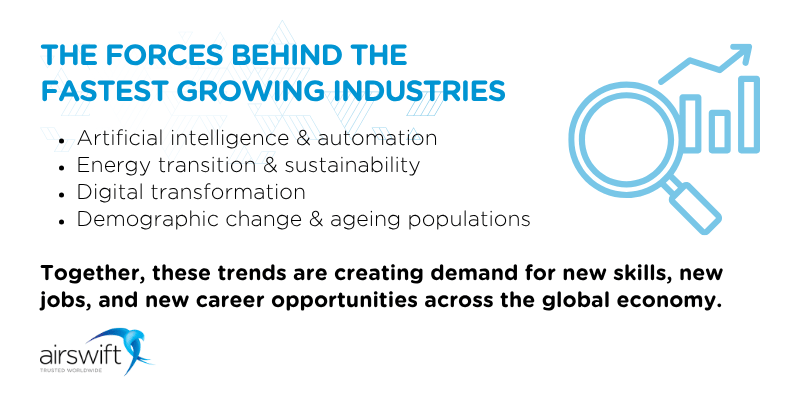
The fastest-growing industries of 2026 may appear very different on the surface, but many are being driven by the same economic, technological, and demographic shifts. Understanding these forces can help professionals anticipate where future opportunities are likely to emerge.
1. Artificial intelligence and automation
Hyperscale companies are expected to deploy nearly $700 billion on artificial intelligence this year. Driven by advances in AI, organisations are transforming, how they operate from customer service and software development to healthcare, manufacturing, and logistics. As adoption accelerates, businesses are investing in AI tools, automation, data infrastructure, and digital skills, creating demand across multiple industries.
Listen to our podcast about AI’s greatest promise and peril with Bane Hunter:
2. The energy transition and sustainability
The Energy Transition Index 2026 highlights a record $2.3 trillion investment in clean energy. Governments and businesses continue to invest in renewable energy, electrification, energy storage, and low-carbon infrastructure to meet climate commitments and strengthen energy security.
While this investment is creating opportunities across engineering, infrastructure, and industrial sectors, the transition also faces challenges, including geopolitical tensions, infrastructure bottlenecks, and rising global energy demand.
3. Digital transformation
Organisations across nearly every sector are adopting digital tools, cloud computing, analytics, and automation to improve efficiency and competitiveness. 60% of employers expect digital access to transform their business by 2030. As a result, demand for technology-driven skills extends far beyond the technology sector itself.
4. Demographic change and ageing populations
The world's population is ageing rapidly. The World Health Organisation projects that the number of people aged 60 and over will grow from 1,1 billion in 2023 to 1,4 billion by 2030. This demographic shift is increasing demand for healthcare, life sciences, and care services, while labour shortages are driving investment in workforce training, automation, and technologies that improve productivity.
What are the top 10 fastest growing industries and jobs in 2026?
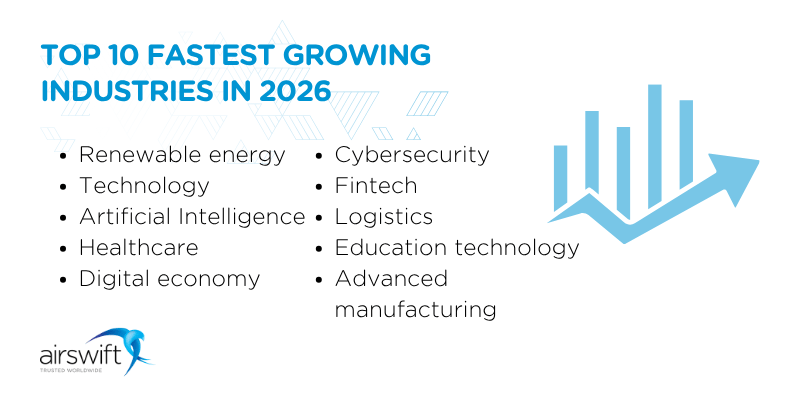
From artificial intelligence and renewable energy to healthcare and cybersecurity, the fastest-growing industries in 2026 are benefiting from strong investment, technological innovation, and changing workforce needs. Below, we explore the sectors creating the greatest career opportunities, along with the jobs and skills employers are seeking most.
Renewable energy, clean tech and sustainability
The transition to lower-carbon energy systems is driving investment in renewable power, battery storage, hydrogen, and sustainable infrastructure projects worldwide. As governments and businesses work towards decarbonisation targets while strengthening energy security, demand for engineers, technicians, and sustainability professionals continues to rise.
In-demand jobs:
- Wind turbine service technicians
- Solar photovoltaic installers
- Environmental engineers
- Renewable energy engineers
- Sustainable project managers
Key skills needed:
- Engineering
- Project management
- HSE
- Risk management
- Regulatory compliance
Technology, software development and digital services
Organisations across every sector are investing in digital transformation to improve efficiency, enhance customer experience, and maintain a competitive advantage. As businesses expand their use of cloud platforms, software solutions, analytics, and automation, demand for technology professionals remains strong.
In-demand jobs:
- Cloud engineers
- Software and applications developers
- Internet of Things (IoT) specialists
- DevOps engineers
- Computer and information research scientists
Key skills needed:
- Cybersecurity and network defense
- Data analytics and business intelligence
- Cloud computing and DevOps
- Software and web development
Artificial Intelligence, machine learning and automation
Artificial intelligence is rapidly moving from experimentation to everyday business use. Organisations are adopting AI and automation technologies to boost productivity, streamline operations, improve decision-making, and develop new products and services, creating demand for professionals who can build, deploy, and manage AI systems.
In-demand jobs:
- AI and machine learning specialists
- Data analysts and scientists
- Prompt engineer
- Machine learning engineer
- AI governance specialist
Key skills needed:
- Prompt engineering
- AI automation
- API integration
- LLM deployment and fine-tuning
- MLOps and LLMOps
Healthcare, biotechnology and pharmaceuticals
Ageing populations, increasing healthcare needs, and advances in biotechnology are creating long-term demand for healthcare and life sciences professionals. At the same time, innovation in areas such as personalised medicine, digital health, and pharmaceutical development is generating new career opportunities.
In-demand jobs:
- Nurse practitioners
- Medical and health service managers
- Physical therapist assistants
- Validation, quality and automation engineers
- Regulatory and compliance specialists
Key skills needed:
- Process validation
- Automation oversight
- Regulatory compliance
- Digital systems
- Strategic commercial planning.
E-commerce, digital economy and digital marketing
Consumer behaviour continues to shift towards digital channels, increasing demand for professionals who can help organisations attract, engage, and retain customers online. Businesses are investing heavily in digital marketing, customer experience, data-driven campaigns, and online sales platforms to support growth.
In-demand jobs:
- UI and UX designers
- SEO specialists
- Performance marketing specialists
- Digital marketing specialists
- Marketplace managers
Key skills needed:
- Data analytics
- Artificial intelligence
- Search algorithms
- Paid ad platforms
- Customer behaviour insights
- Marketing automation
Cybersecurity and data protection
As organisations become increasingly connected and data-driven, the threat of cyberattacks continues to grow. Businesses are investing more in cybersecurity, risk management, and data protection to safeguard critical systems, meet regulatory requirements, and maintain customer trust.
In-demand jobs:
- Security management specialists
- Information security analysts
- Risk management specialists
- Digital forensic examiner
- Cybersecurity architects
Key skills needed:
- Artificial intelligence
- Cloud computing security
- Zero trust implementation
- Digital forensics/incident response
Fintech and digital payments
Financial services are undergoing rapid digital transformation, driven by mobile banking, digital payments, open banking, and financial technology innovation. As consumers and businesses increasingly rely on digital financial services, demand for professionals who can develop, secure, and manage these solutions continues to expand.
In-demand jobs:
- Fintech engineers
- Product managers
- Payment specialists
- Smart contract auditors
- Regulatory compliance professionals
Key skills needed:
- Regulatory frameworks and compliance requirements
- Anti-money laundering and fraud prevention
- Governance, risk and compliance practices
- Ethical finance and customer protection
Logistics and supply chain management
Global supply chains are becoming more complex, technology-driven, and resilient in response to changing consumer expectations and economic uncertainty. Organisations are investing in digital tools, automation, and advanced planning capabilities, increasing demand for logistics and supply chain professionals.
In-demand jobs:
- Supply chain analyst
- Delivery services drivers
- Logistics operations managers
- Supply chain specialists
Key skills in demand:
- Digital systems and automation
- Cross-functional collaboration
- Sustainability
- Compliance
Education technology and professional training
Rapid technological change is creating a growing need for upskilling and reskilling across the workforce. As organisations and individuals seek flexible ways to develop new capabilities, demand for digital learning platforms, training solutions, and education technology professionals continues to increase.
In-demand jobs:
- Instructional designers
- E-learning specialists
- Learning and development specialist
- Learning technology specialists
- LMS administrator
Key skills needed:
- AI literacy and prompting for education
- Digital pedagogy and blended learning design
- Assessment of literacy for digital environments
- Digital classroom management and remote facilitation
Advanced manufacturing, robotics and Industry 4.0
Manufacturers are increasingly adopting automation, robotics, artificial intelligence, and smart factory technologies to improve productivity and address labour shortages. This shift towards digital manufacturing is creating demand for professionals who can design, operate, and maintain advanced production systems.
In-demand jobs:
- Industrial engineers
- Automation specialists
- Maintenance engineers
- Robotics engineers
- Manufacturing engineers
Key skills needed:
- Collaborative robots
- Programmable logic controllers
- Automated production equipment
- Mechanical systems
- Digital systems
Which soft skills do employers still value in 2026?
Technical expertise may help candidates get noticed, but soft skills continue to play a critical role in career success. As workplaces become more digital, automated, and globally connected, employers are increasingly looking for professionals who can adapt to change, collaborate across teams, and solve complex problems.
Some of the most sought-after soft skills in 2026 include:
- Analytical thinking
- Adaptability and resilience
- Communication
- Problem-solving
- Leadership
- Collaboration
- Creativity
- Emotional intelligence
While technical requirements vary between industries, these transferable skills remain valuable across almost every profession.
How to prepare for opportunities in growing industries
As industries evolve, professionals who invest in continuous learning and skills development will be best positioned to take advantage of new opportunities. Whether you're entering the workforce, changing careers, or looking to progress in your current field, building a combination of technical expertise and transferable skills can help you stay competitive.
To prepare for opportunities in growing industries:
- Keep up with emerging technologies and industry trends
- Develop digital and AI literacy
- Pursue relevant certifications and training
- Build transferable skills such as communication and leadership
- Gain practical experience through projects, volunteering, or professional development
- Expand your professional network and stay informed about hiring trends
A proactive approach to learning can help you adapt to changing workforce demands and position yourself for long-term career growth.
FAQs
1. What is the fastest-growing industry in 2026?
Artificial intelligence, renewable energy, healthcare, cybersecurity, and digital services are among the sectors experiencing the strongest investment, innovation, and hiring demand. Many of these industries are benefiting from broader trends such as digital transformation, the energy transition, and demographic change.
2. What is the fastest-growing occupation in the US?
According to the latest projections from the U.S. Bureau of Labor Statistics, wind turbine service technicians and solar photovoltaic installers are among the fastest-growing occupations. Other roles with strong projected growth include nurse practitioners, data scientists, and information security analysts.
3. Is it too late to move into a growing industry?
No. Many of the industries featured in this article are still expanding and continue to face skills shortages. While some roles require specialised qualifications, others can be accessed through certifications, professional training, transferable skills, and relevant work experience.
4. What skills are most valuable across growing industries?
While technical requirements vary between sectors, employers increasingly value digital literacy, data analysis, artificial intelligence, project management, communication, adaptability, and problem-solving skills. These capabilities can help professionals transition between industries and remain competitive in a rapidly changing labour market.
5. How can I prepare for a career in a growing industry?
The best approach is to combine technical expertise with continuous learning. Staying up to date with industry trends, improving digital and AI literacy, gaining practical experience, and developing transferable soft skills can help position you for future opportunities.
Take the next step in your career with Airswift
The fastest growing industries are creating exciting opportunities for skilled professionals around the world. As a specialist STEM workforce solutions provider, Airswift helps connect talent with employers across energy, infrastructure, technology, life sciences, and other high-growth sectors.
Explore our latest vacancies to discover roles that align with your experience and career goals.