
By
Diyaa Mani
January 30, 2026
Updated
June 25, 2026
If you’ve ever sent out dozens of applications and heard nothing back, the culprit could be your resume.
Today’s employers and applicant tracking systems (ATS) evaluate relevance. They want to see how your skills and experience match the job in front of them. A generic resume simply can’t do that.

What job seekers are asking
Before diving into the how-tos, let’s start with the questions you're probably asking:
-
How do I tailor my resume to a specific job description?
-
What keywords should I use to pass ATS filters?
-
How do I show relevant experience when my background is varied?
-
Do I really need to change my resume for every job?
-
What if I don’t have metrics or big wins?
-
Which resume sections matter most when tailoring?
-
How do I avoid keyword stuffing?
Read on for answers to all of these questions with honest, practical strategies.
The truth about tailoring your resume
Here are a few general misunderstandings cleared up:
You don’t need to rewrite your whole resume
Tailoring is about selectively rearranging and modifying existing content so the resume feels custom-built for the job.
A tailored resume performs better
Hiring managers skim your resume for 6-12 seconds. They’re scanning for direct alignment: job titles, tools, keywords, and relevant accomplishments.
The job description is your cheat sheet
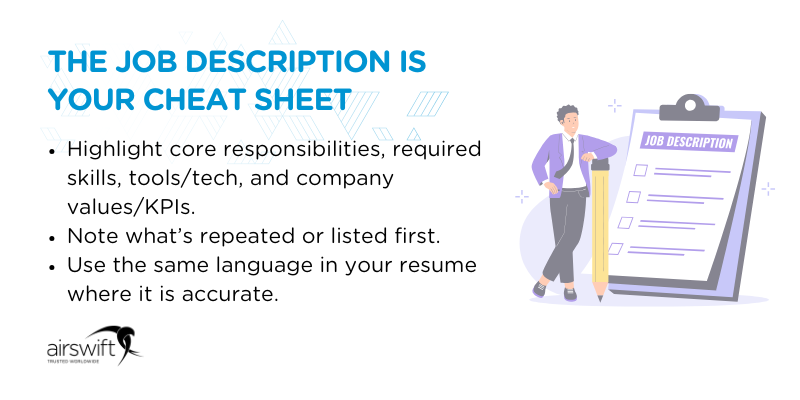
Everything the employer wants is already spelt out. Your job is to reflect that in your resume using honest, accurate language.
Tailoring is strategic, not dishonest
You’re not inventing experience; you’re placing the right experience in the spotlight.
How to tailor your resume to a job description
This is the heart of the process. Use it for every application, especially roles you care about.
Start by analysing the job description
Break the job description into four important categories. A highlighter (digital or physical) works wonders here.
1. Core responsibilities
These tell you what you’ll be doing day to day. Examples:
Manage content calendars, coordinate supplier communication, and design reporting dashboards.
2. Required skills
These highlight the non-negotiables such as: Project management, stakeholder communication, data analysis, and budgeting.
3. Tools and technical skills
These are often the main ATS filters.
Examples: HubSpot, SQL, SAP, Google Analytics, Photoshop, Python.
4. Company values and KPIs
Look for phrases like: detail-oriented, cross-functional collaboration, improving efficiency, meeting deadlines.
Tip: Pay attention to order and repetition
When a skill or responsibility appears multiple times (e.g., client communication, data analysis), it’s a clear signal that it’s a priority for the role.
Also pay attention to ordering. Items listed first -whether in the skills section or responsibilities- are typically the most important to the employer.
Identify and map your strengths and experience to the job description
Start by identifying where your experience clearly matches the job description. For example, if the role emphasises project coordination and you’ve previously managed timelines, deliverables, or cross‑team communication, that’s a direct overlap you should highlight.
Next, look for transferable skills. Even if you haven’t used the exact tools or platforms mentioned, what matters is whether you’ve done work requiring the same underlying capabilities. For instance, if a job asks for a specific design or analytics tool you haven’t used, experience with similar platforms—where you applied comparable skills like visual design, data interpretation, or workflow management—still demonstrates strong relevance.
From there, determine what information is most important by prioritising achievements tied to the role’s top responsibilities, projects involving similar tools or processes, and results aligned with the employer’s KPIs. These are the elements to bring forward in your résumé and application materials.
Rewrite your professional summary
This is the fastest and most powerful tailoring technique.
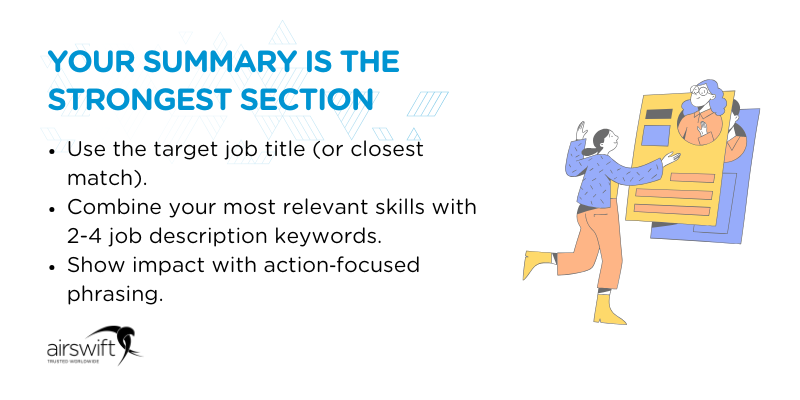
Your summary should:
-
Be two to three sentences, max
-
Mention the job title you’re applying for (or a very close equivalent)
-
Blend your strongest, most relevant skills
-
Use two to four keywords from the job description naturally
-
Hint at your impact with results-oriented language
Generic summary (weak)
Motivated professional with strong communication skills and experience in multiple industries.
Tailored summary (strong)
Content marketing specialist with more than five years of experience managing multi-channel campaigns, optimising SEO performance, and coordinating cross-functional content workflows. Skilled in CMS management, analytics tools, and creating data-driven content that improves engagement and conversions.
The second one matches responsibilities, tools, and KPIs from a typical content marketing job description, making it far more relevant.
Optimise work experience using the CAR method
Most people write bullets based on duties, not results. Tailoring means shifting your bullets to mirror the job needs and show measurable outcomes when possible.
Use CAR: Challenge → Action → Result
Example of untailored bullet point
Responsible for managing social media accounts.
Tailored, CAR-based bullet point
Revamped underperforming social media channels (Challenge) by creating targeted content calendars and keyword-aligned captions (Action), increasing engagement by 45% within three months (Result).
Here’s how you apply the CAR method when matching your resume to a job description or advertisement:
-
Identify which bullets relate to this new job
-
Add metrics where possible
-
Use verbs and keywords found in the job description
-
Cut or minimise irrelevant bullets (e.g., supported office inventory)
Aim for 3 to 5 tailored bullets under your most relevant roles
Highlight the tools and skills the employer mentions
ATS software uses keyword matching, so the skills section isn’t optional; it’s strategic.
How to tailor your skills section
-
Keep exact phrasing where appropriate. If the job description says Google Sheets, don’t write Excel/Sheets. Use both or mirror the job description wording
-
Put the most critical skills first
-
Don’t list skills you can’t speak about in an interview
Where tools should appear
-
In your Skills section
-
In relevant bullet points
-
In your summary, if it’s a top priority
For example, if a job description requires:
-
Salesforce
-
Data analysis
-
Stakeholder management
Then your resume should reflect:
-
Salesforce CRM
-
Data analysis / reporting
-
Cross functional stakeholder coordination
ATS reads these as strong matches.
Add numbers and specific results
If your role wasn’t metrics heavy, you still have results; you just haven’t defined them yet.
Examples of quantifiable improvements:
-
Efficiency: Reduced processing time by 20%
-
Workload: Managed 15+ client accounts concurrently
-
Scale: Coordinated events with 300 attendees
-
Output volume: Produced 25 articles per quarter
-
Speed: Resolved support tickets 2 hours faster on average
-
Quality: Reduced errors by 30%
-
Engagement: Boosted social reach from 10k to 35k
For roles without obvious metrics, use:
-
Before/after scenarios
-
Process improvements
-
Frequency (responded to 50+ inquiries weekly)
-
Comparison (handled double the volume during peak season)
Even qualitative results (e.g., improved team communication workflows) strengthen tailoring.
Style and formatting for tailored resumes
A beautifully tailored resume can still fail if formatting is poor.
Follow these rules:
Keep it skimmable
-
Use clear headings
-
Use bullet points (not paragraphs)
-
Keep margins reasonable
Keep to one page (if early-mid career)
Hiring managers prefer concise resumes. Senior applicants may go to two pages if necessary.
Lead with relevance
Order your resume strategically:
-
Summary
-
Skills
-
Most relevant experience
-
Secondary roles
-
Education
Use ATS-friendly design
Avoid:
-
Heavy graphics
-
Columns that confuse scanners
-
Icons (ATS can’t read them)
Use:
-
Standard fonts
-
Simple layout
-
Clear section labels
What to do next
Think of this section as your action plan; the equivalent of purchasing the solution.
Step 1: Download a job description analysis worksheet
Helps you extract skills, tools, and responsibilities quickly.
Step 2: Use a keyword mapping template
Paste in the job description and list keywords you need to incorporate.
Step 3: Create a base resume you can adapt
Your base version should contain:
-
Full experience
-
A comprehensive skills list
-
A library of bullet points
From this base, you tailor 10–20% each time.
Step 4: Build a reusable bullet point bank
Store variations of your best bullets; quantified, keyword-rich, and role-specific.
This saves hours over the course of a job search.
Handling common objections and concerns
Objection 1: I don’t have relevant experience.
You probably have transferable experience.
Focus on:
-
Communication
-
Team coordination
-
Process improvements
-
Customer interaction
-
Problem solving
-
Operational tasks
-
Project support
Even if the industry differs, the skills often match.
Objection 2: I don’t have numbers or measurable results.
You do, just not the financial ones you’re thinking of.
Use:
-
Volume
-
Speed
-
Consistency
-
Satisfaction
-
Error reduction
-
Output
-
Time saved
-
Scope of work
Every role has something measurable.
Objection 3: I don’t have time to tailor my resume for every job.
You don’t need an hour.
Tailoring only requires adjusting:
-
The summary
-
Three to five bullet points
-
The skills section
Done right, that’s 10 to 15 minutes spent per application.
Objection 4: Won’t this lead to keyword stuffing?
No, if you’re using keywords truthfully and in context.
Keyword stuffing looks like:
Project management project managed manager managed projects…
Tailoring looks like:
Managed cross-departmental projects using (specify system used) workflows.
Use keywords naturally. If it reads smoothly, you’re doing it right.
What this means for your job search
Tailoring your resume isn’t just a nice-to-have; it is what separates candidates who get interviews from those who don’t. When you align your experience with the job description, you’re doing two crucial things: Helping the ATS understand you’re a match and helping the hiring manager see your value instantly
With the steps in this guide, analysing the job description, mapping your strengths, rewriting your summary, optimising bullets, and highlighting skills, you can tailor your resume confidently and efficiently.
Whether you're seeking your next opportunity or exploring a career change, we're here to guide you every step of the way.