
By
Alicia Edwards
July 11, 2025
Updated
July 17, 2025
What does employee leasing entail?
Employee leasing (also called staff leasing) is a form of human resource outsourcing. A client company hires workers through a professional employer organisation (PEO) or staffing firm rather than on its own payroll. You direct their day-to-day tasks. The leasing provider handles payroll, employment taxes, and benefits administration.
How employee leasing works
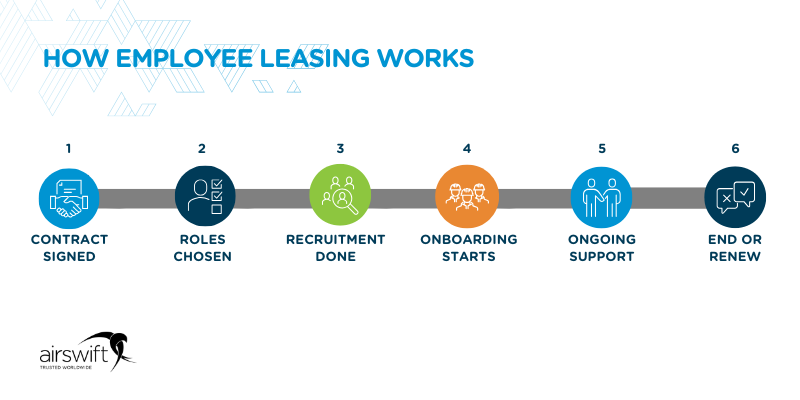
First, your business signs an employment contract with a leasing partner. Next comes the recruitment process: the provider uses its recruiting and onboarding systems and talent database to source staff. Once a temporary employee or full-time hire clears screening, the leasing company onboards them. You get real-time data via a dashboard for workforce management. As staff work onsite, the provider issues payslips, files tax administration, and manages workers’ compensation. Finally, you decide to end, renew, or convert the worker to your direct headcount.
Why choose employee leasing?
Many firms find this simpler than relying on multiple staffing agencies or a temporary staffing model. Here’s what you gain:
- Speed & reach: You tap into a ready staff pool and a wider recruitment process without lengthy ads or agency handoffs.
- HR expertise: The provider supplies full HR administration, from health insurance enrolment to retirement benefits planning.
- Risk mitigation: Liability for compliance—such as regulatory compliance and payroll and tax compliance—shifts to the lease partner.
- Cost clarity: One invoice covers wages, employee benefits, and fees. You avoid surprise charges for National Insurance or other social contributions.
- Scalability: Easily add or cut headcount for a short-term increase in demand.
Common comparisons
Unlike a typical staffing company or staffing agency, a PEO offers co-employment: you share legal responsibility for staff. A plain temporary employment agency fills gaps quickly but may not handle full benefits administration or unemployment insurance. A lease partner blends those services under one cost structure.
Costs and fees
Most leasing firms charge a fixed-rate approach (a mark-up of 10–20%). This covers:
- Wages and employment taxes
- Health insurance and workers’ compensation
- Payroll and tax compliance services
- Benefits administration
Volume discounts or long-term deals can lower fees. Always request a transparent fee schedule before signing.
Legal and compliance notes to consider
In the United Kingdom, providers must follow HMRC rules for auto-enrolment and file Form W-2 equivalents. They also handle unemployment insurance and tax incentives like the Work Opportunity Tax Credit where applicable. Your business remains responsible for site safety and working hours compliance.
In the United States, a PEO must register with each state’s labor department. It holds an Employer Identification Number (EIN) and files W-2 forms for workers. The PEO also manages workers’ compensation insurance and unemployment insurance. It ensures payroll and tax compliance with the IRS. Co-employment rules vary by state, so always verify local regulations before you sign.
Best practices for client companies
- Vet providers: Check industry credentials, ask about ADP TotalSource or other IRS Certified PEO affiliations, and read client reviews.
- Clarify HR duties: Write a scope that covers who does safety, equipment, and performance reviews.
- Protect culture: Treat leased staff as core team members. Include them in meetings and events.
- Align systems: Ensure the partner integrates with your project-management and time-tracking software.
- Review regularly: Meet quarterly to discuss headcount, employment contract changes, and budget forecasts.
Frequently asked questions
What is the difference between a PEO and a staffing firm?
A PEO co-employs your staff and offers full human resources management, including benefits and compliance. A staffing firm may only supply candidates or short-term temps.
Can I hire a leased employee directly?
Yes. Most contracts allow conversion to your payroll after a set period or a buy-out fee.
Do I still need my own HR team?
You still guide day-to-day work, culture, and strategy. The leasing partner covers HR administration tasks.Conclusion
When someone asks, “What is employee leasing?”, you can explain it as a fast, low-risk way to access talent. It combines staff leasing, compliance services, and workforce management under one roof. Used wisely, it helps companies grow lean, move fast, and focus on their core mission.
Want to explore our services? Get in touch to learn more about how we can support your next hire.