
By
Alicia Edwards
August 6, 2025
Updated
August 6, 2025

What is the first mover advantage?
The first mover advantage refers to the benefits that companies experience by being the first to enter a market or industry with a new product or service. By being the pioneer, businesses can establish a dominant position before rivals enter the market. This strategic edge can provide several benefits, such as brand recognition, customer loyalty, and market share.
When asked, “What is the first mover advantage?” the answer is clear: it is the competitive edge gained by being the first to launch a product or service, allowing a company to set the pace for market evolution and create barriers to entry for competitors.
How does the first mover advantage work?
The first mover advantage works by allowing companies to shape market dynamics, establish their brand, and attract early customers. Being the first in the market enables businesses to set the price, control distribution channels, and secure valuable resources.
Benefits of the first mover advantage
The first mover advantage can offer several key benefits for businesses, especially if they can establish a strong brand and customer base early on. Some of the primary advantages include:
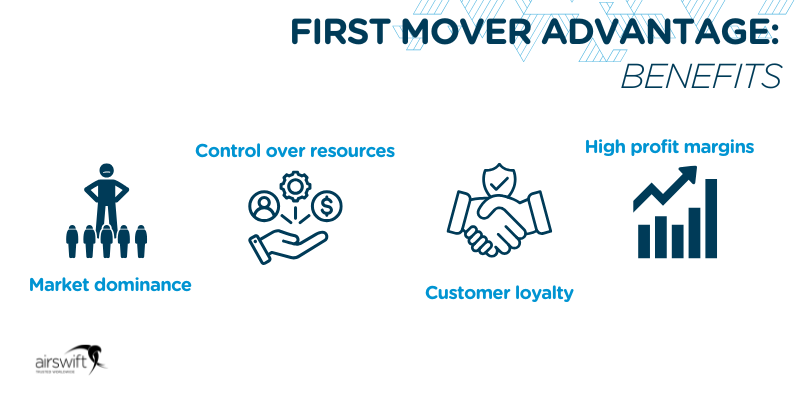
Market dominance
By being the first in the market, companies can establish market dominance and become synonymous with the product or service in the eyes of consumers. Think of Coca-Cola in the beverage industry or Amazon in e-commerce. Their early dominance has helped them maintain strong brand equity even in the face of rising competition.
Customer loyalty and network effects
First movers often enjoy network effects, where the value of a product or service increases as more people use it. For example, LinkedIn gained early traction and built a large user base, which then attracted even more users due to the platform’s growing utility.
High profit margins and premium pricing
Since first movers typically face little to no competition in the early stages, they can charge premium prices for their products or services. This can result in higher profit margins, which can be reinvested in research and development (R&D) to improve products and fend off competitors.
Control over resources
First movers have the advantage of securing critical resources before rivals, such as exclusive distribution channels, manufacturing capabilities, or intellectual property. This provides a significant edge over competitors who will have to compete for limited resources.
Challenges of the first mover advantage
Despite the many benefits, there are also risks associated with being a first mover in the market. These challenges can affect a company’s long-term success and sustainability:
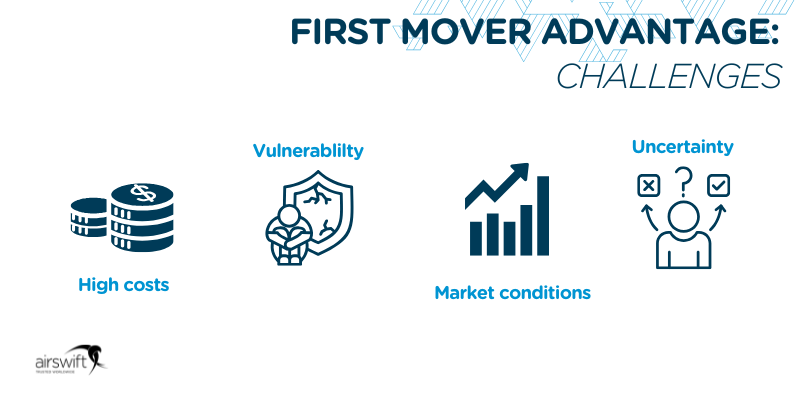
High costs and uncertainty
Being first in the market can require significant investment in R&D, marketing, and education, especially when introducing new products or services. These upfront costs can be risky if consumer demand does not meet expectations or if the product is not well-received.
Vulnerable to imitation
Once a market is established, competitors may enter with better products, more refined strategies, or lower prices. For example, Coca-Cola’s early market share was challenged by Pepsi, who quickly began to compete for customer loyalty. First movers may struggle to maintain their lead against rivals who can leverage lessons learned from their initial success.
Shifting market conditions
Market segmentation and pricing strategies that worked early on may not always be effective as the market matures. Changes in consumer behaviour or the emergence of new technological evolution can challenge the relevance of first mover strategies. Competitors can adapt to these changes more quickly, leveraging improved products or services to gain traction.
Examples of first movers
There are many examples of companies that have successfully used the first mover advantage to establish their dominance in various industries. Some of these include:
-
Amazon: By being one of the first e-commerce platforms to offer a wide range of products online, Amazon established a dominant presence in the market. Over time, Amazon has leveraged its market expansion to offer new products and services, including Amazon Prime and Amazon Web Services.
-
Tesla: Tesla was one of the first companies to develop and market fully electric cars, establishing itself as a leader in the electric vehicle industry. Through technological leadership, innovation, and strong branding, Tesla has maintained its position as a market leader despite competition from traditional car manufacturers.
-
Uber: As one of the first companies to popularise ride-sharing, Uber capitalised on network effects and customer loyalty to dominate the transport industry. By offering a more affordable and convenient option compared to traditional taxis, Uber became the go-to ride-sharing service worldwide.
How to maintain the first mover advantage
Being the first in the market is not enough to guarantee long-term success. To maintain the first mover advantage, companies need to focus on several key factors:
Innovation
Continual research and development and innovation are essential to staying ahead of competitors. First movers should constantly improve their products and services to maintain technological edge and ensure that they meet evolving consumer needs.
Strong marketing strategy
A robust marketing strategy helps reinforce the brand and retain customer loyalty. This is especially important for first movers, as they need to differentiate themselves from new entrants. Brand communications and consumer experience should be consistent and memorable.
Cost efficiency
As the market grows, economies of scale can help first movers maintain their competitive edge. Companies should focus on reducing operational costs and increasing production capacity to stay ahead of new competitors.
Conclusion
The first mover advantage can provide businesses with a significant competitive edge, allowing them to establish market dominance and build strong brand recognition before their rivals enter the space. However, this advantage is not without its challenges, such as high initial costs, the risk of imitation, and shifting market conditions. To maintain the advantage, first movers must focus on continuous innovation, strong marketing, and efficient operations.
By leveraging the first mover advantage, businesses can establish market dominance and stay ahead of the competition. Airswift’s global talent solutions can help your company maintain this edge by providing access to top talent and supporting your growth strategy in emerging markets. Visit our services page to learn more.