
By
Diyaa Mani
February 23, 2026
Updated
February 23, 2026
Why the energy industry needs specialised engineers
Engineers play a central role in designing, building, and safely operating systems across oil and gas, renewables, power grids, and emerging low‑carbon technologies.
As the energy transition accelerates and skills shortages deepen in many regions, companies are competing for engineers who can blend technical expertise with digital fluency and collaborate across disciplines. 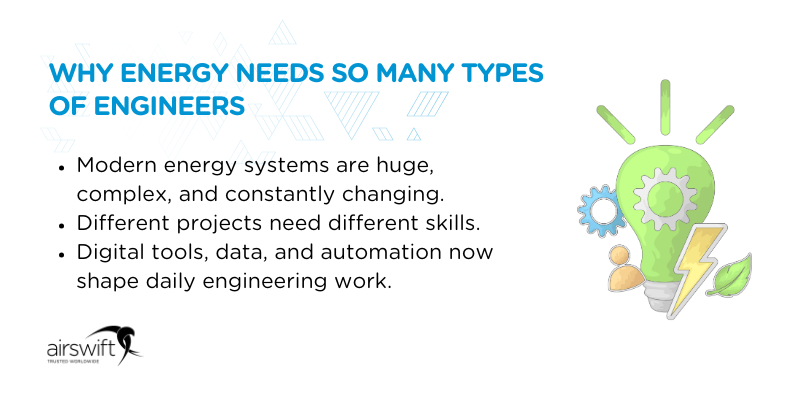
The engineering skills below reflect what energy are seeking today, from traditional upstream roles to offshore wind, hydrogen, and grid modernisation projects.

Power systems and grid engineering
As more renewables connect to the grid, demand for engineers who understand how to plan, protect, and balance complex power networks is rising. Grid operators and developers need specialists who can keep systems stable while integrating large amounts of intermittent energy, such as wind and solar.
Key skills include:
- Power flow and stability analysis for transmission and distribution networks, including knowledge of fault levels, protection coordination, and contingency studies.
- Grid connection studies for renewable plants, battery storage, and industrial loads, using tools such as load flow, short circuit, and dynamic simulations.
- Knowledge of grid codes and interconnection standards, as well as regulatory requirements across different regions, especially in rapidly growing markets.
Renewable energy design and integration
.png?width=800&height=400&name=Why%20energy%20needs%20so%20many%20types%20of%20engineers%20(2).png "Why engineering careers in energy are evolving fast")
Wind, solar, and hybrid projects require engineers who can design cost-effective, finance-ready solutions and then integrate them safely into existing infrastructure. Employers actively seek talent with hands-on experience across feasibility, design, and operations for utility-scale projects.
Essential capabilities:
- System design for PV, onshore/offshore wind, and hybrid plants, including resource assessment, layout optimisation, and selection of inverters, turbines, and balance of plant equipment.
- Performance modelling and energy yield assessment to support investment decisions and long-term offtake agreements.
- Grid integration, curtailment analysis, and understanding of how storage and flexible demand can smooth intermittent generation.
 Process and chemical engineering
Oil and gas, LNG, refining, petrochemicals, and many low-carbon technologies (such as hydrogen, CCUS, and biofuels) all rely on strong process and chemical engineering. These engineers design, optimise, and troubleshoot plants so they run safely, efficiently, and within environmental limits.
Core skills in demand:
- Process design and simulation, including developing flowsheets, performing heat and mass balance calculations, and specifying equipment such as reactors, columns, heat exchangers, and compressors.
- Process safety expertise, including participating in HAZOPs, conducting operability reviews, and applying layers of protection to manage risks.
- Energy, emissions, and yield optimisation, including debottlenecking and executing brownfield modifications to extend the life and performance of existing assets.
Mechanical and rotating equipment engineering
From offshore platforms to onshore plants and wind farms, mechanical and rotating equipment engineers ensure that critical machinery runs reliably, even in harsh or remote environments. Shortages in this skill area can lead to costly downtime and project delays, making these capabilities highly sought after.
Important competencies:
- Selection, design, and lifecycle management of pumps, compressors, gas turbines, steam turbines, and wind turbine drivetrains.
- Reliability engineering, including root cause failure analysis, condition-based maintenance strategies, and the use of sensors to predict failures.
- Knowledge of relevant industry standards and codes for pressure vessels, piping, and rotating equipment used in the energy sector.
Civil, structural, and offshore engineering
Large energy projects demand robust civil and structural design, from foundations and substations onshore to platforms and jackets offshore. With rapid growth in offshore wind, subsea systems, and coastal terminals, specialists in marine and geotechnical engineering are becoming increasingly valuable.
Key focus areas:
- Structural design and analysis for topsides, jackets, monopiles, substations, and support structures under wind, wave, and seismic loads.
- Geotechnical work, including site investigations, soil–structure interaction, and foundation design for both onshore plants and offshore installations.
- Construction engineering, including temporary works, lifting plans, and constructability reviews to reduce risk during execution.
Instrumentation, control and automation
Modern energy facilities rely heavily on automation, advanced control systems, sensors, and industrial networks. Engineers with strong instrumentation and control skills are critical for safe operations, high uptime, and data-rich decision-making.
In-demand skills:
- Design and configuration of DCS, PLC, and SCADA systems, including safety instrumented systems and emergency shutdown logic.
- Specification, calibration, and lifecycle management of field instruments for pressure, flow, temperature, level, and analytical measurements.
- Cybersecure integration of control systems with plant networks and cloud platforms, balancing operational needs with security requirements.
Digital and data engineering
The energy sector is rapidly expanding its use of digital technologies, from predictive maintenance and digital twins to advanced forecasting and optimisation tools. This shift is creating strong demand for engineers who can bridge operations, software, and data.
High value capabilities:
- Data engineering and analytics skills to build pipelines, clean operational data, and generate insights from historians, sensors, and IoT devices.
- Experience with digital twin development, including linking 3D models, asset registers, and live data to support remote operations.
- Coding and scripting (such as Python or similar languages) to automate reporting, build simple tools, and interface with engineering software.
Health, safety, and environmental engineering
Safety and environmental performance are non-negotiable across all energy segments, especially in high-hazard operations and sensitive environments. Engineers who embed robust HSE principles into design and operations help companies manage risk, maintain licences to operate, and protect their reputations.
Key skills and activities:
- Risk assessment and management, including HAZID, HAZOP, SIL determination, and bowtie analysis for major accident hazards.
- Design for safety and environmental compliance, from emissions reduction and flaring minimisation to spill prevention and waste management.
- Familiarity with international and local HSE regulations and the ability to translate them into practical engineering requirements.
Project engineering and execution management
Complex energy projects bring together multiple disciplines, contractors, and international supply chains. Project engineers and managers play a critical role in coordinating all these moving parts to ensure projects are delivered on time and within budget.
Core competencies:
- Frontend engineering design (FEED) coordination, scope definition, and management of technical interfaces between disciplines.
- Cost and schedule control, including development of realistic baselines, progress tracking, and change management.
- Contractor and stakeholder management, with clear communication across owners, EPCs, vendors, and regulators throughout the project lifecycle.
Asset integrity and reliability engineering
Many energy assets are ageing, and extending their safe operating life is a strategic priority. Asset integrity and reliability engineers make data-driven decisions about maintenance, inspection, and refurbishment to maximise uptime and minimise risk.
Critical skills:
- Integrity management planning for pipelines, pressure systems, tanks, and structures, including inspection regimes and fitness for service assessments.
- Reliability-centred maintenance (RCM), failure modes and effects analysis (FMEA), and use of reliability data to prioritise interventions.
- Integration of inspection data, sensor readings, and maintenance records into digital systems to support predictive and condition-based maintenance.
Energy economics and systems thinking
Technical expertise is essential, but today’s engineers also need to understand the commercial, policy, and system‑level factors that shape energy projects. Those who pair strong engineering skills with economic and strategic insight can influence investment decisions and guide long‑term project and portfolio choices.
Valuable capabilities:
- Basic understanding of project economics, including capex/opex tradeoffs, levelised cost of energy, and sensitivity analysis.
- Systems thinking across the full value chain, from upstream production and midstream transport to power markets and end-use sectors.
- Awareness of energy transition policies, carbon pricing, and incentives that affect project viability and technology choices.
Cross-disciplinary collaboration and communication
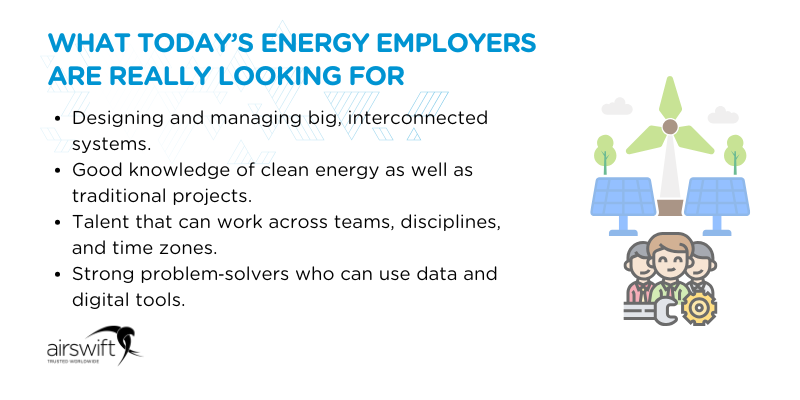
Energy projects rarely sit within a single discipline or company, and many involve teams spread across cultures and time zones. Engineers who can communicate clearly and collaborate across functions are better positioned for leadership roles and international assignments.
Key soft skills:
- Translating complex technical concepts into language that non-engineers, regulators, and community stakeholders can understand.
- Working effectively in cross-functional teams that may include project controls, procurement, HSE, operations, and commercial colleagues.
- Flexibility to work on different project phases and technologies, supporting both traditional and emerging energy segments.
Global mobility and cultural adaptability
The energy sector remains highly international, with major hubs, project sites, and offshore installations spread across multiple continents. Engineers who are open to relocation or rotation and who adapt quickly to new cultures can access a wider range of opportunities.
Important aspects:
- Willingness to take on roles in different regions, including remote sites, offshore assets, and emerging markets.
- Cultural awareness and sensitivity when working with diverse teams, local partners, and host communities.
- Understanding of global workforce trends and how skills shortages in certain regions create demand for mobile engineering talent.
Turning skills into career opportunities with Airswift
With over 40 years of experience in engineering recruitment, Airswift supports both professionals and businesses in finding the right fit across engineering, technology, and the wider STEM space.
If you're an engineer ready for your next step, sign up to our candidate portal to find the latest engineering jobs near you.
For businesses looking to hire qualified engineering talent, connect with our recruitment solutions specialists to learn how we can support your next project.