
By
Alicia Edwards
November 23, 2026
Updated
November 23, 2026
Mobilising a project workforce compliantly means getting the right people legally working in each country, on time.
It breaks down into the same five checks everywhere:
-
The right to work through visas and permits
-
A compliant employment arrangement
-
Correct payroll and tax
-
Local benefits
-
A clean demobilisation plan
Handle all five in every country before people travel and the deployment runs to schedule. Miss one and it stalls, often at the border.

Key takeaways
- Compliant mobilisation rests on five checks in every country: right to work, employment, payroll and tax, benefits, and demobilisation.
- Sort the right to work first; visa and permit timelines, not recruitment, are usually what delay a deployment.
- People must be employed through a compliant local arrangement before they start, not after.
- A demobilisation plan belongs inside the mobilisation plan, so you can scale down without leaving liabilities behind.
- Through in-country teams, an Employer of Record or global mobility partner can run all five checks in each country.
The five-part compliance checklist to use for every country
International workforce mobilisation comes back to the same five core compliance checks. Work through each one for every country in your deployment before committing to start dates.
|
Check |
What it covers |
Why it stalls deployments |
|
Right to work |
Visas, work permits, sponsorship and entry rules |
Permit processing times are long and vary widely by country |
|
Employment |
A compliant local employer and contract |
Workers cannot legally start without one in place |
|
Payroll and tax |
Local payroll, withholding and social security |
The wrong setup creates penalties and back-tax |
|
Benefits |
Mandatory local benefits and insurance |
Missing cover breaches local law and exposes people |
|
Demobilisation |
Notice, final pay, offboarding and records |
Untidy exits create disputes and lingering liabilities |
A step-by-step mobilisation timeline
A clear plan makes international mobilisation much easier to manage. Here’s how the process typically works from start to finish:
- Map the workforce: roles, headcount, locations and start dates.
- Check the right to work in each country and start visa and permit applications early, because these set the critical path.
- Put a compliant employment arrangement in place, either your own entity or an Employer of Record, before anyone starts.
- Set up local payroll, tax withholding and social security correctly from the first pay run.
- Arrange mandatory benefits, insurance and any duty-of-care cover for the location.
- Brief and move people, with travel, accommodation and onboarding aligned to permit dates.
- Run the project, keeping records current as people join, move or leave.
- Demobilise in order: notice, final pay, offboarding and document retention.
Where can deployments go wrong?
Even well-planned deployments can run into problems. Here are some of the most common areas to watch out for:
-
Treating visas as a formality. Work-permit timelines vary widely, from around 5 - 10 working days in the UAE and Singapore to 3 weeks in the UK and several months in Australia, so they can quickly delay start dates.
-
Starting work before employment is in place, which can void compliance from day one.
-
Running everyone on a head-office payroll instead of compliant local payroll.
-
Forgetting mandatory benefits or insurance that the country requires.
-
No exit plan, so demobilisation drags and liabilities linger.
Demobilisation, the part people forget
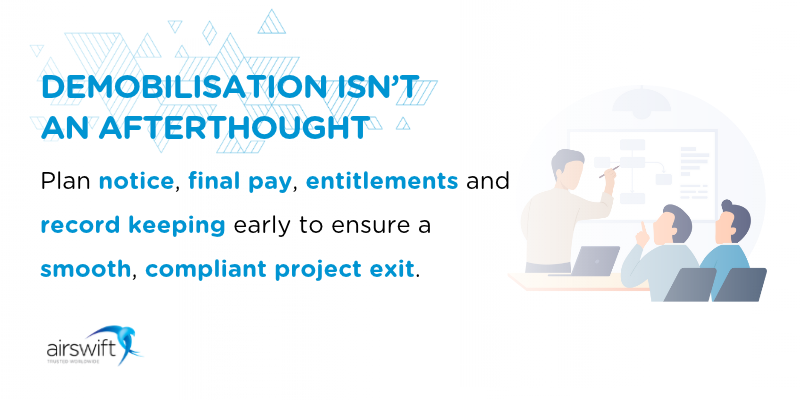
Scaling down is part of mobilising, not an afterthought. Every country has its own rules on notice, final pay, accrued leave and record retention, and getting them wrong at the end can cost as much as getting the start wrong. International labor standards published by the ILO set baseline expectations for fair employment that carry across borders.
Plan the exit when you plan the entry: decide who comes off the project and when, how final payments and statutory entitlements are handled, and how records are kept after people leave. A clean demobilisation protects both the people and the project.
How do country-specific requirements affect the plan?
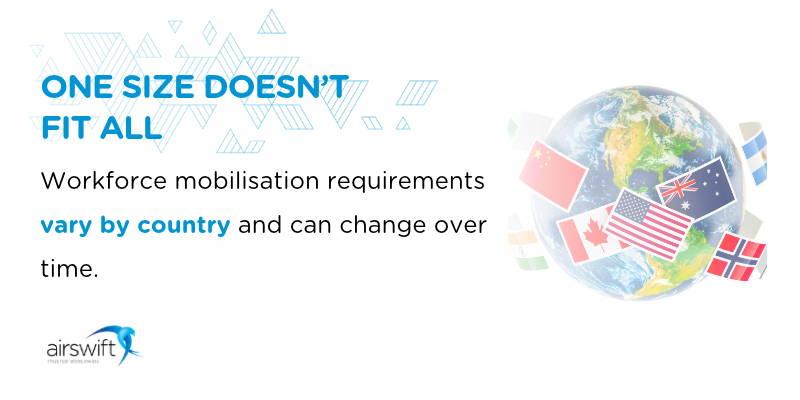
Every country does things a little differently, so it’s important to understand the local requirements before mobilising your workforce.
International workforce mobilisation follows the same five core checks, but the requirements within them vary by country. Visa categories, compliant employment arrangements, payroll and social security requirements, and mandatory benefits can all differ between locations and change over time.
A single checklist applied blindly is risky. For example, official portals such as GOV.UK publish current UK entry requirements that should be checked rather than assumed, ideally through in-country teams who apply them every day.
Frequently asked questions about mobilising a workforce
How do you mobilise a workforce compliantly across multiple countries?
Mobilising a workforce compliantly comes down to five checks in every country: the right to work, a compliant employment arrangement, correct payroll and tax, local benefits, and a clean demobilisation plan. Complete all five before people travel, ideally through in-country teams, so the deployment runs to schedule and scales down without loose ends.
What is the first thing to sort when deploying a team abroad?
The right to work. Visa and work-permit processing times are usually the longest part of a deployment, so start them early. Recruitment and logistics can move faster than immigration, so permits, not people, tend to set the critical path.
Can you employ a project team in a country where you have no entity?
Yes, through an Employer of Record, which acts as the compliant local employer on your behalf and handles payroll, tax and benefits. This lets you deploy people without setting up your own entity, then demobilise cleanly when the project ends.
What is a demobilisation plan?
A demobilisation plan sets out how people come off a project: notice periods, final pay and any statutory entitlements, offboarding, and record retention. Planning it alongside mobilisation prevents disputes and lingering liabilities when the workforce scales down.
Mobilise your international workforce with confidence
Managing workforce mobilisation across multiple countries means coordinating visas and work permits, employment, payroll, tax, benefits and demobilisation. Airswift brings these requirements together through global mobility, Employer of Record (EOR) and integrated workforce solutions, helping organisations move people where they are needed while reducing compliance risk and administrative complexity.
Whether you are mobilising a project team into one new market or coordinating workers across multiple countries, Airswift can help manage the workforce lifecycle from initial deployment through to compliant demobilisation.
Ready to simplify international workforce mobilisation? Contact Airswift to discuss the right solution for your workforce.