By
Alicia Edwards
November 23, 2026
Updated
November 23, 2026
The hardest part of staffing an energy megaproject is not finding talent, it is mobilising and demobilising large, multi-country workforces on schedule and compliantly.
Refinery builds, offshore wind farms and LNG megaprojects each stress a different part of that challenge: scale and trades for refineries, marine conditions and weather windows for offshore wind, and multi-country mobilisation for LNG.
The teardowns below show what each takes, and the pattern they share.

Key takeaways
- Megaprojects are won or lost on workforce logistics, ramp-up, compliance and demobilisation, more than on talent supply.
- A refinery build stresses scale: thousands of trades and engineers across overlapping phases.
- An offshore wind farm stresses marine mobilisation: certification, vessels and weather windows.
- An LNG megaproject stresses multi-country compliance: people, entities and rules across several jurisdictions.
- The shared pattern is one accountable partner that can recruit, employ, mobilise and demobilise across borders.
What makes megaproject workforces uniquely hard?
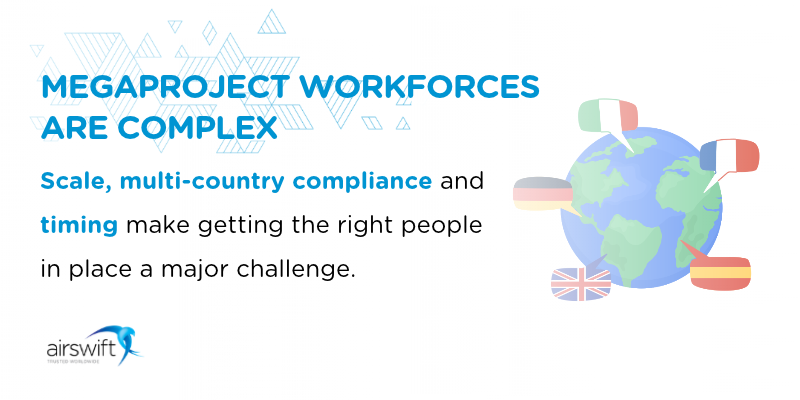
Megaprojects are not just bigger versions of normal projects. They run for years, across multiple countries, with a workforce that ramps from a handful of planners to thousands at peak and back down again.
Three things make that hard: scale, because peak headcount strains any single sourcing channel; multi-country compliance, because people, tax and employment rules differ at every site; and timing, because the schedule depends on people being legally in place exactly when each phase needs them.
Get the workforce logistics wrong and the build slips, whatever the engineering looks like. Industry bodies such as the IEA track the scale of energy investment driving this demand.
Project breakdown A: A multi-country refinery build
A refinery build is a scale problem. At peak it needs thousands of welders, pipefitters, electricians, instrument technicians and commissioning engineers, often more than the local market can supply, drawn from several countries at once.
The workforce challenge is sourcing at volume without dropping quality, employing everyone compliantly across nationalities, and managing rotations and accommodation for a large site crew.
Project breakdown B: An offshore wind farm
Offshore wind shifts the challenge from sheer volume to marine mobilisation. The crews are smaller than a refinery but specialised: turbine technicians, geotechnical and cable specialists, vessel crews and HSE staff, many needing offshore survival and medical certification before they can sail.
Mobilisation has to line up with vessel availability and weather windows, and the question of which country's employment rules apply offshore adds a compliance layer.
Bodies such as the Global Wind Energy Council project rapid offshore growth, which keeps these specialists scarce.
Project breakdown C: An LNG megaproject
LNG concentrates the multi-country problem. A single LNG build can involve engineering in one country, fabrication in another, and construction and commissioning in a third, with people, entities and employment rules spanning all of them at once.
The workforce challenge is less about any one site and more about moving and employing people compliantly across several jurisdictions on one program, then demobilising in order as each scope completes. The common pattern: one partner, fewer vendors, protected schedule
Different as they are, the three share a pattern. Each fails on workforce logistics before it fails on talent, and each runs more smoothly when one partner can recruit, employ, mobilise and demobilise across countries under a single point of accountability, rather than a different vendor per function per country.
|
Project type |
Main workforce stress |
What an integrated partner protects |
|
Refinery build |
Scale and volume sourcing |
Peak ramp-up without compliance gaps |
|
Offshore wind |
Marine mobilisation and certification |
Crews ready for the weather window |
|
LNG megaproject |
Multi-country compliance |
Consistent employment across jurisdictions |
This is the case for an integrated workforce solution on megaprojects: it removes the handoffs between vendors and keeps the schedule, not the paperwork, in control.
Frequently asked questions
What is the best workforce solution for oil and gas megaprojects?
The best fit is a partner that can recruit, employ, mobilise and demobilise large teams across several countries under one point of accountability. Megaprojects fail on workforce logistics more than on talent, so an integrated model that removes handoffs between vendors usually beats a different provider for each function and country.
How do you staff an LNG project across multiple countries?
LNG projects often span engineering, fabrication and construction in different countries at once, so staffing them means employing and moving people compliantly across several jurisdictions on one program. That needs consistent classification, payroll, tax and right-to-work handling per country, and an orderly demobilisation as each scope completes.
Who provides workforce solutions for offshore wind farms?
Offshore wind needs specialised, certified crews mobilised around vessel availability and weather windows, so it suits a workforce partner who can manage offshore certification, medicals and the question of which employment rules apply offshore, alongside sourcing the technicians and engineers themselves.
Why do megaprojects struggle with workforce logistics?
Because they run for years, across multiple countries, with a workforce that ramps to thousands at peak and back down. Sourcing at volume, employing people compliantly at every site, and timing it all to the schedule is genuinely hard, and a single missed permit or compliance step can delay a phase regardless of how the engineering is progressing.
Keep your megaproject workforce moving
Energy megaprojects need more than access to talent. They need thousands of people to be recruited, employed, mobilised and demobilised at the right time, often across multiple countries and compliance environments. Airswift’s integrated workforce solutions bring these services together under one accountable partner, helping reduce vendor handoffs and keep workforce delivery aligned with the project schedule.
Whether you are ramping up a refinery workforce, mobilising specialist offshore wind crews or coordinating an LNG project across multiple jurisdictions, Airswift can support the workforce lifecycle from initial recruitment through to demobilisation.
Ready to simplify workforce delivery on your next megaproject? Talk to Airswift about an integrated workforce solution.