
By
Tomás Battaglia
August 21, 2025
Updated
March 11, 2026
Expanding into new markets is a major milestone for any business, but it comes with a host of operational and legal decisions. One of the first questions companies face is how to hire talent in a country where they don’t yet have a legal presence.
Two common options are using an Employer of Record (EOR) or setting up a local entity. Each approach has its own advantages, challenges and long-term implications.
In this article, we’ll break down what each option involves, compare their pros and cons, and help you decide which path makes the most sense for your business goals.

What is an Employer of Record
An Employer of Record is a third-party organisation that legally employs workers on behalf of another company. This allows businesses to hire talent in countries where they don’t have a registered entity, without taking on the administrative and legal responsibilities of direct employment.
The EOR handles everything from payroll and tax compliance to employment contracts and benefits. Meanwhile, the client company manages the employee's day-to-day work and performance.
This model is especially useful for companies looking to:
- Test new markets without committing to a full legal setup
- Hire remote talent quickly and compliantly
- Support short-term or project-based work in other countries
- Avoid the complexity of navigating foreign labour laws
- By using an EOR, businesses can expand their global footprint with minimal risk and faster timelines.
What does it mean to set up a local entity?
Setting up a local entity involves establishing a formal legal presence in a new country. This could take the form of a subsidiary, branch office or representative office, depending on the business structure and local regulations.
The process typically includes registering with local authorities, opening a bank account, securing tax identification numbers and complying with employment laws. It also requires appointing local directors or representatives and may involve leasing office space or hiring administrative staff.
This approach is often chosen by companies that:
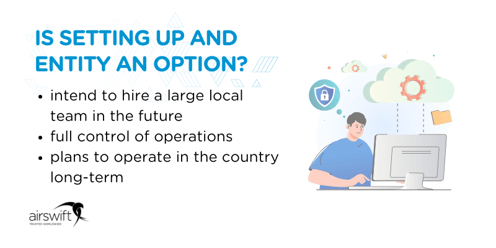
- Plan to operate in the country long-term
- Intend to hire a larger team locally
- Want full control over employment, operations and branding
- Need to build strong relationships with local clients or regulators
Pros and cons of each approach
Choosing between an Employer of Record and setting up a local entity depends on your goals, timeline and resources. Here’s how the two options compare across key areas:
Here’s how the two approaches compare across key areas:
You can get started faster with an EOR
EORs allow you to hire in new markets within days, while setting up a local entity can take weeks or even months due to legal and administrative requirements.
You'll spend less upfront with an EOR
Local entities involve registration fees, legal costs and infrastructure setup. EORs typically charge a monthly fee per employee, which is more predictable and scalable.
You won't have compliance headaches with an EOR
The EOR is responsible for payroll, taxes, and employment law. With a local entity, your team must manage these directly, often with help from local advisors.
You'll have more control with a local entity
A local entity gives you full autonomy over employment terms, branding and operations. EORs offer less flexibility in how contracts and benefits are structured.
You'll be better positioned for long-term growth with a local entity
If you plan to build a permanent presence, a local entity may be more sustainable. EORs are ideal for testing markets or supporting short-term projects.
You can scale quickly with either option, but differently
EORs are great for rapid hiring across multiple countries. Local entities offer deeper integration and stability once your team grows.
.png?width=800&height=400&name=RPO%20models%20Which%20is%20best%20for%20your%20hiring%20strategy%20(3).png)
Choosing the right model: strategy and risks
Selecting between an Employer of Record and setting up a local entity is a strategic decision that depends on your business goals, timeline and appetite for complexity.
If you're entering a new market to test demand or support a short-term project, an EOR offers speed and simplicity. It allows you to hire quickly and stay compliant without navigating local bureaucracy. For companies planning a long-term presence, building a local entity may offer more control and stability.
However, each option comes with its own risks. With an EOR, the legal employer is a third party, which means you may have limited flexibility in how contracts and benefits are structured.
This can affect consistency across teams and may influence how your brand is perceived in certain markets. On the other hand, setting up a local entity involves navigating complex legal and tax systems. Mistakes in registration or compliance can lead to delays, fines or reputational damage.
Budget also plays a role. EORs typically involve predictable monthly costs, while local entities require upfront investment in legal setup, infrastructure and ongoing administration.
Ultimately, the right choice depends on how fast you need to move, how much risk you're willing to take on, and whether your plans for the market are short-term or long-term. Working with experienced partners can help you navigate both models and avoid common challenges.
Navigate global hiring with Airswift
Choosing between an Employer of Record and setting up a local entity is a pivotal decision in global expansion. Each path offers distinct advantages depending on your goals, timeline and resources. An EOR provides speed and compliance for short-term or exploratory moves, while a local entity offers deeper control and long-term stability.
Airswift supports businesses at every stage of international growth, whether you're testing new markets or establishing a permanent presence. With deep expertise in global employment solutions, Airswift can help you navigate both models, mitigate risks and build a compliant, scalable workforce across borders.