
By
Diyaa Mani
July 21, 2026
Updated
July 21, 2026
An oil rig is a structure that drills wells to reach oil and gas beneath the seabed or ground, while an offshore platform is a structure that produces, processes and stores hydrocarbons once the wells are drilled.
Many offshore facilities do both. They range from fixed steel structures in shallow water to floating drillships and FPSO vessels working in depths of several thousand meters.
This guide explains the main types of oil rigs and offshore platforms, how offshore drilling works, and what it is like to work on one, including the roles, rotations and pay involved.

Key takeaways
• An oil rig drills; a platform produces. A rig bores the well, while a production platform or FPSO processes and stores the oil and gas once the well is flowing.
• Type depends on water depth. Fixed platforms suit shallow water up to about 500 m, jack-up rigs work below roughly 120 m, and floating units such as semi-submersibles, spars, drillships and FPSOs operate in thousands of meters.
• Wells link to the surface by risers and flowlines. Subsea wells on the seabed connect through flowlines and risers to the platform, where the oil is processed, stored and offloaded to tankers.
• Offshore work is rotational and well paid. Crews typically work fixed rotations, for example two or three weeks on and the same off, travel by helicopter or boat, and earn above-average wages for the conditions.
• Safety training is mandatory. Offshore workers complete survival and safety training such as BOSIET before they can travel to a rig.
What is the difference between an oil rig and an offshore platform?
The terms are often used interchangeably, but they describe different jobs.
An oil rig, or drilling rig, contains the derrick, drill string and equipment used to bore a well into the rock and reach the reservoir.
An offshore platform is the structure that supports drilling, production, or both, and often houses processing equipment, storage and crew accommodation.
Once a well is brought into production, a production platform or a floating production, storage and offloading vessel (FPSO) takes over the job of separating, treating and storing the oil and gas. Some facilities combine drilling and production in a single structure.
Types of oil rigs and offshore platforms
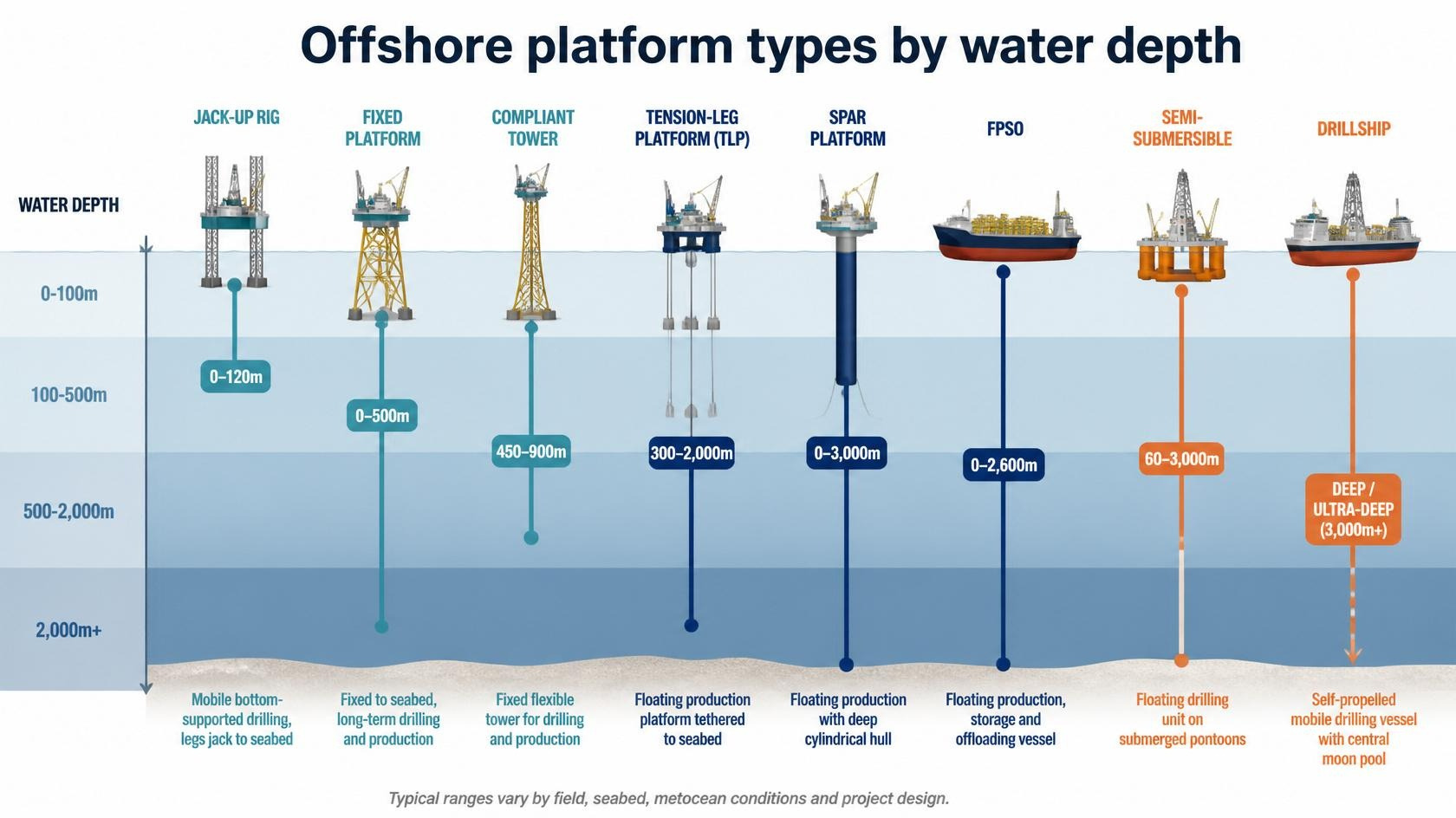
Offshore facilities are chosen mainly by water depth, seabed conditions and whether the unit needs to move between wells. The main types are:
|
Type |
Fixed or floating |
Typical water depth |
Main use |
|
Fixed platform |
Fixed to seabed |
Up to about 500 m |
Long-term drilling and production in shallow water |
|
Jack-up rig |
Mobile, bottom-supported |
Up to about 120 m |
Drilling in shallow water; legs jack down to the seabed |
|
Compliant tower |
Fixed, flexible |
About 450 to 900 m |
Drilling and production on a narrow flexible tower |
|
Semi-submersible |
Floating |
About 60 to 3,000 m |
Deep-water drilling; stable on submerged pontoons |
|
Spar platform |
Floating |
Up to about 3,000 m |
Ultra-deep-water production; deep cylindrical hull |
|
Tension-leg platform |
Floating, tethered |
About 300 to 2,000 m |
Production; tethered to the seabed for stability |
|
Drillship |
Floating, self-propelled |
Deep and ultra-deep |
Mobile drilling through a central moon pool |
|
FPSO |
Floating vessel |
Up to about 2,600 m |
Production, storage and offloading without a pipeline to shore |
How offshore drilling works
Offshore drilling starts with a mobile rig, such as a jack-up, semi-submersible or drillship, boring a well through the seabed to reach the reservoir using a rotating drill string.
Once the well is complete, it is tied back to the surface. Two elements link a subsea well to a floating facility: flowlines carry the oil and gas along the seabed from the wellhead, and risers carry it up to the platform or FPSO.
There, the production stream is separated into oil, gas and water, treated, and either piped to shore or stored on board and offloaded to shuttle tankers.
Safety systems, including blowout preventers on the wellhead, are designed to shut the well in if pressure rises unexpectedly.
Working on an oil rig or offshore platform
Offshore crews cover drilling, production, marine, catering and support functions. Common roles include:
- Roustabout and floor hand (roughneck): entry-level deck and drill-floor labour.
- Derrickhand and driller: operate the drilling equipment.
- Crane operator: handles loads and deck logistics.
- Production and process operators: run the production equipment.
- Engineers and HSE specialists: drilling, subsea, process and safety roles.
- Catering and medic staff: keep the crew fed and safe.
Most offshore work is rotational. Crews fly out by helicopter or travel by boat and live on board for a set period, often two or three weeks, followed by an equal period of leave.
Pay is above average for the skill level because of the demanding, remote conditions. Entry-level offshore roles often pay roughly $50,000 to $70,000 a year, while experienced and specialised workers can earn $80,000 to $120,000 or more, depending on role, region and operator.
*All salary ranges are accurate at the time of writing, subject to varying based on live job-market data.
Demand for offshore crews is global, and many roles are filled on a fly-in fly-out basis through specialist recruiters and dedicated offshore oil rig jobs boards. Workforce research across the offshore and marine sector, including the Global Energy Talent Index (GETI), points to persistent shortages of experienced offshore technical talent.
Safety and training offshore
Offshore work is heavily regulated. Before travelling to a rig, workers must complete survival and safety training, most commonly BOSIET (Basic Offshore Safety Induction and Emergency Training) or a regional equivalent, covering helicopter escape, sea survival, firefighting and first aid.
On board, permit-to-work systems, regular drills and strict personal protective equipment rules govern day-to-day operations.
These standards are a major reason offshore roles require specific certification before a worker can be mobilised.
Frequently asked questions
How much do oil rig workers make?
Pay varies widely by role, experience, region and operator. Entry-level offshore roles such as roustabout or floorhand often pay roughly $50,000 to $70,000 a year, while experienced and specialised workers can earn $80,000 to $120,000 or more. Because offshore work is rotational and demanding, it usually pays above the average for similar onshore roles. Figures should be checked against current job-market data.
What is it like to work on an offshore oil rig?
Offshore work is rotational, with crews living on board for a set period, often two or three weeks, followed by an equal period of leave. Days are long and physically demanding, conditions can be harsh, and safety rules are strict. In return, pay is above average, and many workers value the structured time off. All offshore workers must complete survival and safety training, such as BOSIET before travelling to a rig.
Explore offshore career opportunities with Airswift
Offshore oil and gas operations combine complex engineering, advanced technology and a highly skilled workforce to safely extract energy resources from beneath the seabed. From fixed platforms in shallow waters to floating systems operating thousands of meters deep, each facility is designed to match the environment and purpose, whether drilling, production or both.
Alongside the technical challenge, offshore careers offer structured rotations, competitive pay and global opportunities, making them an attractive path for those with the right skills and training.
If you are considering a career offshore or looking to take the next step, Airswift connects energy professionals with leading projects worldwide. Explore the latest offshore and marine job opportunities by signing up to our candidate portal.