
By
Nathalia Duarte
February 4, 2026
Updated
February 4, 2026
The energy industry is facing significant challenges amid a tough economic climate and AI adoption. These shifts are reshaping workforce mobility, career development, and investment across renewable, transitional, and traditional energy sectors.
The tenth annual Global Energy Talent Index (GETI) Report, the industry’s most comprehensive analysis of energy workforce trends, explores how professionals and employers are adapting, with a strong focus on evolving career pathways and workforce strategies.

Key insights
- Only around half of energy professionals have a Personal Development Plan (PDP), reinforcing the persistent gap between career expectations and employer-provided development support.
- AI adoption has nearly doubled across multiple sectors, reshaping job roles, skill pathways, and entry-level opportunities.
- Global mobility continues to decline, with several sectors reaching record lows in willingness to relocate. This is occurring at the same time organisations need experienced talent more than ever.
- Engineering and technical roles remain the hardest to fill, compounding hiring challenges as ageing demographics intensify.
Salaries and an ageing workforce
Across all energy sectors, GETI 2026 highlights that salary optimism remains resilient despite economic and market pressures, though growth is clearly moderating and workforce challenges persist.
Salary optimism remains high in traditional energy, however pay growth flatlines

Despite slower demand growth and market oversupply, oil and gas professionals remain cautiously optimistic about pay.
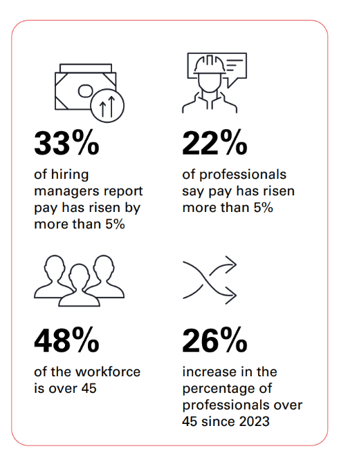
In 2025, 50% reported receiving a salary increase, although the share seeing raises above 5% has fallen for the second consecutive year, signaling a slowdown in wage growth. While 67% still expect a pay rise next year, this is down from 71% in 2025, reinforcing signs of moderation.
At the same time, the workforce continues to age. Professionals over 45 now make up 48% of the workforce, while those aged 25 to 34 account for just 19%, highlighting ongoing challenges around talent renewal and succession.
As the demand for skilled professionals rises, wages are expected to continue to grow, creating more opportunities in the renewable sector. Seventy-three per cent of professionals expect salary increases in the next year, signalling continued wage growth.
Nuclear and power industry workers are optimistic amid global instability
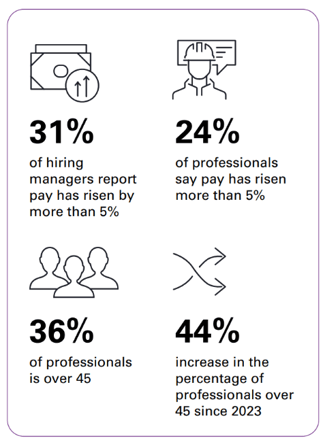
Despite global instability, transitional energy professionals remain optimistic about pay. This year, 53% reported a salary increase, broadly in line with 2025, with 24% receiving raises above 5%.
Salary confidence remains strong as competition for talent edges up. 73% of professionals expect a pay rise next year, and 35% anticipate increases above 5%.
The sector continues to see its average age increase, with the percentage of professionals aged under 35 falling year-on-year from 37% in 2025 to 34% this year.
Renewable energy talent shows resilience amid economic uncertainty
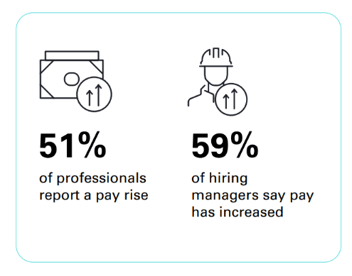
Despite subdued global economic growth in the renewable energy sector, salary trends remain positive. Over 51% of professionals reported a pay rise this year, up from 48% in 2025, with 20% receiving increases above 5%.
Looking ahead, 72% expect another raise, although hiring managers are becoming more cautious as organisations rebalance investment across people, projects, and digital technologies.
Global mobility: a shrinking talent pool across all energy sectors
Global mobility continues to decline across the energy workforce, reaching record lows in several sectors just as demand for experienced talent intensifies. Professionals are increasingly prioritising stability and local opportunities, tightening the global talent pool and compounding existing skills shortages.
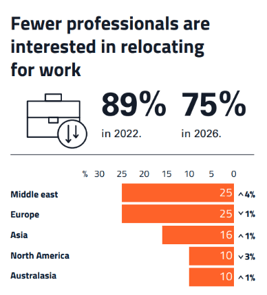
While the trend is consistent across all energy sectors, its impact varies by sector. Traditional energy is seeing a long‑term contraction in mobility alongside an ageing workforce.
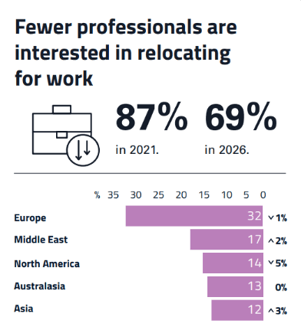
Transitional energy now reports the lowest willingness to relocate on record, intensifying competition for scarce engineering and technical skills.
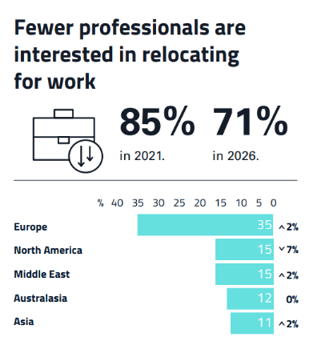
In the future of energy, mobility continues to fall despite record investment, signalling a shift toward localised talent strategies rather than global deployment.
AI and career development: adoption is accelerating, pathways are not
This year’s GETI report highlights that AI adoption has accelerated rapidly across the energy sector, reshaping how professionals develop skills and progress their careers.
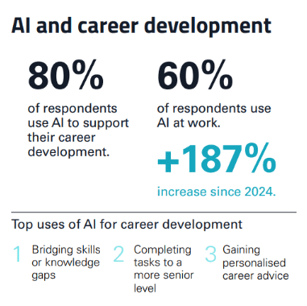
Usage has surged in traditional (45%), transitional (54%), and renewable energy (60%), enabling faster learning, more senior‑level task completion, and skills improvement. However, adoption remains uneven, and career development structures have not kept pace.

In traditional and transitional energy, AI uptake has risen sharply, both up from over 180% since 2024. Yet, engineering and technical roles remain the hardest to fill, underscoring that AI is augmenting, not replacing, core expertise.
Employers are responding with increased investment in automation, training, and learning and development, but skills shortages persist.
In the future of energy, AI adoption is highest, with most professionals actively using it to accelerate progression, even as structured career planning remains limited.
Across all sectors, only around half of professionals have a formal career development plan, despite strong demand for industry training, higher education, and clear progression pathways by the workforce.
The data points to a clear challenge: AI is advancing faster than career infrastructure, making it critical for organisations to pair technology adoption with more consistent, future‑ready development frameworks.
Among all sectors, professionals think organisations should handle the challenges posed by the changing global energy landscape by:
• Improving learning and development programmes
• Deploying technologies such as AI and automation
• Providing mentorship opportunities
Adapting to a changing energy workforce: key takeaways from GETI 2026
Salary growth, AI adoption, career growth and job satisfaction are reshaping the energy workforce. While pay increases remain important, professionals are focusing more on career development, flexibility, and purpose-driven work.
With fewer people willing to relocate and competition for talent increasing, employers must offer clear career paths, strong retention strategies, and a supportive work environment.
For the full insights and data, download the GETI 2026 report.