
By
Leanna Seah
September 1, 2026
Updated
October 27, 2026
How much do oil rig workers make in 2026?
The oil and gas industry consistently provides some of the most competitive salaries worldwide. Although wages may vary due to factors such as experience, location, and specific roles, the overall prospects remain highly competitive.
Read our article to learn more about oil rig jobs, salary trends, and the top-earning oil rig occupations.
And if you are looking for an oil and gas job, you can find plenty on our candidate portal.

Key takeaways
- 50% of traditional energy professionals received a pay increase in 2025, and 67% expect another increase in the coming year.
- Drilling Supervisors are the highest-paid oil and gas professionals in GETI 2026, earning up to $303,000 annually in Australasia.
- Australasia records the highest regional oil and gas salary benchmarks across multiple disciplines.
- Top contractor day rates exceed $1,500 per day for specialised oil and gas roles.
- Specialised skills, leadership experience, and project expertise remain the biggest drivers of long-term salary growth.
What are the oil rig jobs salary trends in 2026?

Fifty per cent of rig workers report a salary increase, with 22% seeing rises above 5%. Five per cent experienced a pay decrease, including 3% with reductions of over 5%.
Among hiring managers, 60% say salaries have increased, and 33% report rises above 5% (down one point from 2025). Nine per cent have seen salaries fall, including 6% by more than 5%.
Salary expectations remain upbeat. Sixty-seven per cent of oil field workers expect a rise next year (down from 71%), with 36% forecasting increases over 5% (down from 42%). Hiring managers are slightly less positive, with 68% anticipating pay growth compared to 72% last year; 39% expect rises above 5%, and only 7% foresee declines.
What are the main jobs on an oil rig?
An oil rig crew is not the same thing as the oil and gas workforce. The tables further down cover every discipline in the sector, office-based roles included. These are the jobs done on the rig itself, roughly in order of seniority on the drill floor:
Roustabout: General labor and maintenance, the usual entry point offshore. No degree required, but an offshore survival and safety certification is.
Roughneck: Works the drill floor, handling pipe and drilling equipment. The first step up from roustabout.
Derrickhand: Works at height on the derrick and looks after the mud pumps and the pit room.
Assistant driller: Supports the driller and stands in during rotation handovers.
Driller: Operates the drilling equipment and runs the drill floor crew shift by shift.
Toolpusher: Senior supervisor for all drilling operations on the rig, and the driller’s line manager.
Drilling supervisor: Accountable for the whole drilling program, usually representing the operator rather than the drilling contractor. The highest paid role in the GETI 2026 data.
Mud engineer: Designs and monitors the drilling fluid, which controls well pressure and cuttings removal.
Crane operator: Moves loads between supply vessels and the deck, one of the highest risk jobs on the platform.
Offshore medic: Sole clinical cover for the whole crew, usually with an emergency care or paramedic background.
Offshore installation manager: Overall command of the installation, with legal accountability for safety.
What is the average oil rig worker salary?
Working on an oil rig offers competitive salary structures across a variety of roles, providing excellent earning potential even for those just starting out. As specialised skills and leadership skills develop over time, industry professionals can see significant increases in their pay, with some salaries starting in the six-figure range.
Whether you're entering the field with no prior experience or bringing specialised qualifications such as offshore certifications, the oil and gas industry offers rewarding financial opportunities across all levels; from entry-level oil rig occupations to mid-level positions and beyond.
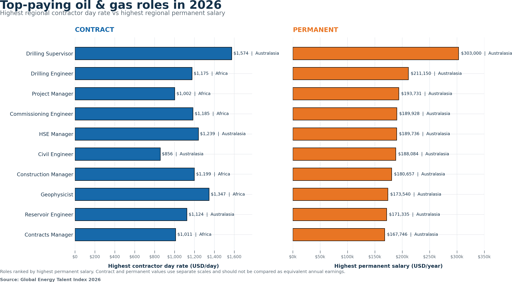
The highest contractor rate in GETI 2026 is a drilling supervisor in Australasia at $1,574 a day, ahead of a geophysicist in Africa at $1,347. Australasia records the highest regional benchmarks in GETI 2026 on both bases, with an average permanent salary of $159,913 against $52,765 in Latin America.
Across oil and gas as a whole, 50% of professionals received a pay increase in the year to GETI 2026, and 67% expect another in the year ahead. Experienced professionals such as drilling supervisors or project managers can earn more than $300,000 annually.
Entry-level maintenance roustabout offshore oil rig jobs typically earn between $45,000 and $60,000 per year, depending on location, employer, and working conditions, with opportunities for training and career advancement.
The following tables from the GETI 2026 report highlight regional variations in day rates and annual salaries for oil and gas professionals, offering insights into global compensation trends across key roles in the industry:
Day rates in the table below run from $150 for an administrator in Asia to $1,574 for a drilling supervisor in Australasia. Regional averages sit between $377 in Latin America and $916 in Africa.
| Oil & Gas - Contractor day rates by region (USD) | |||||||
|---|---|---|---|---|---|---|---|
| Job Title | Africa | Asia | Australasia | Europe | Latin America | Middle East | North America |
| Averages | 916 | 626 | 896 | 808 | 377 | 647 | 776 |
| Accountant | 488 | 310 | 472 | 450 | 171 | 422 | 400 |
| Administrator | 204 | 150 | 407 | 200 | 170 | 214 | 280 |
| Chemical Engineer | 677 | 509 | 949 | 700 | 224 | 608 | 631 |
| Civil Engineer | 646 | 529 | 856 | 650 | 211 | 557 | 801 |
| Commissioning Engineer | 1185 | 633 | 1118 | 1139 | 403 | 579 | 987 |
| Construction Engineer | 931 | 563 | 848 | 824 | 278 | 621 | 803 |
| Construction Manager | 1199 | 979 | 955 | 1033 | 492 | 681 | 850 |
| Contracts Manager | 1011 | 702 | 990 | 796 | 426 | 707 | 680 |
| Drilling Engineer | 1175 | 900 | 1156 | 1029 | 569 | 822 | 818 |
| Drilling Supervisor | 1376 | 1250 | 1574 | 1317 | 671 | 1098 | 1258 |
| Electrical Engineer | 894 | 613 | 721 | 860 | 442 | 580 | 900 |
| Finance Manager | 773 | 558 | 758 | 750 | 423 | 650 | 720 |
| Geophysicist | 1347 | 759 | 1132 | 850 | 393 | 785 | 869 |
| HSE Manager | 992 | 540 | 1239 | 800 | 376 | 677 | 800 |
| Inspection Engineer | 1027 | 519 | 742 | 700 | 447 | 549 | 1019 |
| Instrumentation Engineer | 957 | 610 | 794 | 697 | 413 | 610 | 900 |
| Maintenance Engineer | 847 | 628 | 763 | 716 | 333 | 569 | 646 |
| Mechanical Engineer | 915 | 529 | 660 | 800 | 309 | 605 | 800 |
| Process Engineer | 948 | 631 | 787 | 879 | 326 | 629 | 828 |
| Production Engineer | 865 | 485 | 985 | 894 | 383 | 700 | 573 |
| Project Engineer | 867 | 691 | 831 | 823 | 460 | 615 | 666 |
| Project Manager | 1002 | 924 | 863 | 880 | 439 | 883 | 719 |
| QA/QC Inspector | 665 | 510 | 891 | 806 | 322 | 598 | 700 |
| Reservoir Engineer | 985 | 649 | 1124 | 864 | 458 | 872 | 967 |
| Welding Engineer | 914 | 480 | 790 | 749 | 298 | 544 | 775 |
Table 1: Oil and gas contractor day rates by region, in USD, Global Energy Talent Index 2026
Permanent salaries below run from $33,441 for an administrator in Europe to $303,000 for a drilling supervisor in Australasia. Regional averages sit between $52,765 in Latin America and $159,913 in Australasia.
| Oil & Gas - Permanent salaries by region (USD) | |||||||
|---|---|---|---|---|---|---|---|
| Job Title | Africa | Asia | Australasia | Europe | Latin America | Middle East | North America |
| Averages | 88,079 | 80,623 | 159,913 | 88,668 | 52,765 | 85,080 | 100,757 |
| Accountant | 54,684 | 49,717 | 104,246 | 65,430 | 37,568 | 49,122 | 54,493 |
| Administrator | 34,366 | 33,803 | 75,740 | 33,441 | 37,105 | 33,979 | 41,646 |
| Chemical Engineer | 89,775 | 65,065 | 164,430 | 74,874 | 45,360 | 75,333 | 69,000 |
| Civil Engineer | 74,126 | 73,164 | 188,084 | 70,384 | 45,234 | 68,960 | 100,379 |
| Commissioning Engineer | 101,397 | 87,848 | 189,928 | 90,245 | 52,920 | 84,874 | 137,443 |
| Construction Engineer | 110,265 | 91,836 | 142,481 | 96,994 | 49,443 | 70,831 | 105,510 |
| Construction Manager | 107,673 | 112,637 | 180,657 | 95,655 | 81,497 | 112,728 | 100,012 |
| Contracts Manager | 67,226 | 64,738 | 167,746 | 82,483 | 68,040 | 119,202 | 65,059 |
| Drilling Engineer | 98,949 | 120,000 | 211,150 | 109,274 | 52,920 | 113,261 | 116,325 |
| Drilling Supervisor | 123,500 | 125,000 | 303,000 | 144,154 | 67,516 | 145,957 | 174,002 |
| Electrical Engineer | 82,256 | 84,931 | 131,435 | 87,505 | 44,905 | 64,658 | 113,494 |
| Finance Manager | 71,918 | 73,917 | 149,535 | 87,385 | 71,442 | 97,779 | 98,158 |
| Geophysicist | 100,105 | 105,227 | 173,540 | 102,061 | 79,713 | 123,610 | 129,124 |
| HSE Manager | 82,578 | 75,697 | 189,736 | 89,299 | 60,093 | 99,508 | 101,021 |
| Inspection Engineer | 96,235 | 68,753 | 137,982 | 74,861 | 45,360 | 66,851 | 129,602 |
| Instrumentation Engineer | 119,933 | 77,000 | 129,523 | 88,673 | 47,560 | 67,330 | 124,602 |
| Maintenance Engineer | 95,294 | 70,487 | 132,063 | 89,477 | 45,248 | 71,434 | 87,086 |
| Mechanical Engineer | 78,271 | 67,918 | 139,636 | 80,584 | 43,291 | 67,559 | 96,830 |
| Process Engineer | 99,349 | 76,641 | 142,668 | 91,980 | 44,993 | 82,519 | 106,338 |
| Production Engineer | 89,570 | 66,479 | 155,726 | 92,273 | 45,324 | 88,209 | 94,820 |
| Project Engineer | 86,065 | 86,284 | 143,094 | 98,065 | 45,299 | 90,536 | 91,422 |
| Project Manager | 90,734 | 106,076 | 193,731 | 97,240 | 57,960 | 119,110 | 89,539 |
| QA/QC Inspector | 77,235 | 66,000 | 157,862 | 74,642 | 44,987 | 53,523 | 80,909 |
| Reservoir Engineer | 98,782 | 111,751 | 171,335 | 110,570 | 57,456 | 122,247 | 137,069 |
| Welding Engineer | 71,694 | 54,594 | 122,496 | 89,159 | 47,880 | 37,886 | 75,046 |
Table 2: Oil and gas permanent salaries by region, in USD, Global Energy Talent Index 2026
Where are oil rig salaries the highest?
Highly experienced oil and gas professionals command lucrative salaries. Here are the highest-earning oil platform jobs according to GETI:
Top 5 highest-earning salaries for permanent workers
| Position | Region | Annual Salary (USD) |
| Drilling Supervisor | Australasia | $303,000 |
| Drilling Engineer | Australasia | $211,150 |
| Project Manager | Australasia | $193,731 |
| Commissioning Engineer | Australasia | $189,928 |
| HSE Manager | Australasia | $189,736 |
Table 3: Highest earning permanent oil and gas salaries by role and region, in USD, Global Energy Talent Index 2026
Top 5 highest-earning rates for contractors
| Position | Region | Day Rate (USD) |
| Drilling Supervisor | Australasia | $1,574 |
| Geophysicist | Africa | $1,347 |
| HSE Manager | Australasia | $1,239 |
| Construction Manager | Africa | $1,199 |
| Commissioning Engineer | Africa | $1,185 |
Table 4: Highest contractor day rates by role and region, in USD, Global Energy Talent Index 2026
What is the average oil rig starting salary?
Entry to the rig floor normally starts as a roustabout or roughneck. The requirement at that level is fitness, offshore survival and safety certification, and a willingness to work rotation, rather than a degree. Pay varies widely by region, operator and rotation pattern, so treat any single global figure with caution.
The engineering entry points in the GETI 2026 data below, such as welding engineer and QA/QC inspector, start higher because they require a qualification before day one, offering a solid salary and plenty of room for career growth.
Over time, Welding Engineers can move into senior technical roles, including Maintenance Supervisors or Engineering Managers, which come with higher responsibilities and pay scales.
Meanwhile, a QA/QC Inspector is essential to the smooth operation of the rig and offers a clear pathway toward leadership positions in health and safety, quality control management, or even operational oversight.
With experience and further training, these entry-level roles can evolve into highly specialised positions, such as Drilling Supervisors or Project Managers, where salaries can easily surpass six figures.
Many oil companies also offer extensive training programs, allowing workers to specialise in areas like subsea engineering or environmental compliance, further expanding career opportunities.
See below for figures on what an Oil Rig Welding Engineer's salary can look like according to region:
- Africa: Up to $71,694 annually
- Asia: Up to $54,594 annually
- Australasia: Up to $122,496 annually
- Europe: Up to $89,159 annually
- Latin America: Up to $47,880 annually
- Middle East; Up to $37,886 annually
- North America: Up to $75,046 annually
For QA/QC Inspectors, salaries range from $44,000 to $80,900 depending on location and experience.
Offshore oil rig salary expectations in 2026
Often, offshore oil rig jobs pay higher than land-based roles due to the hazardous nature of the work.
Offshore oil rig workers typically earn higher wages to compensate for the physically demanding tasks, long shifts, and extended periods away from home.
These roles often involve working in harsh weather conditions, managing complex machinery, and adhering to strict safety protocols, all of which require specialised training and resilience.
High offshore oil rig salary expectations reflect not only the risks involved but also the technical skills and certifications that offshore workers require to perform the job safely and efficiently.
You may also have opportunities to travel globally, working where production demand is highest. Airswift supports international travel logistics and relocation services to help you take advantage of these opportunities in offshore roles.
How offshore pay actually works
Offshore pay is structured differently from an onshore salary, and the headline figure can mean several different things.
Rotation: Offshore work runs on rotation, commonly 14 days on and 14 off, or 28 and 28 on longer haul assignments. A rotation year contains roughly half the working days of an onshore year, which is part of why day rates look high next to annual salaries.
Day rate against salary: Contractors are paid a day rate for days worked. Permanent staff are paid an annual salary that already accounts for time off rotation. Comparing the two without adjusting for days actually worked overstates the contractor figure.
Time off rotation: Whether days off rotation are paid depends on the contract, not on the role. It is the first thing to check when comparing two offers.
Allowances: Offshore assignments usually carry additions to base pay, which can include an offshore or hardship allowance, travel to the heliport or port, and accommodation in transit.
Tax and residency: Working overseas on rotation does not automatically remove a tax liability at home, and the treatment depends on the residency rules in both countries. Anyone taking a first international rotation should get advice specific to their situation before assuming a net figure.
Airswift: Your path to lucrative oil and gas careers
Airswift is a global leader in recruiting for the energy sector, offering exceptional opportunities for professionals at all stages of their oil and gas careers. Whether you're just starting or aiming to boost your salary, we can connect you with roles that match your skills and goals.
We’re dedicated to helping job seekers climb the oil rig salary ladder. With our global network and strong partnerships with major companies, we provide access to unique opportunities to advance your career in this fast-paced environment.
From preparing you for the job application process to ensuring you're positioned to attract top employers, we support your growth every step of the way.
Ready to take the next step? Upload your CV or visit our job portal to explore new job opportunities in oil rig opportunities and elevate your career today.