
By
Nathalia Duarte
August 11, 2026
Updated
August 11, 2026
Most people think recruiters are only responsible for finding and hiring talent. In reality, their responsibilities vary depending on whether they work for a recruitment agency or an in-house team, and their role is often far more strategic than many realise.
In this guide, you'll learn what recruiters do (and don't do), the different types of recruiters, how the recruitment lifecycle works, and the value specialist recruiters bring to the hiring process.

Key takeaways
- Recruiters help employers attract, assess and hire the right talent. They also provide workforce planning support and valuable market insights.
- Recruiters do not charge candidates for their services. Any recruiter or agency requesting payment from a job seeker should be treated with caution.
- In staffing agency recruitment, the employer pays the recruitment fee.
- Recruiter responsibilities vary by hiring model, including agency recruitment, in-house recruitment, RPO and MSP solutions, and executive search.
- Specialised technical recruiters bring industry expertise, market intelligence and access to niche talent networks that generalist recruiters often cannot reach.
What does a recruiter do?
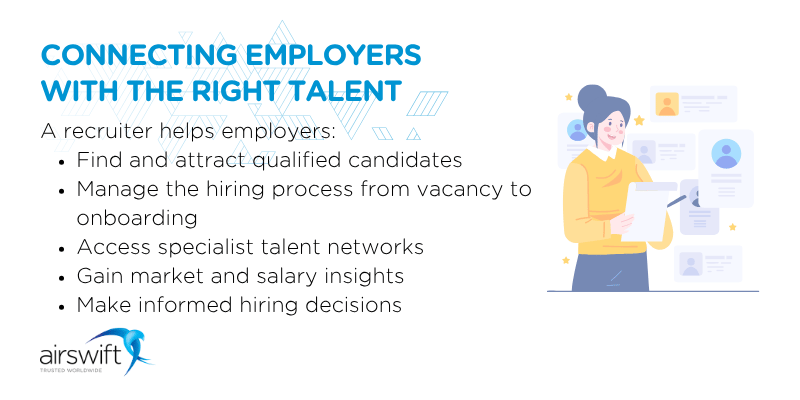
A recruiter helps employers find, attract, and hire the right talent. In a staffing agency, they act as a talent specialist on behalf of the employer, managing the recruitment process from the initial hiring need through to onboarding. They also provide hiring managers with market insights, access to candidate networks, and guidance throughout the hiring process.
A recruiter’s responsibilities typically include:
- Defining the role profile, including required skills, salary expectations, and success criteria
- Supporting candidates throughout their job search and interview preparation
- Reviewing and advising on resumes and cover letters
- Sourcing candidates through job boards, social media, referrals, and professional networks
- Screening and interviewing candidates
- Managing salary and offer negotiations
- Advising clients on hiring and workforce challenges
- Staying up to date with employment legislation and labour market trends
- Providing market intelligence on salaries, skills availability, and industry developments
Recruiters work across a range of industries and hiring models, but their core objective remains the same: connecting the right people with the right opportunities.
What does a recruiter not do?
While recruiters manage the recruitment process, their role is often confused with HR or the hiring manager. Here are five common misconceptions:
- Recruiters do not make final hiring decisions: They shortlist and recommend candidates, but the hiring manager makes the final hiring decision.
- Recruiters do not set salary bands: They provide market and salary insights, but the employer determines compensation ranges, benefits, and perks.
- Recruiters do not replace the hiring manager in interviews: They may conduct initial screening calls and coordinate interviews, but assessing technical skills, team fit, and culture fit remains the hiring manager's responsibility.
- Recruiters do not manage long-term employment: For permanent hires, performance management, career development, and employee relations are handled by the employer's HR team and line managers.
- Recruiters do not charge job seekers: In staffing agency recruitment, employers pay the recruitment fee. Candidates should be cautious of any recruiter or agency requesting payment, as this is often a sign of a scam.
What are the main types of recruiters?
Many people assume all recruiters do the same job, but their responsibilities and approach vary depending on the hiring model. The main types of recruiters are agency recruiters, in-house recruiters, RPOs and MSPs, and executive search consultants.
Agency recruiters
Agency recruiters work for third-party staffing agencies and are hired by employers to fill roles on a project or ongoing basis. They use industry networks, headhunting techniques, and talent databases to find qualified candidates, including passive talent who may not be actively looking for a new role.
In-house recruiters
In-house recruiters are employed directly by an organisation and focus solely on filling that company's vacancies. They have a deep understanding of the business, culture, and hiring needs, which helps them identify candidates who are a strong fit. However, they may have less access to niche talent pools when recruiting highly specialised roles.
RPOs and MSPs
Recruitment Process Outsourcing (RPO) providers and Managed Service Providers (MSPs) manage recruitment programmes rather than simply filling individual positions.
An RPO acts as an extension of an employer's talent acquisition team, taking ownership of part or all the permanent recruitment process.
An MSP manages a company's contingent workforce, including contractors, temporary workers and suppliers. Their responsibilities often include supplier management, compliance oversight, and rate benchmarking.
Executive search
Executive search, often called headhunting or retained search, focuses on senior leadership hiring. These firms are typically engaged to fill C-suite, board and other high-impact leadership positions.
Unlike traditional agency recruitment, executive search is usually conducted on an exclusive basis and is often used for confidential or business-critical hires, as these roles can have a significant impact on an organisation's strategic direction and long-term performance.
Who does a recruitment agency work for, and how are they paid?
A recruitment agency works on behalf of its client, the employer. While recruiters support both employers and candidates throughout the hiring process, their primary responsibility is to help organisations fill open positions with the right talent.
Because recruiters work for the employer, the employer pays the recruitment fee. This fee varies by agency, industry, and role type, and is typically calculated as either a fixed amount or a percentage of the candidate's first-year salary.
In most cases, recruiters are only paid when they successfully place a candidate. However, the employer always makes the final hiring decision.
It's important to note that a recruiter's fee does not affect a candidate's salary. Compensation is determined by the employer's salary structure, market conditions and the requirements of the role.
The recruitment fee is a separate cost paid by the employer and should never be deducted from or influence a candidate's pay.
What is the recruitment lifecycle?
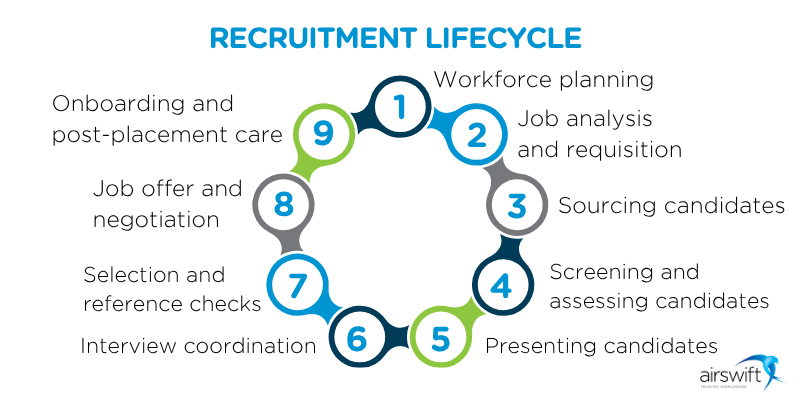
While every recruitment agency has its own approach, most follow a similar process to identify, assess and secure the right talent.
Stage 1: Workforce planning
The recruitment process starts with understanding current and future hiring needs. This includes workforce planning, budget alignment, and identifying skills gaps to determine what talent is required and when.
Stage 2: Job analysis and requisition
Once a hiring need is identified, the recruiter works with the employer to build a detailed understanding of the role and the ideal candidate.
This typically includes:
- Salary range
- Required skills and experience
- Interview requirements
- Benefits and compensation
- Company culture
- Management style
- Reason the position is open
- Start date
- Career progression opportunities
- Job boards
- Company websites
- Social media
- Professional networks
- Referrals
- Talent pools
- Internal databases
The goal is to create a clear picture of both the role and the company before starting the search.
Stage 3: Sourcing candidates
Recruiters use multiple channels to find suitable candidates, including:
They also proactively approach passive candidates who may not be actively looking for a new role but could be open to the right opportunity.
Stage 4: Screening and assessing candidates
After sourcing candidates, recruiters review resumes and conduct screening interviews to evaluate technical skills, experience, and cultural fit.
These conversations help uncover insights that may not appear on a resume, such as career motivations, communication style, and long-term goals.
Where required, recruiters may also conduct background or reference checks before presenting candidates to the employer.
Stage 5: Presenting candidates
At this stage, recruiters do more than submit resumes.
They provide context around each candidate's experience, strengths, career aspirations, and suitability for the role, helping hiring managers make more informed decisions about who they want to interview.
Stage 6: Interview coordination
Recruiters manage interview scheduling and keep the process moving efficiently for both candidates and hiring teams.
They also gather feedback after interviews and ensure clear communication throughout the process, helping maintain a positive candidate experience.
Stage 7: Selection and reference checks
The hiring manager makes the final hiring decision, supported by the recruiter.
At this stage, recruiters coordinate reference checks, background checks, and candidate feedback to help employers make a confident, informed choice.
Stage 8: Job offer and negotiation
Once a preferred candidate is selected, the recruiter helps facilitate the offer process.
This may include managing salary discussions, negotiating start dates, and addressing any concerns from either party. Recruiters also communicate outcomes to unsuccessful candidates and may introduce them to future opportunities.
Stage 9: Onboarding and post-placement care
Many recruiters stay involved after a candidate starts their new role.
Regular check-ins with both the employer and employee help identify and resolve any early issues, supporting a smoother transition and improving long-term retention.
Maintaining these relationships also helps recruiters support future hiring needs and career opportunities down the line.
What does a specialised technical recruiter do differently?
Another type of recruiter is a specialised technical recruiter. For example, Airswift recruiters are specialised in STEM talent. They do more than source candidates. They bring deep industry knowledge, market insight, and access to talent networks that generalist recruiters often can't reach.
The difference isn't just who they find, but how they find, assess and engage candidates.
1. They understand the role
Generalist recruiters often rely on keywords. Technical recruiters understand the skills, technologies, and industry requirements behind a job description. This helps them identify genuinely qualified candidates rather than simply matching keywords on a resume.
2. They map the market
Rather than focusing solely on filling a vacancy, specialised recruiters build a clear picture of the talent landscape. They identify where the best talent works, skills availability by region, compensation trends, competitor hiring activity, and potential passive candidates. This creates a more strategic and targeted search.
3. They reach passive candidates
Many of the strongest technical professionals aren't actively looking for a new role. Specialised recruiters build long-term relationships within their industry, giving them access to candidates who are unlikely to apply through traditional channels.
4. They conduct more effective screening
Technical recruiters can have informed conversations about skills, projects, and industry challenges. Beyond reviewing experience, they assess technical expertise, project complexity, industry relevance, problem-solving ability, and career motivations. This leads to stronger shortlists and more productive interviews.
5. They provide market insight
Because they work within a specific sector every day, specialised recruiters understand salary benchmarks, talent shortages, hiring competition, workforce trends and geographic talent availability. They help employers understand what is achievable before a search begins.
6. They focus on long-term success
The goal isn't just to make a placement, it's to make the right placement. Specialised recruiters consider technical capability, team fit, career goals, project alignment, and long-term retention potential. By understanding both the role and the industry, they can better assess whether a candidate is likely to succeed over the long term.
Partner with a trusted recruitment team
Looking to streamline your recruitment strategy?
Partnering with Airswift gives you access to qualified STEM talent, helping you reduce hiring complexity, save time, and fill critical roles faster.
With more than 40 years of experience and a presence in over 60 countries, Airswift connects employers with highly skilled professionals across a range of STEM industries.
Contact us today to find top talent and build a stronger workforce.