
By
Diyaa Mani
October 27, 2026
Updated
October 27, 2026
Visa and immigration compliance in ASPAC is complex, fast-moving, and highly country-specific.
This article outlines 13 key compliance considerations for organisations moving talent into Asia-Pacific, from choosing the right visa and meeting sponsorship requirements to managing payroll, tax, documentation and remote work.
By understanding these requirements and implementing structured processes, employers can minimise compliance risk, avoid costly delays and protect both their organisation and international assignees.

Key takeaways
- Match the visa to the work being performed. Business visitor status does not automatically permit productive work, so employers should assess the individual’s activities, duration and assignment structure before travel.
- Build immigration requirements into workforce planning. Sponsorship, local entity requirements, labour market testing, salary thresholds and processing lead times can all affect when and how an employee can start work.
- Keep immigration, payroll and tax aligned. Visa status, employment contracts, payroll arrangements, tax residency and social security obligations should reflect the employee’s actual working situation.
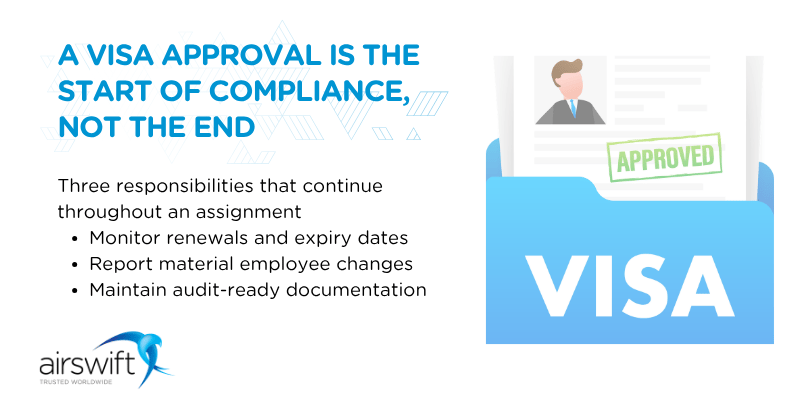
- Treat compliance as an ongoing responsibility. Employers need processes for renewals, reporting changes, document retention, dependent permissions and audit readiness, not simply the initial visa application.
What are some compliance considerations to take note of?
Below are 13 practical compliance considerations that typically apply across key ASPAC markets such as Australia, China, Singapore, Malaysia, Indonesia, Thailand, Vietnam, Japan, South Korea, New Zealand, India, and others, with a focus on how globally mobile employers often manage risk in the region.
1. Matching visa type to the actual assignment
One of the most common compliance pitfalls is using the wrong visa category (for example, sending someone on a business or tourist visa for what is effectively employment).
Key points to consider:
- Ensure the visa type (business visitor, short‑term assignment, long‑term work permit, intra‑company transfer, etc.) matches the real activities, duration, and remuneration.
- Many ASPAC countries define “work” more broadly than employers expect; even short technical interventions, project work, or hands‑on supervision can trigger the need for a work authorisation rather than business visitor status.
- Clearly document job description, location, duration, and reporting line, and make sure these align across contract, visa application, and internal HR records.
2. Sponsorship and entity requirements in‑country
Most ASPAC jurisdictions require a locally registered entity or approved sponsor to obtain work visas.
Questions to address:
- Do you have a legal entity, branch, or representative office in the host country that can act as sponsor?
- If not, do you need to use an Employer of Record (EOR) / professional employment organisation or a trusted in‑country partner to host the employee?
- Are the sponsoring entity’s business scope, tax status, and registration details consistent with the role and salary declared in the visa application?
Misalignment between the sponsoring entity’s approved activities and the assignee’s role can trigger refusals, audits, or later compliance issues.
3. Labour market testing and local hire priority
Several ASPAC countries apply local labour market protections before approving foreign workers.
Compliance considerations:
- Some jurisdictions require advertising the role locally for a specified period or demonstrating that no suitably qualified local candidate was available.
- You may need to provide evidence of recruitment efforts, interview notes, or justification for hiring a foreign national instead of a local worker.
- Failing to meet or document these steps can lead to visa refusals, sponsor sanctions, or caps on future applications.
HR and recruitment should coordinate closely to ensure that labour market testing requirements are built into project timelines.
4. Minimum salary, role seniority, and qualification thresholds
Many work visas in ASPAC are tied to:
- Minimum salary levels
- Job classification / seniority
- Years of experience or formal qualifications
To stay compliant:
- Check whether the proposed salary meets minimum thresholds for the specific visa class and sector (for example, higher thresholds for professionals in financial services or technology).
- Ensure the candidate’s degree, professional license, and experience match what is required for the visa category and what is declared on the application.
- Keep internal job descriptions, contracts, and immigration forms aligned; discrepancies between internal grade and what is declared externally can cause issues during audits or renewals.
5. Degree, credential, and background verification
A growing number of ASPAC countries are tightening checks on:
- Degrees and professional qualifications
- Previous employment
- Criminal records and security background
Points to watch:
- Many authorities now require formal verification of degrees from approved agencies, not just copies of diplomas.
- Background checks (including criminal record certificates or police clearances) often need to be recent, translated, and legalised/apostatised.
- Providing incomplete or inconsistent information can result in refusals or bans for corporate sponsors, not just individual applicants.
Internal pre‑screening and robust document management significantly reduce the risk of last‑minute surprises.
6. Dependents, family reunification, and spousal work rights
Moving talent into ASPAC often involves families, and each country treats dependents differently.
Key compliance aspects:
- Confirm which family members qualify as dependents (spouse, children, sometimes parents) and what proof of relationship is required (marriage certificates, birth certificates, notarised translations).
- Understand whether dependents may:
- Reside but not work
- Work under certain conditions or with a separate permit
- Access public services such as schooling or healthcare
- Ensure benefit policies (allowances, schooling, insurance) reflect what is legally possible in each host country, not just what is offered globally.
Failure to plan correctly can put dependents in non‑compliant situations (for example, working without authorisation on a dependent visa).
7. Tax residency, social security, and payroll alignment
Immigration compliance is closely linked to tax and social security in ASPAC.
Important considerations:
- Determine when an assignee becomes tax resident in the host country (often a days‑in‑country threshold combined with local law).
- Align visa start dates, assignment letters, and actual arrival dates; authorities may cross‑check with border records.
- Clarify where payroll is run (home, host, or split) and how social security contributions are handled (totalisation agreements, exemptions, or local registration).
- Misalignment between immigration status, payroll location, and tax filings is a common trigger for audits and penalties.
Close collaboration between HR, global mobility, tax, and payroll teams is essential.
8. Business visitor compliance and short‑term travel
Short‑term business travel across ASPAC is frequent, but “visa‑free” or “e‑visa” does not mean “free to work.”
To stay compliant:
- Define clearly what business visitors may do: typical permissible activities include attending meetings, conferences, training, or exploratory visits—not productive work or delivery.
- Implement internal policies requiring pre‑clearance for any hands‑on activities (such as equipment installation, supervision, or commissioning) that may actually require a work permit.
- Track travel patterns; frequent entries, long stays, or repeated visits on a business visa can attract scrutiny.
An internal matrix of permitted activities by country is often a useful tool for managers and travelers.
9. Registration, notifications, and reporting obligations
Many ASPAC countries have ongoing registration or reporting requirements beyond the initial visa approval.
Examples of obligations to monitor:
- Registration with local police or immigration authorities within a set number of days after arrival.
- Reporting changes to role, salary, address, marital status, or employer within a prescribed time frame.
- Annual reports, in‑country presence confirmations, or re‑validation of employer status.
Failure to meet ongoing reporting obligations can impact both the individual’s status and the company’s ability to sponsor future visas.
10. Document retention, audits, and on‑site inspections
Authorities in ASPAC increasingly conduct compliance audits and on‑site inspections focused on foreign workers.
To prepare:
- Maintain organised files (digital and/or physical) containing:
- Passports, visas, permits, and renewals
- Employment contracts and assignment letters
- Proof of qualifications, background checks, and tax filings
- Ensure site managers and HR teams know what to do if approached by inspectors: who can speak on behalf of the company, where records are stored, and how to respond consistently.
- Conduct internal mock audits or reviews to identify gaps before authorities do.
Strong documentation and consistent record‑keeping are often the difference between a routine check and a serious enforcement action.
11. Timelines, lead times, and project planning
Visa and work permit lead times in ASPAC can range from a few days to several months, depending on:
- Country and city
- Role seniority and sector
- Nationality of the assignee
- Completeness of documentation
- Compliance risk arises when:
- Projects are scheduled without factoring in realistic immigration timelines.
- Workers arrive before final approvals or start working while technically still on visitor status.
- Extensions or renewals are left too late, leading to gaps in status or forced exits.
Build immigration lead times into project planning and resourcing decisions, and set automated reminders well ahead of expiry dates.
12. Remote work, hybrid arrangements, and “digital nomad” scenarios
Post‑pandemic, more organisations allow flexible work patterns, but immigration rules in ASPAC generally still assume a clear link between location, employer, and work authorisation.
Risk points:
- Employees working remotely from an ASPAC country where the company has no entity or where they hold only a visitor or tourist status.
- Hybrid arrangements where someone lives in one country and “commutes” into another for part‑time work without appropriate permits.
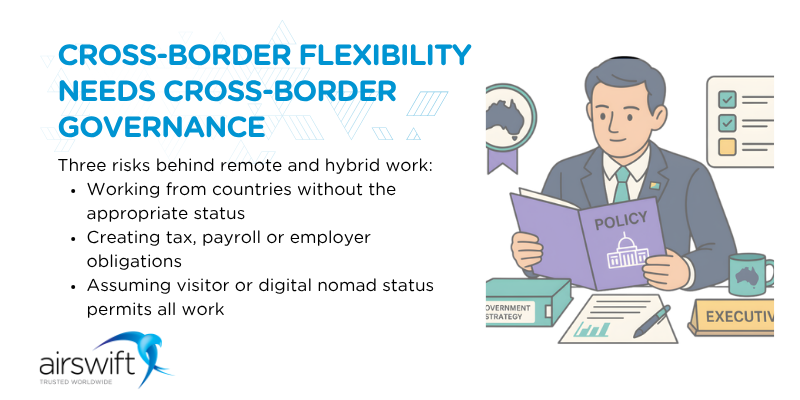
- Misuse or misunderstanding of “digital nomad” or long‑stay visitor visas whose conditions may restrict the type of work allowed.
Policies should expressly address cross‑border remote work and ensure HR is involved before approving such arrangements.
13. Using local partners and global workforce solutions
Because ASPAC rules vary widely and change frequently, many companies work with:
- Local immigration specialists
- Global mobility providers
- Employer of Record / workforce solutions partners
When doing so:
- Make sure roles and responsibilities are clearly defined: who gathers documents, who liaises with authorities, who monitors renewals, who owns data protection compliance.
- Ensure third‑party processes align with your internal standards on ethical conduct, anti‑bribery and corruption, and data privacy.
- Keep ultimate accountability for compliance within your organisation; outsourcing administration does not outsource legal responsibility.
A coordinated approach across HR, legal, tax, and trusted partners is the most effective way to maintain compliance at scale across ASPAC.
While each ASPAC country has its own unique visa categories, documentation standards, and processing culture, these 13 areas tend to drive most of the risk and preventable disruption for organisations moving people across the region. By embedding immigration compliance into project planning, talent strategy, and vendor management, you can reduce delays, protect your workforce, and support sustainable growth in Asia‑Pacific.
Managing visa and immigration compliance across ASPAC
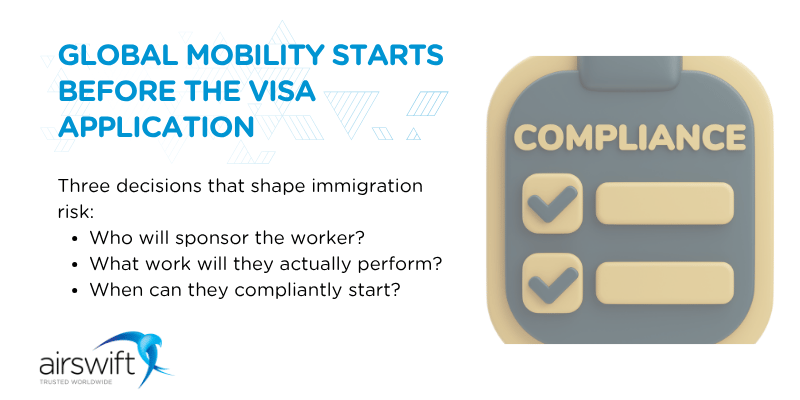
Managing a mobile workforce across ASPAC requires more than securing the right visa. Employers need to consider sponsorship, employment conditions, tax and payroll, documentation, renewals and changing working arrangements throughout the assignment lifecycle.
With requirements varying significantly between countries, a coordinated approach can help businesses reduce compliance risk while getting people where they need to be with fewer avoidable delays.
Airswift can support organisations navigating international workforce requirements across ASPAC, from Employer of Record services to workforce and mobility support. Whether you are entering a new market, mobilising specialist talent or managing workers across multiple jurisdictions, speak to Airswift about building a compliant workforce.