
By
Diyaa Mani
June 30, 2026
Updated
June 30, 2026
International technical staffing should give energy companies access to scarce skills, faster project execution, and global best practice.
Yet, in reality, many cross‑border hiring efforts stall, run over budget, or fail outright, especially in complex oil and gas, power, and renewables projects.
This list breaks down the most common reasons international technical staffing goes wrong and what you can do differently.

 1. Underestimating the global energy skills gap
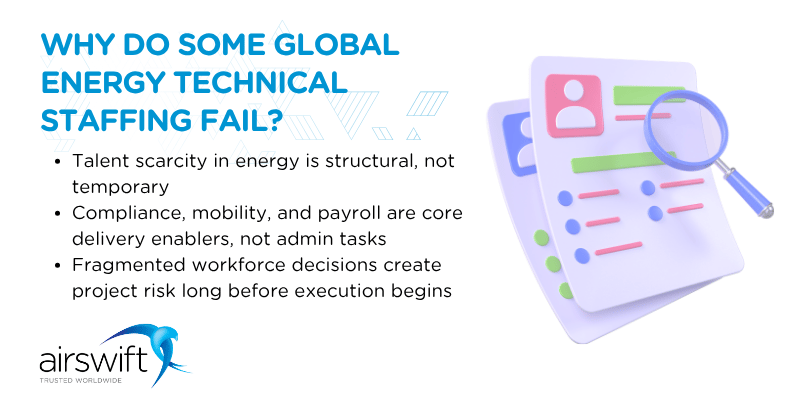
A major reason international staffing fails is that companies assume the right engineers, technicians, and project professionals are “out there somewhere” and just need to be found. In reality, the sector faces deep structural shortages, particularly in mid‑career roles with hands‑on project experience in fields like offshore wind, grid modernisation, LNG, and complex upstream operations.
What do recent workforce analyses show?
- A growing global shortfall of specialist renewable workers through 2030
- A large proportion of the existing energy workforce nearing retirement by the 2030s, taking critical tacit know‑how with them
When hiring plans are built on unrealistic assumptions about candidate availability, projects launch with overly optimistic timelines and budgets. The result is repeated “failed searches,” rushed compromises on quality, or roles staying vacant long enough to impact safety and production.
2. Treating international hiring as a simple extension of domestic recruiting
Many energy companies try to scale their domestic recruitment playbook directly into new countries, only to find that what worked in Houston or Aberdeen falls flat in places like the Middle East, West Africa, or remote parts of Australia.
What are some common pitfalls of international hiring?
- Using the same employer branding and messaging in markets where energy workers have different expectations around stability, rotation patterns, and family relocation support
- Relying on home‑country networks instead of tapping into local talent pools and professional communities
- Ignoring how compensation benchmarks differ between mature and emerging energy hubs
Specialist international providers emphasise tailoring attraction strategies to local labour markets, including region‑specific salary data, mobility incentives, and career narratives aligned to the energy transition. When companies skip that localisation, their offers simply do not resonate, and roles remain unfilled.
3. Weak compliance, immigration, and Employer‑of‑Record planning
A frequent failure point is underestimating the complexity of employing people legally and compliantly in multiple jurisdictions. Even when hiring the right technical profiles, projects can stall if visas, work permits, payroll, and tax structures are not handled correctly.
What are some typical issues in global hiring and compliance?
- Treating international contractors as if they were domestic, without addressing permanent establishment, tax residency, or social security obligations
- Inconsistent contracts, benefits, and HR policies across countries, creating legal and reputational risks
- Long permit timelines that are not built into project schedules, causing critical staff to arrive months late
This is why experienced firms highlight services like employer of record (EOR), global mobility, and compliant payroll as core parts of their value proposition, not just “add‑ons.” When those foundations are missing, international staffing initiatives can be blocked by regulators, delayed at borders, or reversed after audits.
4. Misalignment between project requirements and role definitions
Another cause of failure is vague or unrealistic role scoping, especially on large capital or transition projects where job descriptions are written in isolation from real‑world site conditions.
How do role scoping issues commonly show up as?
- “Unicorn” descriptions that combine several full‑time jobs (for example, expecting one engineer to manage detailed design, on‑site commissioning, stakeholder management, and regulatory reporting across multiple time zones)
- Over‑generic titles that fail to specify the exact technologies, standards, or project phases involved
- Lack of clarity on whether the role is construction‑focused, operations‑focused, or dedicated to digital transformation and data
Global workforce providers in energy repeatedly stress the need for joint scoping sessions between hiring managers, project leaders, and recruiters to translate project deliverables into concrete competencies and experience bands. Without this alignment, you either get a flood of unqualified CVs or a search that drags on because “nothing looks quite right.”
5. Ignoring workforce mobility and retention dynamics
.png?width=800&height=400&name=Why%20do%20some%20global%20energy%20technical%20staffing%20fail%20(2).png "operational discipline matters as much as hiring capability")
Even when energy companies successfully hire international technical staff, they sometimes fail to keep them long enough to realise a return on investment. Recent workforce trend data shows high openness to career moves in energy, driven by shifting expectations around work‑life balance, project type, and compensation.
When do international staffing fail?
- Rotation patterns, accommodation, and travel policies are not competitive with other global projects
- Career paths are unclear for international hires, who may feel stuck as “project nomads” without development opportunities
- Family, schooling, and relocation support are treated as afterthoughts for long‑term assignments
Airswift and similar firms highlight the importance of structured mobility support, long‑term contractor care, and retention‑focused workforce planning for energy projects in remote or challenging locations. Without that, attrition rises mid‑project, forcing expensive re‑recruitment and knowledge loss.
6. Limited use of data and market intelligence in staffing decisions
Energy companies sometimes make international staffing decisions based on anecdote rather than real market data. That leads to misjudging which locations can realistically supply which skills, and what conditions are needed to attract them.
What do market intelligence from sector‑focused providers cover?
- Where specific technical skills (for example, offshore cable installation, hydrogen, or subsea engineering) are concentrated globally
- How salary levels, day rates, and benefits compare between countries and regions
- How workforce sentiment is shifting, such as why many experienced workers are considering career changes or leaving traditional energy roles
When companies ignore this insight, they may base project plans on low‑cost locations that do not actually have the needed expertise, or on unrealistic assumptions about how quickly teams can be assembled. That disconnect is a common root cause of failed or abandoned international search campaigns.
7. Overreliance on short‑term contractors without knowledge capture
Contractor models are essential in energy, especially for construction and commissioning. But international technical staffing fails when contractors are treated as fully disposable, with no mechanisms to capture knowledge, standardise practices, or transition expertise to permanent teams.
What are the risks in international technical staffing?
- Repeating the same onboarding, safety, and system training for each new wave of contractors
- Losing critical project context when senior contract staff roll off, leaving permanent teams with a limited understanding of why key decisions were made
- Increased exposure to safety and quality issues as institutional knowledge remains “in people’s heads” rather than in systems or documentation
Leading workforce partners encourage blended models using contractors for flexibility while building internal capability, documentation, and succession plans. When organisations ignore this, they remain perpetually dependent on increasingly scarce international experts and struggle to stabilise operations.
8. Fragmented ownership of global workforce strategy
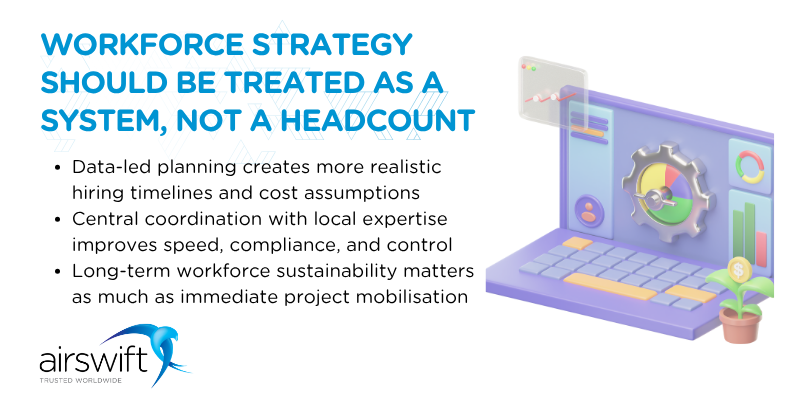
Finally, international technical staffing often fails simply because no one owns it end‑to‑end. Responsibility gets split between local HR teams, project managers, procurement, and external agencies, each optimising for their own metrics.
How does fragmented ownership show up?
- Conflicting priorities between cost, speed, risk, and quality across regions
- Different vendors and processes in each country, with no consistent view of workforce performance
- Slow decision‑making on offers, relocation, and retention because approvals are scattered
Global workforce solutions providers emphasise central coordination with local execution: a single strategy and reporting view combined with in‑country expertise and compliance. Where that centre of gravity is missing, even well‑designed international staffing initiatives can stall under their own complexity.
5 FAQs about international technical staffing for energy companies
1. Why is it so hard for energy companies to fill technical roles internationally?
It is difficult because demand for specialised skills in both conventional and renewable energy is rising faster than the supply of experienced professionals, especially in mid‑career technical and operational roles. Many workers are also reconsidering their career paths in light of the energy transition and changing expectations around work, which adds to mobility and retention challenges.
2. How can partnering with a global workforce solutions provider reduce failure risk?
A specialist provider brings established international networks, local market knowledge, and compliant employer‑of‑record and mobility capabilities that most individual companies cannot maintain in‑house. They can design realistic hiring strategies by combining recruitment expertise with data on skills availability, salary benchmarks, and workforce sentiment across multiple energy hubs.
3. What role do compliance and immigration play in international staffing success?
Compliance and immigration are foundational: if visas, work permits, payroll, and contracts are not set up correctly, even the best hiring decisions can be delayed, reversed, or penalised. Using structured employer‑of‑record and global mobility solutions helps energy companies onboard staff quickly while meeting local labour and tax requirements in each jurisdiction.
4. How can energy companies improve retention of international technical staff?
Retention improves when companies offer competitive rotation and compensation packages, clear career development paths, and practical support for relocation and family life. Ongoing engagement, upskilling aligned to the energy transition, and visible safety and wellbeing commitments also make international assignments more attractive over the long term.
5. What is the first step to fixing a failing international staffing strategy?
The first step is to map your current and planned roles against real market data: where the skills exist, what they cost, and how long they truly take to hire and mobilise. From there, many energy companies benefit from consolidating fragmented vendors into a smaller number of strategic workforce partners who can support both recruitment and compliant international employment at scale.
Turning global staffing risk into a strategic advantage
International technical staffing does not fail because going global is the wrong strategy, it fails when it is approached tactically instead of strategically. Energy companies that succeed are those that align hiring plans with real talent availability, local market conditions, compliance requirements, and long-term workforce sustainability, rather than relying on assumptions or fragmented processes.
If your cross-border hiring efforts are slowing projects or failing to secure the right expertise, it is time to rethink your approach. By partnering with a global workforce solutions provider, energy companies can move from reactive hiring to a coordinated, data-led strategy that covers recruitment, compliance, mobility, and retention at scale.
Speak to an Airswift staffing specialist today and turn your international staffing strategy into a competitive advantage.