By
Nathalia Duarte
June 22, 2026
Updated
June 25, 2026
What causes candidates to drop out mid-interview?
Think back to the last time you went through a job interview; Did you feel informed, valued, and excited? Or were you left chasing updates, questioning the role, or losing interest along the way?
Today’s job seekers are paying close attention to every interaction, and small missteps can quickly turn enthusiasm into disengagement. In this article, we break down seven common interview mistakes employers make that cause candidates to drop out.

1. Long, overly complex hiring process
Taking too long to move from interview to decision is one of the biggest deal-breakers for candidates. Lengthy delays signal inefficiency or low employer interest, prompting candidates (especially high-demand talent) to pursue other offers.
Extended gaps between interviews or slow decision-making are particularly risky: for instance, a SHRM report on Monster’s 2024 Work Watch found that 36% of candidates dropped out when they felt they were being asked to “jump through too many hoops”, and 42% left because scheduling interviews took too long.
How to trim down your hiring process:
- Set a clear timeline: Aim to complete the process within 2–3 weeks. Top candidates often exit the market much sooner.
- Coordinate interviews in advance: Align interviewer availability early and schedule stages close together to maintain momentum.
- Reduce unnecessary steps: Keep interview rounds focused and essential. Redundant panels or tasks increase drop-off risk.
- Track where candidates stall: Monitor time-to-hire and drop-off points. If candidates disengage after round three, it’s a signal to simplify.
2. Poor communication and candidate “ghosting”
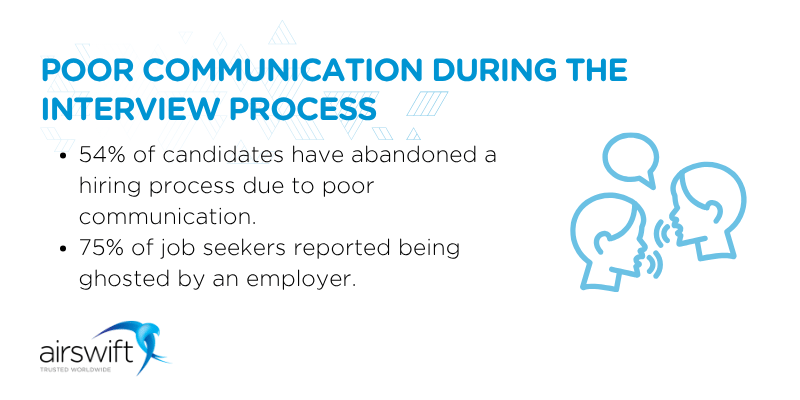
Lack of communication is the #1 red flag for job seekers. According to a Criteria’s 2023 Candidate Experience report, 54% of candidates have abandoned a hiring process due to poor communication from recruiters or employers.
Ghosting, or failing to update candidates or abruptly cutting off contact, is alarmingly common: in one study, 75% of job seekers reported being ghosted by an employer after an interview. Candidates widely view silence or patchy updates as disrespectful and anxiety-inducing, leading them to step away.
How to communicate better with candidates:
- Keep communication consistent: Update candidates at every stage. Even a brief “we’re still reviewing” is better than silence.
- Set clear expectations: Tell candidates when they’ll hear back. For example, “you’ll receive an update by next Friday”.
- Respond quickly: Acknowledge emails and questions promptly to show respect and maintain engagement.
- Close the loop: Always follow up, even with rejected candidates. A polite rejection or brief feedback protects your employer brand and keeps future doors open.
3. Unprofessional or disrespectful interviewer behaviour
When candidates encounter rude, unprepared, or disengaged interviewers, many choose to walk away. In a 2025 survey, 46% of job seekers said they would withdraw from a hiring process due to an interviewer’s negative attitude or unprofessional behaviour.
Common issues include interviewers arriving late or failing to review a candidate’s résumé in advance. Candidates often see this as a sign of poor leadership or a disrespectful culture, raising doubts about how they would be treated as employees.
How to improve the candidate's experience:
- Train interviewers: Reinforce that interviews are also an opportunity to represent and promote the company. Punctuality, preparation, and professionalism matter.
- Prepare thoroughly: Interviewers should review résumés and plan relevant questions in advance. A lack of preparation is immediately noticeable.
- Create a welcoming atmosphere: Simple actions (clear introductions, attentive listening, small courtesies) help candidates feel respected.
- Collect and act on feedback: Ask candidates for feedback on their interview experience and share insights constructively with interviewers to drive continuous improvement.
4. Misleading job descriptions and lack of clarity
Vague or changing job details quickly erode trust. When companies fail to clearly communicate the role, responsibilities, or expectations, candidates question the organisation’s transparency and reliability.
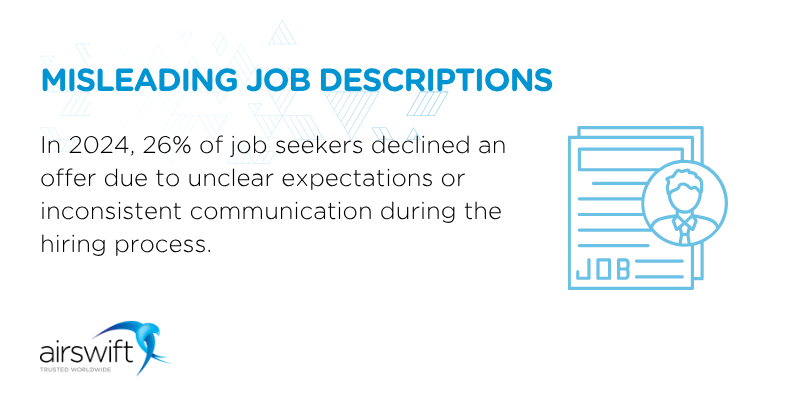
This often shows up as poorly written job descriptions, misalignment between the role advertised and what interviews reveal, or last-minute changes to scope or offer details. The impact is real: In 2024, 26% of job seekers declined an offer due to unclear expectations or inconsistent communication during the hiring process.
How to improve your job advertisements:
- Define the role early: Share a clear, accurate job description and stick to it. If the scope changes, address it openly and immediately.
- Stay aligned internally: Ensure all interviewers communicate the same expectations around responsibilities, growth, and hiring criteria.
- Invite honest questions: Encourage candidates to ask about the role, team, and culture at every stage. Transparent answers build trust.
- Show the real job: Use concrete examples of day-to-day tasks or projects to give candidates a realistic view, helping reduce late-stage dropouts.
5. Uncompetitive or non-transparent compensation and benefits
Money still talks and missteps around compensation cost offers. When pay or benefits don’t meet expectations, candidates are quick to walk away. According to a 2023 Gartner survey, 52% of candidates say a higher salary impact their decision.
Lack of pay transparency is another issue: 6 in 10 workers say they won't apply to a job that doesn't include a salary range. In short, a non-competitive or opaque offer can quickly undo all the goodwill built during the interviews.
How to improve your compensation package:
- Be transparent early: Share salary ranges as soon as possible, ideally in job postings. With pay transparency laws expanding across Europe, openness is now expected.
- Benchmark your offers: Use market data to ensure compensation is competitive and fair.
- Highlight total rewards: If base pay isn’t leading the market, emphasise benefits such as bonuses, healthcare, pensions, remote work, extra leave, and career development.
- Stay flexible: Be open to negotiation. Small adjustments, like a sign-on bonus or tailored benefits, can make the difference between acceptance and rejection.
6. Inflexible work arrangements and lack of work-life balance
Rigid work policies, especially around remote work and scheduling, are increasingly deal-breakers for candidates.
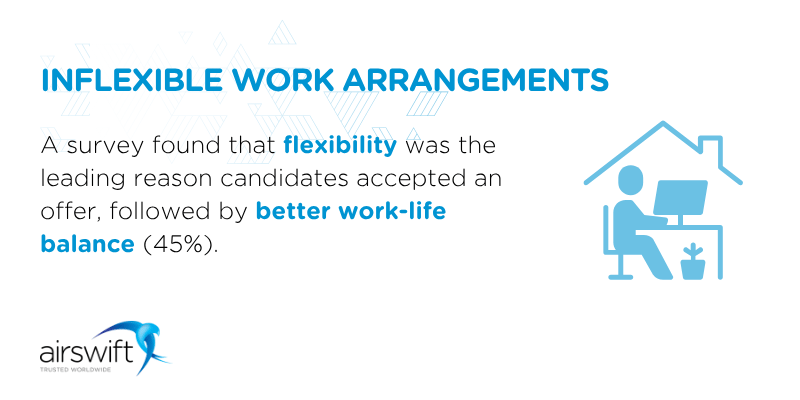
Flexibility and work-life balance now rank among the top priorities for job seekers. A 2023 Gartner survey found that flexibility was the leading reason candidates accepted an offer, followed by better work-life balance (45%).
When policies feel inflexible or misaligned with expectations, top talent is likely to choose employers offering a more modern, adaptable approach to work.
How to improve work-life balance initiatives:
- Offer flexibility where possible: If remote or hybrid work is viable, make it part of the offer.
- Demonstrate commitment to balance: Highlight flexible hours, wellness initiatives, or generous leave during interviews to reinforce your support for employee wellbeing.
- Be transparent when flexibility is limited: If a role requires set hours or on-site presence, explain why and offset with benefits such as overtime pay, commuter support, or compressed schedules.
- Understand individual needs: Ask candidates about their work style preferences and accommodate where business allows. This flexibility can often secure acceptance.
7. Culture and values misalignment
Cultural fit matters, and candidates are quick to reject employers that don’t align with their values or reputation. A Gartner survey found that 90% of candidates withdrew from a hiring process when the employer’s brand or culture conflicted.
Job seekers actively research employers on platforms like Glassdoor and social media. If they spot signs of a toxic culture, weak reputation, or values mismatch, they’re likely to walk away.
How to showcase your company's culture:
- Show your culture in action: Let candidates meet potential teammates or tour the workplace (virtually if needed). Real interactions speak louder than website copy.
- Reflect your values throughout the process: If collaboration matters, use panel interviews. If innovation is key, share how new ideas are supported.
- Communicate purpose and impact: Highlight your mission, community initiatives, employee resource groups, or development programs to bring your values to life.
- Protect your employer brand: Monitor review platforms, address negative feedback thoughtfully, and reinforce positive stories to build trust and credibility.
Partner with Airswift to improve your hiring process
Airswift helps you hire faster, filling roles up to five days quicker than other recruitment firms.
With 40+ years of talent acquisition expertise and over 60 international offices, we support employers worldwide in streamlining hiring processes and securing in-demand talent quickly and efficiently.
Ready to build a stronger team? Talk to our recruitment experts today.