
By
Diyaa Mani
July 22, 2026
Updated
July 22, 2026
Technology hiring remains highly competitive in 2026, with organisations facing ongoing skills shortages, tighter project timelines, and growing pressure to remain agile.
As a result, staff augmentation, a form of contract hiring, has become a strategic workforce solution that allows businesses to access specialised talent without expanding permanent headcount.
However, not all staff augmentation providers offer the same level of expertise, compliance support, or service quality. This guide explains how staff augmentation works, why demand continues to grow, and the key criteria organisations should use to evaluate providers before making a hiring decision.

Key takeaways
-
Staff augmentation enables organisations to add external specialists to internal teams while retaining full control over projects, workflows, and team management.
-
Demand for staff augmentation is growing due to ongoing skills shortages, the need for workforce flexibility, faster hiring requirements, and increased digital transformation initiatives.
-
Staff augmentation helps companies access specialised talent quickly, including software developers, cloud engineers, cybersecurity professionals, AI specialists, and other hard-to-hire experts.
-
When evaluating a staff augmentation provider, focus on four key areas: technical expertise, compliance and risk management, scalability and hiring speed, and ongoing support.
-
Staff augmentation differs from outsourcing because the client retains project ownership and oversight, while augmented professionals work as integrated members of the internal team.
-
The best staff augmentation providers combine strong candidate vetting, compliance expertise, scalable talent networks, and post-placement support to help organisations build a flexible and sustainable workforce strategy.
What is staff augmentation?
Staff augmentation is a workforce strategy that enables companies to add external professionals to internal teams on a temporary or project basis while maintaining direct management oversight.
Unlike traditional outsourcing services, staff augmentation allows organisations to retain control over projects, processes, and team management. External specialists work alongside permanent employees and follow the company's workflows, tools, and reporting structures.
Organisations use staff augmentation in several ways:
- Filling short-term skill gaps
- Supporting large-scale digital transformation projects
- Hiring contractors for specialised initiatives
- Expanding engineering capacity during peak demand
- Accessing niche expertise that is difficult to hire permanently
It is especially common in highly regulated sectors such as nuclear energy, where organisations frequently require specialist engineers, project professionals, outage personnel, and compliance experts for project-based or time-sensitive work.
A simple way to understand the model is:
Internal team + Augmented talent = Scalable workforce
By leveraging external talent when needed, organisations gain flexibility while maintaining operational control and project visibility.
Why are more companies using staff augmentation in 2026?
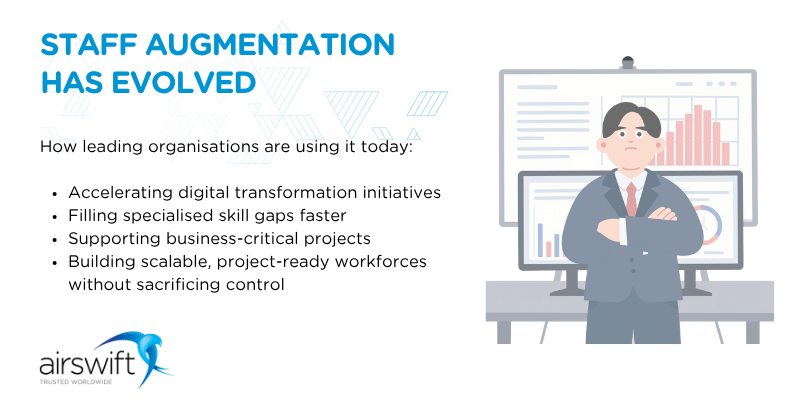
The growing popularity of staff augmentation is driven by several workforce trends that continue to shape hiring decisions across industries.
Addressing critical skills shortages
Many organisations struggle to find qualified professionals as the demand for specialised technical expertise often exceeds local talent availability.
Rather than delaying projects while searching for permanent hires, companies increasingly turn to staff augmentation providers to access qualified professionals quickly.
Improving workforce flexibility
Economic uncertainty has made employers more cautious about increasing permanent headcount. Workforce leaders want the ability to scale teams up or down based on project needs.
Staff augmentation supports this approach by allowing organisations to bring in talent only when required, helping improve workforce planning and budget management.
Accelerating hiring timelines
Traditional recruitment processes often take weeks or months to fill specialised roles. For organisations launching critical projects, those delays can significantly impact delivery timelines.
Many staff augmentation providers maintain active talent networks, enabling businesses to access pre-vetted professionals considerably faster than conventional hiring methods.
Accessing global talent pools
Remote work has expanded the geographic reach of talent acquisition. Organisations are no longer limited to local hiring markets.
Through global staffing networks, companies can access highly skilled professionals from multiple regions while still maintaining team integration and project oversight.
Supporting digital transformation
As organisations adopt new technologies, many require skills that are unavailable internally. Staff augmentation provides immediate access to specialised expertise without requiring long-term workforce commitments.
For many businesses, staff augmentation is no longer simply a hiring solution. It has become a critical workforce strategy for maintaining competitiveness.
How to evaluate staff augmentation providers?
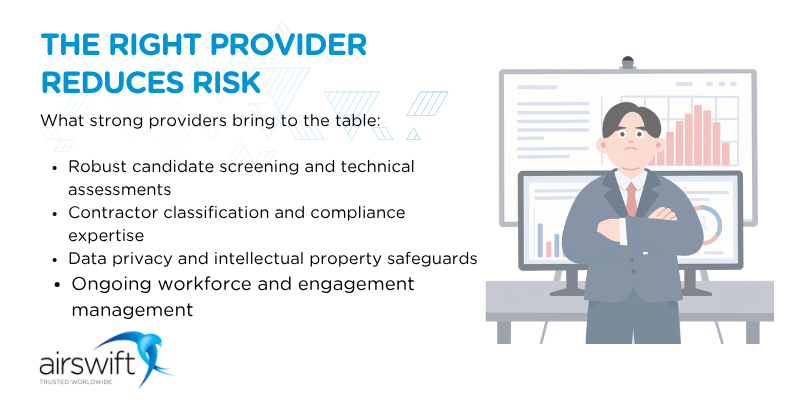
Choosing the right provider requires more than reviewing pricing or candidate availability. The most successful partnerships are built around four key evaluation areas.
1. Technical fit
A provider's ability to identify and deliver qualified talent should be your first consideration.
Not all staff augmentation providers specialise in the same industries or technical disciplines. While some specialise in general engineering or technology recruitment, others have deep expertise supporting nuclear operators, EPCs, regulators, SMR developers, decommissioning projects, fuel cycle facilities, and major capital programmes.
To evaluate technical fit, ask:
- How are candidates screened?
- What technical assessment methods are used?
- Which industries do they specialise in?
- Can they support highly specialised roles?
- What certifications or qualifications do candidates possess?
Strong providers typically use multiple evaluation methods, including:
- Technical interviews conducted by subject matter experts
- Verification of industry experience and project history
- Qualification and certification validation
- Competency-based assessments
- Role-specific experience reviews against regulatory and project requirements
2. Compliance and risk management
Hiring contractors introduces legal, regulatory, and operational risks that organisations cannot afford to overlook.
A reputable provider should demonstrate expertise in:
-
Worker classification requirements
-
Employment regulations
-
Contractor management
-
Data privacy standards
-
Security procedures
- Intellectual property protection
Compliance becomes especially important when hiring across international markets. Different countries have varying employment laws, tax obligations, and contractor regulations.
Questions worth asking include:
-
Who manages contractor classification?
-
How is regulatory compliance maintained?
-
What safeguards exist for data protection?
-
How is intellectual property ownership protected?
- What security standards are enforced?
Strong compliance frameworks help reduce legal exposure while ensuring contractors can work effectively within your organisation.
A provider that cannot clearly explain its compliance process should be viewed as a potential risk.
3. Speed and scalability
Speed matters, but sustainable scalability matters even more.
Many providers promote rapid hiring capabilities. While fast access to talent is valuable, organisations should also evaluate whether a provider can support future growth.
Important questions include:
-
What is the average time-to-fill?
-
How large is the provider's talent network?
-
Can they support international hiring?
-
Have they successfully scaled teams for similar clients?
-
What are their fill-rate metrics?
Request measurable performance indicators such as:
-
Candidate submission timelines
-
Placement success rates
-
Candidate availability percentages
-
Retention statistics
Scalability becomes particularly important for organisations undertaking multi-phase projects, product launches, or long-term digital transformation initiatives.
The ideal partner should be capable of supporting both immediate hiring needs and future workforce expansion.
4. Delivery and ongoing support
Many organisations focus heavily on candidate sourcing while overlooking the importance of provider support after placement.
The most effective staff augmentation providers continue supporting both clients and contractors throughout the engagement.
Look for providers that offer:
-
Dedicated account management
-
Structured onboarding assistance
-
Contractor engagement support
-
Performance monitoring
-
Replacement guarantees
-
Regular review meetings
Ongoing support often contributes significantly to project success. Even highly skilled professionals may struggle without proper onboarding, stakeholder alignment, or performance management.
Strong providers help address these challenges proactively. A quality staff augmentation partner should function as an extension of your workforce strategy rather than simply a talent supplier.
Staff augmentation vs outsourcing services
Organisations frequently compare staff augmentation and outsourcing services when evaluating workforce solutions.
While both models involve external talent, they operate in different ways.
|
Factor |
Staff augmentation |
Outsourcing services |
|
Team control |
High |
Lower |
|
Project ownership |
Client |
Vendor |
|
Flexibility |
High |
Moderate |
|
Team integration |
High |
Low |
|
Scalability |
High |
Moderate |
With staff augmentation, external professionals become integrated members of your team. Internal managers oversee priorities, workflows, and project delivery.
With outsourcing services, the vendor typically assumes responsibility for project execution and delivery outcomes.
Staff augmentation is often preferred when organisations:
-
Need specialised expertise
-
Want to retain project control
-
Require close collaboration with internal teams
-
Anticipate changing workforce demands
Outsourcing services may be more appropriate when organisations want to delegate an entire function or project to an external vendor.
For companies seeking maximum flexibility while maintaining operational control, staff augmentation usually provides the stronger solution.
What are the red flags to watch for when evaluating staff augmentation providers?
Not every provider delivers the same level of service. Watch for these warning signs during the evaluation process.
Unclear vetting processes
If a provider cannot clearly explain how candidates are assessed, there may be concerns about talent quality.
Unrealistic hiring claims
Promises that every role can be filled immediately often indicate overpromising rather than proven delivery capability.
Limited compliance expertise
Providers should be able to discuss employment regulations, contractor classification, data protection, and risk management confidently.
Weak client references
A lack of case studies, testimonials, or reference clients can make it difficult to validate performance claims.
Minimal support infrastructure
Providers without dedicated account managers, onboarding support, or replacement processes may struggle to maintain service quality.
Recognising these red flags early can help organisations avoid costly hiring mistakes.
Staff augmentation provider evaluation checklist
Use the following checklist when comparing providers.
Technical capability
- Role specialisation
- Technical assessment process
- Skill validation
- Industry expertise
Compliance
- Contractor management
- Worker classification support
- Data privacy controls
- Intellectual property protection
Delivery
- Time-to-fill metrics
- Talent network strength
- International hiring capabilities
- Scalable workforce solutions
Support
-
Dedicated account manager
-
Onboarding assistance
-
Replacement guarantee
-
Performance review process
Common mistakes companies make when selecting a provider
Organisations often encounter avoidable challenges during the provider selection process.
Common mistakes include:
Choosing based solely on cost
The lowest-cost provider may not deliver the strongest candidate quality, compliance support, or workforce outcomes.
Prioritising speed over quality
Fast hiring is valuable, but poor candidate quality can create larger project delays later.
Ignoring compliance risks
Compliance failures can expose organisations to significant legal and financial consequences.
Failing to verify assessment methods
Not all technical screening processes are equally rigorous. Always understand how candidates are evaluated.
Neglecting onboarding
Even highly qualified contractors require proper onboarding to become productive quickly.
Overlooking long-term scalability
Workforce needs evolve. Your provider should be capable of supporting future growth as well as current requirements.
Avoiding these mistakes can improve hiring outcomes and maximise the value of staff augmentation programs.
Frequently asked questions
What is the difference between staff augmentation and tech staffing?
Tech staffing generally refers to recruiting technical professionals, while staff augmentation is a workforce model that embeds external talent directly into internal teams under client management.
Are staff augmentation providers responsible for legal compliance?
Most providers assist with compliance, contractor management, and worker classification. However, organisations should clearly define responsibilities within contracts and service agreements.
How quickly can staff augmentation providers deliver talent?
Delivery timelines vary by role, location, and skill level. Strong providers typically maintain active talent networks to accelerate hiring.
What engineering roles are commonly filled through staff augmentation?
Common roles include software developers, cloud engineers, cybersecurity specialists, DevOps engineers, data scientists, QA professionals, AI engineers, and solution architects.
Is staff augmentation more cost-effective than hiring full-time employees?
It can be, particularly for short-term projects or specialised skills. Organisations avoid long-term employment costs while gaining immediate access to expertise.
How do you measure provider performance?
Common metrics include time-to-fill, retention rates, candidate quality, project outcomes, hiring manager satisfaction, and compliance performance.
Can staff augmentation support international hiring?
Yes. Many providers offer access to global talent pools while managing local compliance and contractor requirements.
What should be included in a service-level agreement (SLA)?
An SLA should define performance expectations, response times, candidate quality standards, compliance responsibilities, onboarding support, and replacement guarantees.
The right provider can strengthen your workforce strategy
Selecting the right staff augmentation provider requires a careful evaluation of technical expertise, compliance capabilities, speed, scalability, and ongoing support.
The best partner is not necessarily the fastest or least expensive. It is the one that consistently delivers qualified talent, manages workforce risk effectively, adapts to changing business needs, and supports long-term project success.
Contact our staffing experts today for a workforce planning consultation to discuss your hiring goals with a specialist.