
By
Diyaa Mani
June 30, 2026
Updated
July 21, 2026
When you hire technical contractors across borders, compliance quickly becomes the hardest part: worker classification, payroll taxes, data privacy, immigration, and local labour laws all vary by country.
That is why more engineering and energy companies now rely on specialised staffing and workforce solutions providers to manage contractor compliance as a core service, not an afterthought.
Below is a practical list of the key technical staffing services that can take multi‑country contractor compliance off your plate, plus FAQs at the end.

1. Employer of Record (EOR) services
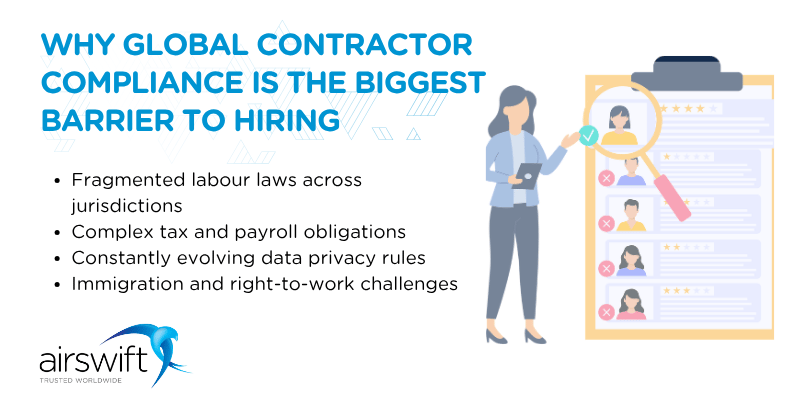
Employer of Record (EOR) is one of the most widely used services for handling contractor and employee compliance across multiple countries.
What does an EOR do?
- Legally employs workers on your behalf in each country, even where you have no local entity.
- Manages local contracts, payroll, tax withholding, social security, and statutory benefits in line with national rules.
- Keeps pace with legal changes, so you do not need to track every update to labour codes and tax law.
For technical teams expanding into new markets, EOR is often the fastest way to engage talent legally without building full HR and legal infrastructure in every country.
2. Global payroll outsourcing for contractors and employees
Global payroll outsourcing goes hand‑in‑hand with EOR. Instead of trying to run fragmented local payrolls, you centralise contractor and employee pay through a single specialist partner.
What does a global payroll provider do?
- Calculates and processes gross‑to‑net pay in each country, applying local tax, social security, and statutory deductions.
- Issues country‑specific documents (such as W‑2s in the US, P60s in the UK) and manages local payroll filings.
- Monitors changes to tax rates, social insurance schemes, and reporting rules, updating workflows whenever regulations shift.
For technical contractors, correct and timely pay is both a compliance requirement and a major driver of retention.
3. Global Employment Outsourcing (GEO) and multi‑country contractor management
Global employment outsourcing (sometimes called GEO) is a broader service model that combines recruitment, EOR, payroll, and mobility under one umbrella.
What do GEO services usually cover?
- Talent acquisition and contract hire in multiple countries through a single provider.
- In‑country support in project locations where the client lacks an entity, with the provider acting as the local employer and compliance expert.
- Ongoing consulting on country‑specific employment laws, labor inspections, and risk mitigation.
This is the kind of integrated solution that lets technical leaders focus on project delivery rather than navigating each jurisdiction alone.
4. Contractor classification and compliance advisory
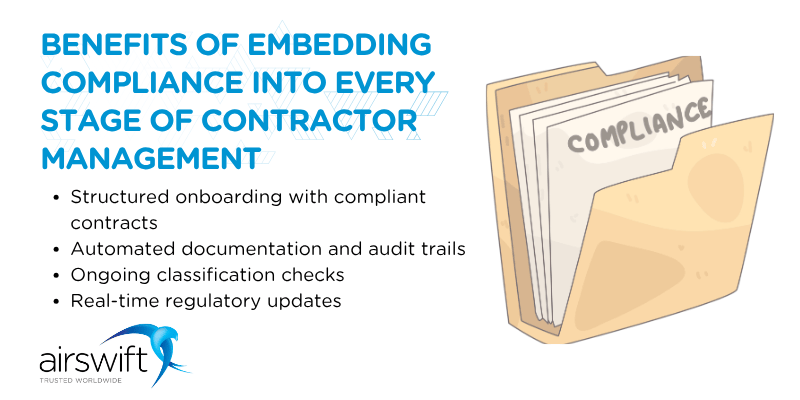
Staying compliant is not only about who runs payroll; it starts with correctly classifying each worker and structuring the relationship in line with local law.
How do specialist technical staffing partners help?
- Assessing whether each role should be engaged as an employee, independent contractor, or via EOR, based on local labour tests.
- Drafting compliant contracts that clearly define scope, control, deliverables, and IP, reducing misclassification risk.
- Reviewing arrangements regularly as laws, case precedent, or tax guidance change in each country.
Working with a provider that understands these nuances across markets is often the difference between safe flexibility and costly reclassification.
5. Global contractor management platforms with compliance built‑in
Some providers offer contractor management platforms where compliance is baked into the workflows: onboarding, contract generation, payments, and record‑keeping.
What features do global contractor management platforms typically include?
- Centralised contractor records with country‑specific compliance fields (work status, permits, insurance, tax forms).
- Automated reminders for expiring documents (for example, visas, certifications) and audit‑ready logs of approvals and changes.
- Integration with EOR and global payroll services to ensure that data flows correctly from onboarding to payments and reporting.
A single platform, well developed platform can handle contractor management and keep gig workers compliant across borders. Combined with the right advisory layer, this gives technical companies a scalable way to manage contractor compliance at volume.
6. Immigration, visa, and work permit services
For many technical roles, especially in energy, IT, or infrastructure, the best candidate may not hold the right to work in the project country. Multi‑country staffing providers often bundle immigration support into their compliance offering.
What do staffing providers’ immigration services typically include?
- Eligibility assessments and advice on the most suitable visa or permit route for each contractor.
- Preparation and submission of visa, work permit, and sponsorship documentation, aligned with local rules.
- Coordination between immigration timelines and project start dates to avoid non‑compliant “early starts.”
When providers handle this centrally, you reduce the risk of sanctions, fines, or forced project delays.
7. Local benefits, social security, and co‑employment risk management
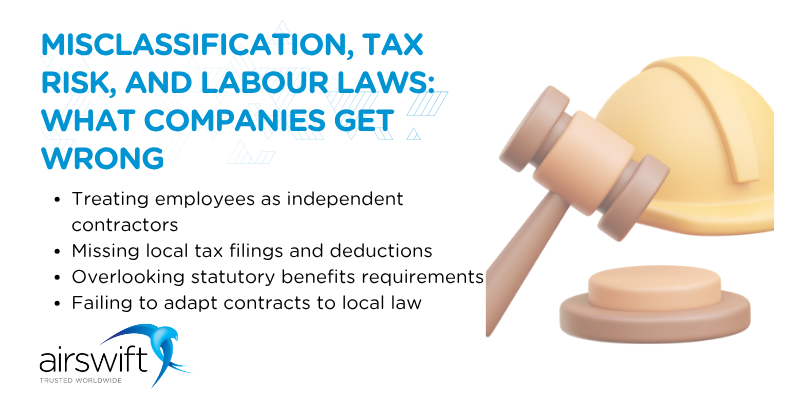
Compliance is also about what you provide, not just how you classify and pay. In many countries, mandatory benefits and social protections apply even to certain contractor categories.
How do technical staffing and workforce solutions providers help?
- Mapping statutory benefits (for example, pension, healthcare, insurance, holidays) that must be offered in each country.
- Administering these benefits under EOR or GEO structures so individuals are treated fairly and lawfully.
- Managing co‑employment risks when clients use third‑party staffing partners, ensuring roles and responsibilities are clearly defined.
This is particularly important when contractors work side‑by‑side with employees in long‑term technical projects.
8. Ongoing global compliance management and monitoring
Finally, compliance is not “set and forget.” Laws, tax regimes, and enforcement priorities change regularly, so global contractor compliance needs continuous management.
How do leading providers support global compliance management?
- Monitoring legislative updates across key markets and updating processes and templates accordingly.
- Conducting periodic compliance reviews, looking at classifications, documentation, contracts, and pay practices against current rules.
- Providing clients with regular reporting on compliance status, identified risks, and remedial actions.
This ongoing oversight is what turns a technical staffing vendor into a true compliance partner.
5 FAQs about multi‑country contractor compliance
1. What types of technical staffing providers can handle contractor compliance across multiple countries?
You should look for global workforce solutions providers that combine recruitment with EOR, global payroll, and compliance consulting rather than pure agencies. These providers are better equipped to manage the legal, tax, and regulatory complexities of hiring contractors across different jurisdictions.
2. How does an Employer of Record differ from a traditional staffing agency?
A traditional agency primarily sources candidates and may run local payroll, but an EOR becomes the legal employer in each country, assuming responsibility for contracts, taxes, social security, and statutory benefits. This makes EOR particularly suited to multi‑country compliance where clients do not want to establish local entities.
3. Can global payroll outsourcing cover both contractors and employees?
Yes. Many global payroll providers support compliant payments for both employees and certain categories of contractors, depending on the country. In some cases, a single platform can manage contractor payments while helping ensure gig workers remain compliant within local regulations.
4. What are the biggest compliance risks when hiring technical contractors internationally?
Key risks include misclassifying contractors as self‑employed when they should be employees, failing to withhold or report taxes correctly, breaching local labour standards, and mishandling personal data. Choosing the wrong hiring model or overlooking country-specific regulations can lead to fines, back pay obligations, or forced reclassification.
5. When should a company consider using an EOR or GEO instead of hiring directly?
You should consider EOR or GEO when you want to engage technical talent in a country where you lack a legal entity, when speed to hire matters, or when you do not have in‑house expertise on local labour, tax, and immigration rules. These models let you test or scale in new markets while a specialist partner manages the compliance complexity on your behalf.
Simplify multi-country contractor compliance with the right partner
Managing contractor compliance across multiple countries is complex, but it does not have to limit your growth. With the right partner, you can engage technical talent quickly while staying compliant with local labour laws, tax requirements, and employment regulations in every market.
If you are exploring international expansion or scaling contract hires, Airswift offers integrated recruitment, Employer of Record (EOR), and global payroll services across 60+ countries to support your ambitions. You can connect with an Airswift expert to discuss your specific hiring challenges and explore the most effective approach for your business.