
By
Alicia Edwards
July 15, 2025
Updated
July 17, 2025
What does Annual Wage Supplement mean?
The Annual Wage Supplement, often called the 13-month bonus, is a fixed, year-end payment equal to one month of an employee’s basic salary. Unlike variable bonus payments that hinge on a company’s performance metrics or an individual’s sales targets, the AWS is normally written into the employment contract and paid to full-time employees and eligible contract workers as part of their regular reward package.
When someone asks, “what is annual wage supplement?” you can answer in one line: it is a lump-sum top-up treated as supplemental wages under many tax regulations designed to help staff cover holiday-season costs or grow their savings.
How did AWS start and who pays it today?
The practice took off in post-war Europe and later spread across Asia. In Singapore, the Ministry of Manpower encourages (but does not compel) firms to pay up to one month if business results allow. Multinationals now extend the perk to UK, US and EU payrolls to keep parity with regional packages.
In markets such as Singapore and Malaysia, workers even budget for the AWS when using a home-buying salary calculator. In Germany or Italy, similar 13-month or 14-month structures are mandated by local labour laws. The United Kingdom has no statute, yet global tech firms still offer it to boost employee satisfaction and remain competitive during a talent shortage or recession.
Eligibility rules and edge cases
Most firms require a full calendar year of service. HR will pro-rata the supplement when someone joins mid-year. Common clauses include:
- Probation period. Staff still in probation usually get a partial AWS or must wait until confirmation.
- Severance pay. Departing employees can receive the AWS they have accrued, provided local employment regulations allow it.
- Off-cycle payroll run. A pro-rated AWS may be released off-cycle if somebody resigns late in the year.
- Equity holders. Employees with stock options generally still receive the cash AWS unless policy states otherwise.
An established history of paying the AWS can become an implied contract term, so HR leaders should document any change well before the review date.
Core mechanics of an AWS payment
An AWS is simple:
- AWS calculation. How to calculate Annual Wage Supplement: One month of pay multiplied by the AWS factor, typically 1.0. A monthly salary of £3 200 therefore yields a £3 200 AWS.
- Payroll system entry. Finance schedules the lump sum for December or splits it between June and December to smooth cash flow.
- Taxation and deductions. The payment is subject to income tax, National Insurance in the UK, Medicare taxes and Social Security in the US, and—up to the CPF Annual Salary Ceiling—a CPF contribution in Singapore.
- Payslip coding. The stub shows a clear “13th-Month / AWS” line so auditors can distinguish it from variable payments such as commissions, equity grants or signing bonuses.
Because the AWS counts as ordinary wages, US employers must include it in federal income-tax withholding and report it to the Internal Revenue Service. Singapore entities declare the figure to the Inland Revenue Authority of Singapore and the Central Provident Fund board.
Why employers offer an AWS
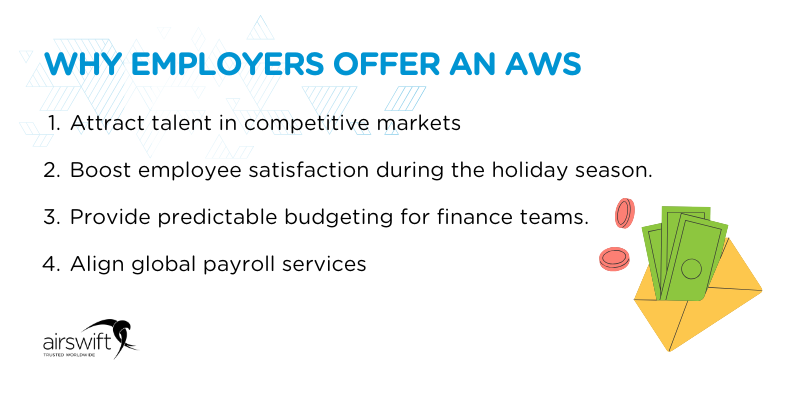
- Attract talent in competitive markets. Job adverts listing “12 months + AWS” stand out, especially among Singapore permanent residents who rely on the supplement for mortgage planning.
- Boost employee satisfaction during the holiday season. Extra cash lifts morale and reduces December turnover; many HR solutions track AWS sentiment in performance reviews.
- Provide predictable budgeting for finance teams. Because the formula is fixed, accountants can accrue one-twelfth of the cost each month and protect the profit margin from surprise bonus spikes.
- Align global payroll services. A single AWS policy simplifies multi-country payroll services and keeps packages consistent across different HR teams and vendors.
Drawbacks and mitigation
- Cash-flow pressure. Smaller firms may struggle with a large December payout, so some set aside monthly accruals or split the payment mid-year.
- Fixed cost in downturns. Cancelling AWS during layoffs can spark legal disputes. Employers often reserve adjustment rights in the employment contract.
- Tax complexity. Multi-country AWS forces companies to juggle US Social Security, UK National Insurance and Singapore CPF rules. A modern payroll system with global compliance flags is essential.
Taxation and reporting hotspots
United Kingdom. The supplement is ordinary pay, subject to PAYE withholding and National Insurance. Add the figure to the year-end P60 totals.
Singapore AWS is usually capped at one month unless a union or contract states more. Employers must declare it to IRAS, and both employer and worker share CPF on the lump sum.
United States. AWS falls under supplemental wages; companies must apply federal income-tax withholding (flat-rate or aggregate method) and include the sum in boxes for Social Security and Medicare on Form W-2.
Local labourbor laws may link the payment to leave-management rules or severance packages, so specialist legal counsel should confirm every regional nuance.
Linking AWS to a broader reward strategy
The supplement should not sit in isolation. Leading HR leaders weave it into a wider package that can also include performance-linked bonuses, equity grants or stock options. During annual review cycles, managers can present an AWS breakdown on reward dashboards. Modern HR solutions now give department heads self-service access to AWS analytics by grade, tenure or gender data that supports fair-pay decisions and diversity goals.
Implementation checklist for HR teams
- Draft or update AWS clauses using industry templates from a reliable contract database.
- Confirm the maximum amount permitted under any collective agreement.
- Test the payroll system with a staging record and an off-cycle payroll run.
- Communicate after-tax figures so staff understand the connection between AWS, income tax and Social Security.
- Publish an FAQ that covers probation rules, pro-ration and any clawback tied to business results.
Should you adopt an Annual Wage Supplement?
Assess four points before deciding:
- Market practice. Peers in sectors such as fintech or manufacturing may already pay an AWS.
- Employee satisfaction. Engagement surveys often show a sharp rise when a thirteenth-month payment is introduced.
- Cost modelling. Insert an AWS line in salary forecasts and test worst-case scenarios.
- Legal fit. Ensure compliance with local regulations, from UK employment-rights case law to Singapore CPF rules.
If the numbers stack up, the AWS can offset rising signing bonuses and other variable payments while delivering a clear, predictable reward.
Final thoughts
The annual wage supplement remains a straightforward, morale-boosting perk. By writing it into the employment contract, codifying the AWS calculation and routing it through compliant payroll services, companies strengthen loyalty without relying solely on volatile performance-linked payouts. Once you promise an extra month’s pay, staff will plan around it, so schedule accruals, communicate early and monitor local tax regulations. Done well, the AWS becomes a lasting pillar of a data-driven total-reward strategy.
Visit Airswift’s workforce solutions page to learn how our flexible talent strategies can help your business adapt, scale, and thrive in today’s dynamic market.