By
Tomás Battaglia
August 26, 2025
Updated
August 26, 2025
The renewable energy industry is evolving at an extraordinary pace, driven by global efforts to reduce carbon emissions and transition to cleaner sources of power. Solar, wind and hydropower projects are expanding rapidly, reshaping the energy landscape and creating new opportunities for businesses and professionals alike.
According to the International Energy Agency, global renewable power capacity is expected to increase by more than 1,500 gigawatts between 2024 and 2029, surpassing the total electricity capacity of the United States. Solar energy alone is set to account for over two-thirds of this growth, supported by falling costs and favourable policy frameworks.
As the sector scales, human resources teams play a vital role in enabling this transformation. From strategic workforce planning to attracting and retaining top talent, HR professionals are central to building resilient and future-ready teams.
In this article, we explore the most pressing HR challenges facing the renewable energy industry today and share practical strategies to help your organisation overcome them and thrive in a competitive global market.
Attracting the right talent
Finding the right candidates remains one of the most pressing challenges in the renewable energy sector. As the industry grows, so does the demand for professionals with a diverse mix of skills, from engineering and environmental science to data analytics and automation. Many roles are field-based and require not only technical expertise but also the ability to think systemically and contribute to sustainable solutions.
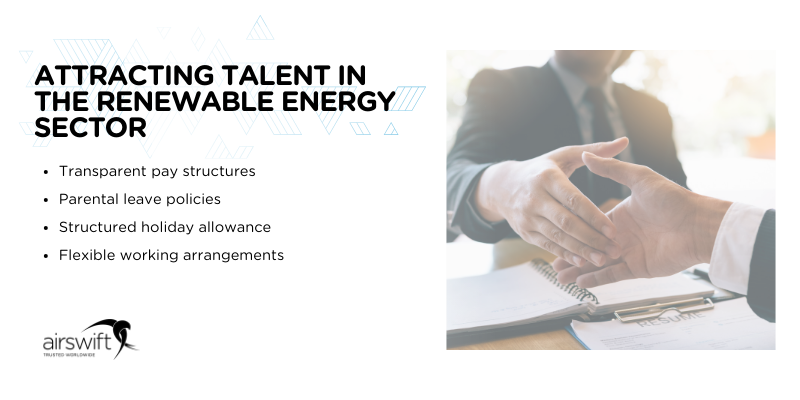
To attract top talent, companies must invest in a thoughtful and inclusive recruitment strategy. This means highlighting benefits that resonate across different demographics and career stages. Examples include:
- Transparent pay structures
- Parental leave policies
- Structured holiday allowance
- Flexible working arrangements
Beyond traditional energy roles, there is an increasing need to recruit tech professionals. Digitalisation is reshaping the sector, and roles such as software developers, cybersecurity analysts and AI specialists are becoming essential. However, competition for tech talent is fierce, with candidates often drawn to established brands in finance, healthcare and technology.
To stand out, renewable energy companies should:
• Strengthen their employer branding to communicate a clear and compelling value proposition
• Emphasise the environmental impact of their work, which can be a powerful motivator for purpose-driven candidates
• Showcase career development opportunities and the chance to work on innovative, high-impact projects
Building long-term commitment in a competitive market
Attracting the right candidates is only the beginning. Once you have built a skilled and motivated team, the next challenge is keeping them engaged and committed for the long term.
Recent industry reports show that retention is becoming increasingly difficult, especially as competition for talent intensifies across sectors. Many professionals in renewable energy are open to exploring opportunities elsewhere, not necessarily due to dissatisfaction, but because of concerns around career progression, leadership gaps and the pace of innovation in the sector.
One of the key factors influencing retention is the availability of development opportunities. When employees feel they are growing professionally, they are more likely to stay. This is particularly important in areas where talent shortages persist, such as strategic planning, leadership and process management. Without investment in these areas, companies risk reduced productivity and operational inefficiencies.
To address this, organisations should consider:
• Introducing structured training programmes and apprenticeships to upskill existing staff
• Creating clear pathways for career advancement
• Offering mentorship schemes to support leadership development
• Encouraging cross-functional learning to build more versatile teams
These initiatives not only help close skills gaps but also signal a long-term commitment to employee growth. When people see a future for themselves within the company, they are more inclined to stay and contribute meaningfully.

Scaling teams for rapid project deployment
As renewable energy projects continue to multiply, HR teams face mounting pressure to scale operations quickly and efficiently. Most work in the sector is project-based, which means companies must be able to mobilise skilled teams at short notice, often in remote or unfamiliar locations.
This urgency has led to increased reliance on contract workers and globally mobile professionals. To manage this effectively, companies need a proactive approach to workforce planning. Maintaining a strong talent pipeline is essential. By staying in touch with candidates throughout the recruitment process, you can build a pool of pre-qualified professionals ready to be deployed when new projects arise.
Expanding your search beyond local markets is also key. Tapping into international talent pools allows you to access specialised skills that may be scarce in your region. Partnering with a global workforce solutions provider can help streamline this process, offering support with immigration, compliance, background checks and onboarding while also contributing to strategic workforce planning in the energy transition.
.png?width=800&height=400&name=Contingent%20staffing%20offers%20fast%2c%20flexible%20access%20to%20skilled%20talent%E2%80%94helping%20teams%20stay%20agile%2c%20cost-effective%2c%20and%20ready%20for%20change.%20(1).png)
Supporting global mobility and employee wellbeing
As renewable energy projects expand across borders, companies increasingly rely on international talent to meet demand. Many professionals relocate to work on projects in remote or unfamiliar regions, which can present significant personal and professional challenges. Ensuring that expatriates feel supported and settled is essential for maintaining motivation, wellbeing and productivity.
HR teams play a crucial role in helping employees adapt to new environments. This includes cultural integration, family support and practical relocation logistics. When these needs are overlooked, it can lead to disengagement, reduced performance and even early contract termination.
Partnering with a global mobility provider can ease this burden by managing key aspects of the relocation process. Services may include:
• Immigration and visa support
• Property management and housing assistance
• Intercultural training and language support
• Counselling and family relocation services
These services not only help employees feel more at home but also demonstrate a company’s commitment to their wellbeing, which can improve retention and strengthen employer reputation.
Creating an inclusive and future-ready workforce
Diversity and inclusion are essential to the success of the renewable energy sector. As the industry evolves, companies must build teams that reflect a wide range of backgrounds and experiences. This not only fosters fairness but also drives innovation and resilience.
Despite growing awareness, representation gaps remain. In oil and gas, for example, women still account for only around one fifth of the workforce. While the outlook is more promising in renewables, there is still room for improvement in gender balance, ethnic diversity and inclusive career progression.
HR teams can take practical steps to build a more inclusive culture:
• Use inclusive language in job descriptions to attract a broader range of candidates
• Gather regular feedback on career development to ensure all employees feel supported
• Monitor promotion and pay trends to identify and address unconscious bias
• Make training and development opportunities accessible to all staff
Creating a workplace where everyone feels valued and empowered helps attract purpose-driven talent and strengthens long-term retention.
Partner with Airswift to address your HR challenges
Navigating HR challenges in the renewable energy sector requires agility, insight and the right partnerships. From attracting top talent and reducing turnover to scaling teams for global projects and fostering inclusive workplaces, each step demands strategic planning and expert support.
Airswift specialises in workforce solutions tailored to the energy industry. With decades of experience and a global presence, we help companies build resilient teams, streamline mobility processes and stay competitive in a fast-changing market.