
By
Nathalia Duarte
July 6, 2026
Updated
July 6, 2026
Are you looking for job opportunities in Australia, but wondering if the work visa process could keep you up at night? You're not alone. Between choosing the right visa, understanding eligibility requirements, and gathering the necessary documents, the process can feel overwhelming, especially for first-time applicants.
Whether you're pursuing a temporary role, permanent migration, or a working holiday, understanding your visa options is an essential first step towards working legally in Australia.
In this article, we explain the main Australian work visa categories, outline the application process, and cover the key requirements for both employers and employees to help you navigate the process with confidence.
What are the main Australian work visa types?
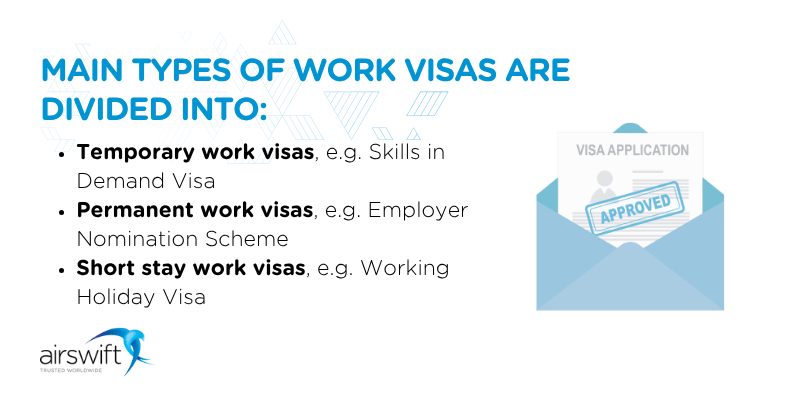
Australia offers several work visa options depending on your skills, employment status, and intended length of stay.
Temporary visas are typically designed for skilled workers, trainees, and employer-sponsored candidates, while permanent visas provide a pathway to long-term residence and employment.
Short-stay visas are available for specialist work assignments and young travellers who want to work while visiting Australia.
Temporary work visas:
- Skills in Demand (SID) Visa (subclass 482)
One of Australia's most common work visas, designed for skilled workers sponsored by approved employers. Applicants must have the required skills and experience for the role and meet English language requirements. The visa allows stays of up to four years. - Skilled Employer Sponsored Regional Visa (subclass 494)
A provisional visa for skilled workers sponsored by employers in regional Australia. Valid for up to five years, it requires applicants to have an occupation on the relevant skilled occupation list, complete a skills assessment, be under 45, and meet English language requirements. - Training Visa (subclass 407)
A temporary visa for workplace-based training and professional development. Applicants must be sponsored, nominated, or invited and can stay in Australia for up to two years.
Permanent work visa:
- Employer Nomination Scheme (subclass 186)
A permanent employer-sponsored visa for skilled workers nominated by an approved Australian employer. Applicants must meet health, character, and English language requirements. - Independent Visa (subclass 189)
A points-tested permanent visa for invited skilled workers with occupations in demand in Australia. No employer or state sponsorship is required, but applicants must be under 45 and receive an invitation to apply. - Skilled Nominated Visa (subclass 190)
A permanent visa for skilled workers nominated by an Australian state or territory government. It allows holders to live, work, and study in Australia, sponsor eligible relatives, and apply for citizenship if eligible.
Short stay work visas:
- Short Stay Specialist Visa (subclass 400)
A short-term visa for highly specialised, non-ongoing work in Australia. It is generally granted for up to six months and cannot be extended. - Working Holiday Visa (subclass 417)
For young adults aged 18 to 30 (or up to 35 for eligible countries) who want to travel and work in Australia. Applicants must hold a passport from an eligible country and cannot be accompanied by dependent children. - Work and Holiday Visa (subclass 462)
A similar visa for young adults aged 18 to 30 who wish to fund their travels through short-term work. Applicants must hold a passport from an eligible country and cannot bring dependent children.
How to apply for an Australian work visa?
The Australian work visa application process involves steps for both employers and employees.
For sponsored visas, employers must first demonstrate that they cannot fill the role locally, obtain the necessary sponsorship approvals, nominate the position, and provide supporting documentation. They must also meet ongoing compliance obligations throughout the sponsorship period.
Applicants, meanwhile, must ensure they meet the requirements of their chosen visa category. Depending on the visa type, this may include obtaining a skills assessment, securing a job offer, proving English language proficiency, and completing health and character checks.
What employers need to provide
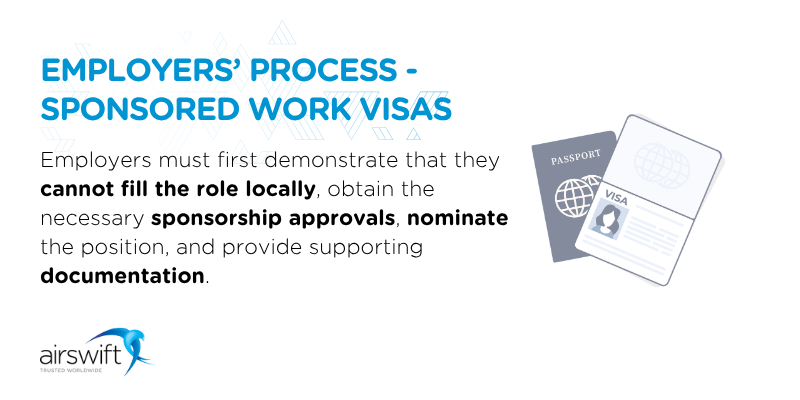
For sponsored work visas, employers must:
- Complete Labour Market Testing (LMT):
Advertise the role through approved channels and demonstrate that no suitable Australian worker is available. - Obtain a sponsorship license:
Secure a valid sponsorship license from the Department of Home Affairs by providing business registration details, financial information, and any required training commitments. - Nominate the position:
Submit a nomination for the role and the candidate through ImmiAccount, where applicable. - Provide supporting documentation:
Supply a clear job description, employment contract, and justification for the hire. - Meet ongoing compliance obligations:
Comply with sponsorship requirements after nomination or visa approval, including verifying employees' work rights through VEVO.
What employees need to provide
.png?width=800&height=400&name=employees%20%20process%20(1).png)
Requirements vary by visa type. For points-tested skilled visas, applicants must first submit an Expression of Interest (EOI) through SkillSelect and receive an invitation before applying. In most cases, work visa applicants will need:
- A valid passport for the duration of their stay in Australia.
- A skills assessment, where required, from the relevant assessing authority.
- A job offer or employment contract, if applicable to the visa category.
- Proof of English language proficiency through a recognised test, such as IELTS or PTE.
- Health and character clearances, including any required medical examinations and police certificates.
To understand each visa requirement, visit the Australian Department of Home Affairs page.
10 factors that can affect an Australian work visa application
Several factors can influence whether an Australian work visa is approved and how long it takes to process, such as:
- Visa eligibility: Applicants must meet the specific requirements for their chosen visa, including age limits, qualifications, skills, and work experience.
- Occupation requirements: Many skilled visas require the applicant's occupation to appear on the relevant skilled occupation list.
- Skills assessment results: Some visa categories require a positive skills assessment from an approved assessing authority.
- English language proficiency: Applicants may need to demonstrate their English language ability through recognised tests such as IELTS or PTE.
- Employer sponsorship: For sponsored visas, the sponsoring employer must be approved and meet all sponsorship and nomination requirements.
- Labour Market Testing (LMT): Employers may need to show that no suitable Australian worker is available for the role before sponsoring a foreign worker.
- Health requirements: Applicants must complete any required medical examinations and meet Australia's health standards.
- Character requirements: Police certificates and background checks may be required to demonstrate good character.
- Application volumes and processing priorities: Processing times can vary depending on demand, visa category, and government priorities at the time of application.
- Payment of application fees: Applications are not processed until the required visa fees have been paid.
Where do I submit my Australian work permit application?
Australian work visa applications must be submitted online through ImmiAccount. Before applying, ensure you have gathered all required documents and paid the relevant visa application fee, which varies by visa type. Your application will not be processed until payment is received.
After submission, make a note of your Transaction Reference Number (TRN), as you will need it to track your application and communicate with the Department of Home Affairs.
Be sure to check your application status regularly through ImmiAccount, as the Australian government may request additional information or supporting documents during the assessment process.
How long does it take to process a work visa?
Processing times for Australian work visas vary depending on the visa type, the applicant's circumstances, application volumes, and government priorities. For the latest estimates, check the Department of Home Affairs' visa processing times tool.
As a general guide, processing times can range from a few days for some working holiday visas to several months for skilled and employer-sponsored visas. Permanent skilled visas typically take longer and may take close to a year to process in some cases.
Applicants should ensure all required documents are submitted correctly, as missing information can lead to delays.
Once I have a work visa in Australia, can I work in any profession?
Not always. For most employer-sponsored and temporary work visas, your work rights are linked to the role, employer, occupation, or region specified in your visa. Working in a different position or for a different employer may require a new visa or approval.
The main exceptions are permanent skilled visas, which generally allow holders to work for any employer, and working holiday visas, which offer greater flexibility to take short-term jobs while travelling. However, working holiday visas are designed for cultural exchange and travel rather than long-term employment.
Before changing jobs or occupations, it is important to check the conditions attached to your visa to ensure you remain compliant.
How can I extend my Australian work permit?
Whether you can extend your stay depends on your visa type. Some visas can be renewed or replaced with a new visa, while others require you to apply for a different visa category before your current visa expires.
For employer-sponsored visas, such as the Skills in Demand (subclass 482) visa, you may be able to remain in Australia if your employer continues to sponsor you and you meet the visa requirements.
Working holiday visa holders may be eligible for a second or third Working Holiday visa, provided they meet the relevant eligibility criteria.
To avoid gaps in your work rights, submit your new visa application before your current visa expires. If eligible, you may be granted a bridging visa that allows you to remain in Australia while your application is being processed.
Always check the Australian Department of Home Affairs website for the latest eligibility requirements and visa options.
Looking for a job opportunity in Australia?
If you're considering a move to Australia for work, Airswift can connect you with employers experienced in hiring international talent. With a global network and deep expertise across key industries, Airswift helps professionals identify opportunities that align with their skills, experience, and career goals.
Whether you're just starting your job search or ready to apply, partnering with a specialist recruiter can help simplify the process. Browse Airswift’s latest vacancies to explore opportunities across Australia and take the next step in your career.