By
Leanna Seah
July 24, 2025
Updated
February 20, 2026
Are you trying to decide between the different types of Recruitment Process Outsourcing (RPO) arrangements? This guide is for you.
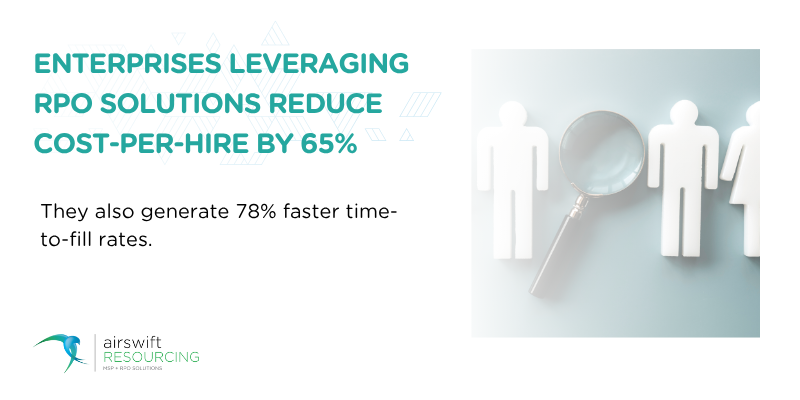
According to research by Ardent Partners and Future of Work Exchange, enterprises leveraging RPO solutions reduce cost-per-hire by 65% and generate 78% faster time-to-fill rates.
Read on for a clear answer on which model suits your hiring goals, budget, growth plans, and the talking points you need to win over the rest of the leadership team.
What is recruitment process outsourcing and how does it work?
Recruitment Process Outsourcing is a partnership in which an external service provider manages all or part of your company’s hiring activities.
An RPO provider supports the recruitment of permanent employees. Acting as an extension of your HR team, we assess your current recruitment processes and implement solutions to help scale and optimise hiring efforts.
This provides the flexibility and efficiency of an in-house team while reducing costs.
When does recruitment process outsourcing make sense?
Businesses turn to RPO for many reasons, usually a combination of the circumstances listed below. But it's worth remembering that an RPO can’t fix deeper organisational issues like a weak employer brand or unclear hiring priorities.
Part of outsourcing is being open to change. The right partner will bring strategies to help you improve recruitment, but they need the space to make an impact.
Predictable, high-volume demand
If your headcount plan calls for dozens (or hundreds) of hires every quarter, an RPO’s dedicated team, processes, and technology can help you scale quickly and efficiently.
Need for data-driven optimisation
Best-in-class RPO contracts include service-level agreements covering time-to-hire, quality-of-hire, and Candidate Net Promoter Score (cNPS), all supported by real-time dashboards your leadership team can access. Companies that use RPO see a 62% increase in cNPS.
Limited or overstretched internal TA infrastructure
Start-ups and high-growth scale-ups often lack the recruiter head-count, ATS configuration and EVP assets to compete for talent. An RPO partner embeds those capabilities on day one, acting as an instant TA department but funded as an operating expense rather than payroll.
Strategic workforce planning, not just filling jobs
Mature RPO providers run market mapping, skills-gap analysis and succession pipelines alongside day-to-day recruiting.
Multi-country expansion and compliance risk
Expanding into a new market brings unfamiliar labour laws, payroll rules, and reporting requirements. An experienced RPO partner can handle right-to-work checks, payroll, and compliance—lightening the load on your legal team. They also help ensure a consistent candidate experience across regions, which protects your employer brand.
Transformation, M&A or large-scale change programmes
When a business undergoes a merger, plant relocation, or digital overhaul, internal teams are often spread thin across change-management work. Handing recruitment to an RPO provider frees HR to focus on organisational design while ensuring that critical vacancies are still filled quickly.
Which RPO model is best for your business?
End-to-end RPO
In an end-to-end RPO (or enterprise RPO), the provider manages the entire recruitment lifecycle from workforce planning to onboarding. They act as your in-house hiring team, often sitting on-site or fully integrated into your internal systems and processes. This model offers the deepest level of partnership and is usually long-term, designed for consistent, ongoing recruitment across the business.
When it’s the best fit:
- You have a steady volume of open roles across departments or geographies. An end-to-end RPO ensures continuity and efficiency when recruitment is constant and touches multiple teams or regions.
- You need to improve consistency, compliance, and time-to-hire.
Centralising recruitment through one provider streamlines processes, enforces compliance, and speeds up hiring timelines. - You want strategic input into workforce planning and employer branding. Mature RPOs help shape long-term talent strategy, succession plans, and your employer value proposition.
- You're replacing an in-house talent acquisition (TA) function or scaling quickly without the internal resources to manage hiring. Instead of building your own recruitment team, an end-to-end RPO gives you instant infrastructure, tools, and expertise.
Project RPO
Designed for high-volume or time-sensitive hiring needs, this model provides all the advantages of a full RPO but for a limited time to support project-based recruitment goals. It’s a fixed-term engagement that gives you focused support to mission-critical hiring efforts.
When it's the best fit:
- You’re opening a new site or entering a new country and need to hire fast. Project RPOs can deploy recruiters quickly to hit ambitious hiring targets while navigating local labour laws and talent markets.
- You're rolling out a product or service that demands specialist headcount. If success depends on quickly hiring niche skill sets, a project RPO brings market reach and sourcing firepower.
- You need to hire 30 engineers in three months, but won’t need that pace long-term. A project-based setup helps you scale fast without committing to long-term costs or permanent headcount.
On-demand RPO
Offering flexible, as-needed support, this model allows you to tap into RPO expertise when required. The service provider supplies trained recruiters to supplement your in-house team, offering scalable support managed by you—typically with a minimum six-month commitment.
When it’s the best fit:
- You have unpredictable hiring spikes and want to avoid overstaffing internally. On-demand RPO gives you access to recruiters exactly when you need them—without the burden of keeping a large internal team during quiet periods.
- You need to backfill for internal recruiters on leave or during peak times. Whether it's maternity cover or seasonal surges, on-demand support ensures hiring doesn’t stall due to internal gaps.
- You’re testing new markets or launching a short-term programme. When you're unsure if growth will last, this model helps you test the waters without overcommitting.
- You want to avoid the overheads of building a full TA function. Startups and lean teams benefit from a plug-and-play model that delivers results without the investment in tools, training, and salaries.
Hybrid RPO
.png?width=626&height=313&name=Hybrid%20RPO%20models%20(1).png)
A hybrid model combines the strengths of your in-house recruitment team with the support of an external RPO provider. New research shows that companies using a hybrid RPO model are 65% more likely to achieve scalable hiring.
This approach is useful when you require specialised expertise or additional resources for specific hiring needs. By partnering with an RPO provider for targeted areas, you can maintain control over core recruitment functions while benefiting from external support where necessary.
When it's the best fit:
- Unpredictable hiring spikes
If requisitions jump in some quarters and fall the next, a hybrid set-up lets you “dial up” external recruiters only when the curve rises. Advanced RPOs position their hybrid service as on-demand capacity that can scale by role type, region, or business line, sparing you the fixed fee of an enterprise RPO. - Niche or hard-to-fill roles alongside business-as-usual hiring
Let your in-house team focus on familiar, generalist roles—then bring in external specialists to tackle niche hires like cybersecurity leads, bilingual sales managers, or other hard-to-fill positions. - Strong employer brand that you want to protect
Your team still owns early candidate messaging, culture pitches, and final selection, while the partner manages sourcing and first-round screening. - Internal TA already in place but stretched
A hybrid model plugs experience, tools, and market intel into a competent but overloaded team. Rather than adding permanent recruiters, you tap external bandwidth only for the overflow, easing payroll and head-count constraints. - Test bed before a full RPO
Leadership still unsure about wholesale outsourcing? A hybrid pilot for one division shows the service level agreement (SLA) data, stakeholder feedback, and candidate experience gains without committing the whole company. - Knowledge transfer to upskill your recruiters
External sources bring market mapping tools and fresh techniques. Working side by side, your team learns new channels and analytics, then retains that know-how once demand subsides.
Signs it's time to transition to an RPO
The right recruitment model depends on your organisation’s goals, team capacity, and talent demands. If you're starting to feel the strain, here are some signs it might be time to consider RPO:
- Your annual hiring plan is growing faster than internal recruiters can scale.
- Leadership wants one point of accountability for global talent metrics.
- Multiple external suppliers are creating inconsistent processes or duplicated effort.
- You’re struggling to source hard-to-find or niche skill sets.
Partner with a top-tier RPO agency
Choosing between RPO models comes down to capacity, culture fit, and the complexity of the roles you need to fill.
Look for a partner with sector expertise, transparent pricing, and the flexibility to scale as your hiring demand changes.
Contact us if you're ready to explore an RPO partnership.