
By
Diyaa Mani
March 18, 2026
Updated
March 18, 2026
How do I know when it's time to consider an MSP?
As contingent workforce demands grow, most organisations don’t suddenly wake up and decide they need a Managed Service Provider (MSP). Instead, the signs appear gradually; processes stretch, costs rise, and visibility becomes harder to maintain.
What begins as a manageable program quietly becomes a complex ecosystem of suppliers, contracts, and workers that requires a more structured approach.
If your teams are feeling the strain, or if your current model no longer provides the clarity and control you need, the following indicators will help you assess whether an MSP is the right next step.

You’ve quietly crossed the “critical mass” threshold
If you have 50 to 125 or more contractors, temps, and statement of work (SoW) resources, you are in classic MSP territory. At this scale, ad hoc processes and spreadsheet tracking stop working, and visibility over contractors, rates, and suppliers become fragmented.
GETI 2026 reports that 50% to 53% of energy professionals received salary increases, reflecting rising competition and contractor pay rates. With higher costs and demand, manual tracking becomes not just inefficient but also risky.
MSP's are specifically designed for organisations with a large number of non-permanent staff spread across multiple locations, business units, and agencies.
If you’re spending a significant annual budget on contingent labour and still cannot answer basic questions like “How many contractors do we have globally, and what are we paying?", it’s time to consider an MSP solution.
You rely on too many suppliers with no real strategy
If your vendor list has grown organically rather than by design, you likely face inconsistent rates, varying contract terms, and uneven service quality. Procurement and HR teams may end up chasing contracts, trying to standardise terms, and firefighting supplier performance issues instead of driving strategic value.
An MSP consolidates and rationalises your supplier base into a fit-for-purpose, fully engaged supply chain. That means harmonised commercials, clearer performance expectations, and transparent reporting on which partners are delivering and which are not.
Time-to-hire is slipping and projects are at risk
When it takes too long to get contractors onboarded, your current model is reaching its limits. Lengthy requisition approval, fragmented sourcing, and manual onboarding can delay critical projects and erode stakeholder confidence.
GETI shows 33% of professionals were contacted from outside their sector, giving them more options and increasing the risk of losing candidates if internal hiring timelines lag. MSPs centralise and accelerate sourcing, dramatically reducing time‑to‑hire.
An MSP centralises and streamlines the end-to-end process, from requisition through sourcing, screening, and onboarding. By introducing standard workflows, clear SLAs, and often a Vendor Management System (VMS), MSP programs consistently reduce time-to-hire and minimise ramp-up time so contingent workers are productive sooner.
You have little visibility into your contingent workforce
If you can’t easily report how many contingent workers you have, where they are, what they do, and what they cost, you’re operating with a blind spot. This makes it difficult to forecast demand, manage risk, or validate whether suppliers are delivering value.
Modern MSPs prioritise complete visibility of non-permanent workers and associated costs, often underpinned by VMS technology and robust analytics. With a single source of truth, you gain real-time insight into headcount, spend, supplier performance, and workforce trends.
Compliance and legislative changes are becoming a concern
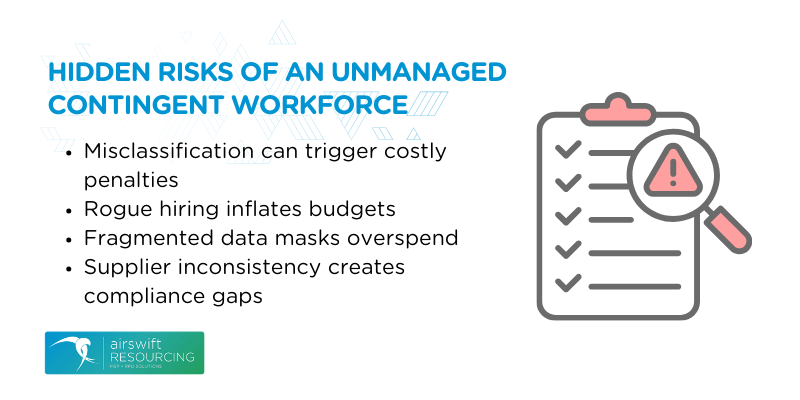
As regulations around employment, taxation, and worker classification evolve, compliance for contingent workers becomes more complex, especially across multiple jurisdictions. If you’re worried about misclassification risk, inconsistent background checks, or whether contracts reflect current legislation, your internal teams may be stretched too thin.
In a market where 51% of hiring managers say technical talent is hard to find, organisations are leaning more heavily on flexible labour, and inconsistent compliance cannot keep pace with this reliance.
A mature MSP program improves compliance processes throughout the supply chain, standardising contracts, documentation, and risk controls.
Your internal teams are overwhelmed by “non-core” hiring
When HR, talent acquisition, and procurement spend disproportionate time managing temp and contractor requests, other strategic priorities inevitably slow down. Overloaded teams may struggle to engage the right suppliers, benchmark rates, or proactively plan contingent needs.
An MSP assumes prime responsibility for the non-permanent workforce; sourcing, screening, engaging, and administering contractors while operating as an extension of your internal teams.
This frees your people to focus on core workforce strategies, employer branding, and long-term planning, rather than transactional tasks.
You suspect you’re overpaying, but can’t prove it
If you lack consistent rate cards, structured benchmarking, or consolidated spend data, it’s difficult to know whether you’re paying market rates for contingent talent. Different business units may negotiate independently, leading to rate inflation and “favourite supplier” arrangements that don’t stand up to scrutiny.
GETI reflects upward pressure on salaries across nearly all energy sectors, with 31% to 33% of hiring managers reporting pay increases above 5%. In this environment, unmanaged contractors spend compounds rapidly.
A strategic MSP brings sustainable cost optimisation through rate bench marking, supplier rationalisation, and life-cycle efficiencies. Research cited by Airswift Resourcing shows that businesses leveraging MSPs achieve significantly higher cost savings year-over-year by standardising rates and reducing hidden inefficiencies in the recruitment supply chain.
Your processes are manual and technology is fragmented
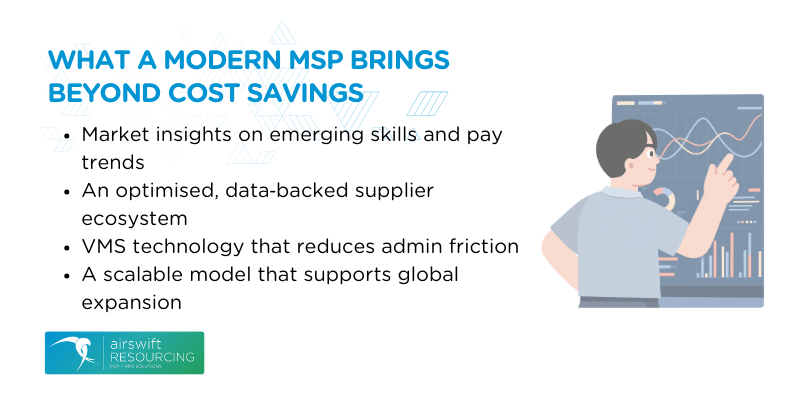
If you rely on emails, spreadsheets, and disparate systems to manage requisitions, approvals, time sheets, and invoices, process friction is inevitable. Manual processes increase the risk of errors, delay reporting, and make it harder to scale.
GETI findings show an accelerating shift toward automation and AI, with 80% of professionals using AI to support their development. The future of workforce management is digital, and a VMS is the foundation.
MSPs typically implement or manage a VMS to centralise requisitions, candidate submissions, approvals, and billing. Combined with configurable workflows and integrations into your existing HR and finance systems, this technology foundation enables automation, real-time data, and more consistent experiences for hiring managers and suppliers.
Hiring manager experiences vary wildly across the business
If some hiring managers enjoy fast, proactive support while others feel ignored or stuck in process bottlenecks, your contingent program lacks standardisation. Inconsistent engagement can lead to rogue buying, where managers bypass preferred processes and suppliers to “just get someone in.”
In a world where 84% of professionals say they would consider switching roles, managers often feel a sense of urgency, which can lead to shortcuts. A well-designed MSP focuses on user experience, providing clear entry points, defined SLAs, and dedicated support for hiring managers.
With centralised governance and ongoing communication, managers know who to contact, what to expect, and how to get the right contractor quickly, regardless of location or function.
You struggle to find niche STEM skills at speed
In technical and high-stakes projects, a lack of access to niche expertise can delay delivery and undermine competitiveness. If your existing suppliers and internal teams struggle to source specialised STEM talent or scale quickly for project peaks, you risk missed opportunities.
Industry specialist MSPs like Airswift Resourcing blend sector knowledge with global networks of STEM professionals.
They centralise access to high-quality contingent talent, leveraging data-driven sourcing, talent pools, and global mobility to secure the right skills in demanding markets.
Your contingent strategy isn’t aligned with business goals
If contingent hiring decisions are made in isolation by project or department, rather than as part of a cohesive workforce strategy, you’re leaving value on the table.
There may be limited coordination between permanent and non-permanent talent plans, or little linkage to broader organisational goals such as digitisation, expansion into new markets, or innovation.
MSPs operate as strategic partners rather than purely transactional vendors. They align talent acquisition models with business objectives, providing total talent intelligence, workforce analytics, and insights that support agile workforce planning across permanent, contingent, and project-based work.
You’re expanding into new markets and geographies
Global growth amplifies the complexity of managing contract workers, different labour laws, tax rules, cultural expectations, and supplier landscapes all come into play. If each new country requires you to reinvent your contingent process, expansion can stall.
A global MSP with on-the-ground support helps you enter and operate in new markets with a consistent framework. Services such as Employer of Record (EOR), payroll, and talent mobility can be folded into the program, ensuring compliance, efficient onboarding, and seamless management of contractors across borders.
Stakeholders raise concerns about control or quality
As contingent volumes grow, senior stakeholders may worry about governance, quality, and overreliance on external partners. They may question whether outsourcing more workforce management will reduce visibility or dilute business-specific knowledge.
These are common concerns when organisations first consider an MSP, and they can usually be addressed through the right design. Clear SLAs, regular performance reviews, collaborative governance structures, and a hybrid or phased model ensure you retain strategic control while the MSP manages day-to-day execution and brings industry-specific expertise.
You’re ready to move from reactive hiring to proactive workforce planning
If contingent hiring still feels like a series of urgent, tactical transactions, you’re not yet realising its full strategic potential. In volatile industries such as energy, process, and infrastructure, being able to scale the workforce up and down quickly, while maintaining quality and compliance, is a competitive advantage.
An MSP turns contingent workforce management into a proactive, data-driven capability. With access to workforce analytics, talent market insight, and AI-enabled skills matching, you can anticipate needs, build talent pipelines, and design workforce models that support long-term sustainability and innovation, not just short-term gap-filling.
Why the move toward MSP solutions is accelerating
Across industries, the contingent workforce complexity is increasing, while the resources and time available to manage it are not.
For organisations seeking a partner with deep expertise in global talent ecosystems, especially in complex, technical industries, a workforce solutions leader such as Airswift Resourcing offers the experience, scale, and industry insight needed to build a resilient and future‑ready contingent workforce strategy.