
By
Diyaa Mani
May 26, 2026
Updated
May 26, 2026
Many professionals think about working in the United States. It represents opportunity, career growth, international exposure, or access to industries that may not exist locally.
However, the process can be complex. Many applicants start out with strong intentions but are unsure about many critical aspects of applying to work in the United States; for instance:
- Which visa category actually fits my situation?
- How complicated is the process really?
- Where do people typically get it wrong?
This article, while not promising a confirmed visa approval, will is give you a realistic, grounded understanding of how temporary worker visas work, so you can make a more confident and informed decision before committing time, money, and expectations.
If you are a non-U.S. citizen seeking temporary employment in the United States or are already in or have concluded discussions with a U.S. employer or sponsor, you may find this article helpful.

What does a “temporary worker visa” mean in the United States?
The term “temporary worker visa” can be misleading. It does not necessarily mean short-term. Some visas can last for several years, depending on the category and employment terms.
What it does mean is:
- Your stay is tied to a specific job and employer
- Your authorisation to remain in the U.S. is conditional and time-bound
In most cases, a temporary worker visa requires:
- A U.S. employer sponsor
- A petition filed on your behalf
- Approval from U.S. immigration authorities (USCIS)
For most categories, the employer must first file a petition before you can even apply for the visa.
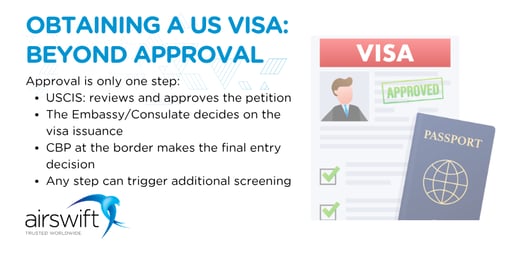
Important note: A visa does not guarantee entry into the United States. It allows you to request entry, but the final decision is made at the border by U.S. Customs and Border Protection (CBP).
Which U.S. temporary work visa is right for you?
There are multiple types of temporary worker visas, each designed for very different situations. Below are some of the most common ones:
Common temporary worker visa categories
- H-1B (Specialty occupations)
- For roles that usually require a bachelor’s degree or higher (e.g.: engineers, analysts)
- H-2A / H-2B (Seasonal work)
- H-2A: Agricultural work
- H-2B: Non-agricultural seasonal roles
- L-1 (Intra-company transfer)
- For employees transferring within the same company (e.g.: from a Malaysia office to a U.S. branch)
- O Visa (Extraordinary ability)
- For individuals with high-level recognition in fields like science, arts, business, or sports
- P / Q Visas (Performers, athletes, cultural exchange)
- For entertainers, athletes, or cultural program participants
- H-1B1 (Chile / Singapore only)
- A special category for professionals from these countries
Source: Temporary Worker Visas
Important note: The correct visa category depends on very specific details, based on job role, employer, qualifications, and even nationality.
How does the U.S. temporary work visa application process work?
This is where expectations often clash with reality.
The process typically follows these steps:
1. Employer files a petition
Your employer submits a non-immigrant petition to USCIS. You generally cannot start the process independently.
2. Petition is reviewed
USCIS either approves or denies the petition.
3. You complete a visa application (DS-160)
This is the online form required for all non-immigrant visa applicants.
4. Embassy or consulate interview
Most applicants typically attend a face-to-face interview with a consular officer.
5. Administrative processing (if needed)
Some cases require additional checks with no fixed timeline.
6. Entry decision at the U.S. border
Even with a visa, entry is not automatic.
Key points to keep in mind
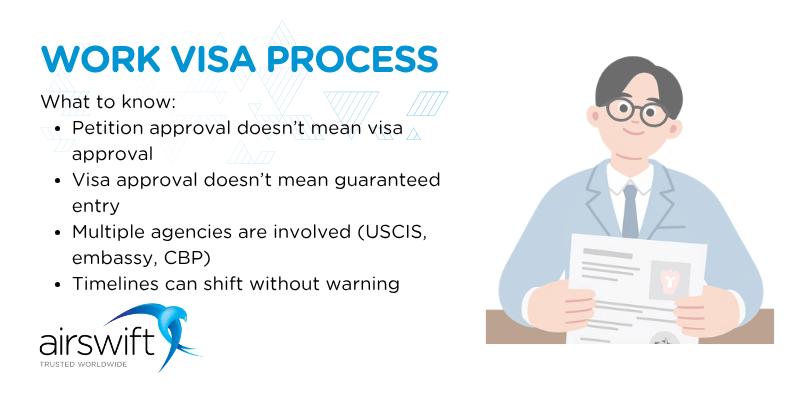
- You cannot do most of this alone; your employer plays a central role
- Delays and refusals are common
- Petition approvals are not visa approvals
- Visa approvals are not entry approvals
Understanding this early can save you significant frustration later.
How much does a U.S. temporary work visa cost?
There is a core visa fee of $205 USD for most temporary worker visa categories. This fee is non-refundable, and is required even if your visa is denied.
Possible additional costs
Depending on your situation:
- Reciprocity fees (based on nationality)
- Fraud prevention or security-related fees
- Document preparation costs
- Travel for embassy interviews
Why are U.S. temporary worker visas refused?
Visa refusals are often misunderstood and feared. However, the issues are usually specific and easily identified.
Common reasons include:
- Applying under the wrong visa category
- Insufficient evidence of qualifications
- Missing or inconsistent documents
- Problems with the employer’s petition
- Concerns about eligibility under U.S. law
U.S. authorities may also refuse visas if:
- They lack sufficient information
- The applicant does not meet visa requirements
Section 214(b)
For many non-immigrant visas, applicants must demonstrate to the immigration officer that they do not intend to remain permanently. Failure to do so can result in refusal of entry, even if other aspects are strong.
What do most applicants underestimate about the process?
This is where gaps in understanding typically become apparent:
1. Time and patience
The process can take months, and sometimes longer.
2. Employer dependency
Your application depends heavily on your employer’s accuracy, timeliness and commitment.
3. Interview scrutiny
You are not just submitting documents. You’re also being assessed in person.
4. Administrative processing
There is no guaranteed timeline, and you cannot speed it up.
5. Immigration history matters
Past overstays or violations can significantly affect outcomes.
Can you bring your family on a U.S. temporary work visa?
This is an important, often overlooked concern.
Who can join you?
Typically:
They apply under dependent visa categories.
What to expect
- You must show financial ability to support them
- Dependents may face work restrictions, depending on the visa type
- Each member must apply separately
What happens if your U.S. work visa is refused or denied?
A refusal can feel final, but it usually isn’t. Refusal does not mean a permanent ban. Often, applicants are told the reason why their application was refused. Mostly, refusals stem from missing information and/or eligibility concerns.
You can almost always reapply, but bear in mind that submitting the same application with the same weaknesses will likely lead to the same outcome.
Most non-immigrant visa refusals do not have a formal appeal process
When is a U.S. temporary worker visa not worth pursuing?
You may want to reconsider if:
- You don’t have a committed employer sponsor
- Your role doesn’t meet visa criteria
- You need to start work immediately
- You are uncomfortable with uncertainty
These are not minor obstacles; these are structural barriers.
What are the next steps to apply for a U.S. work visa?
If you’re still considering this path, here’s what you can do:
- Speak openly with your prospective employer about sponsorship
- Review embassy-specific instructions for your country
- Read official guidance from:
- USCIS
- U.S. Department of State
- Seek qualified immigration advice if your situation is complex
Why understanding the process gives you a real advantage
The U.S. temporary worker visa system is not simple. It’s structured, regulated, and at times unpredictable. But it is also navigable with the right expectations. Understanding how it works is your first real advantage. Those who succeed are not always the most optimistic; they are well-informed, realistic about timelines, and prepared for uncertainty.
Find U.S. job opportunities with Airswift’s global expertise
If you're exploring opportunities to work in the United States, Airswift can connect you with employers who have experience hiring international talent. With a strong presence across key industries, Airswift helps professionals navigate job opportunities with greater clarity and confidence.
Whether you're at an early stage or actively applying, working with an experienced recruitment partner can make the process more straightforward. Explore Airswift’s open roles to find opportunities that match your skills and goals.