
By
Nathalia Duarte
January 6, 2026
Updated
May 11, 2026
Data center construction is reaching record levels as demand for IT infrastructure continues to rise. Growth in enterprise workloads and generative AI is accelerating investment, with major technology companies expected to deploy $1.8 trillion globally between 2024 and 2030 to meet demand, according to BGC.
The United States currently holds 60% of globally installed data center capacity, with more than 4.000 facilities nationwide.
This article explores what data centers are, the main types in use today, infrastructure components, the jobs being created across the industry and the biggest facilities.

What is a data center used for?
A data center is a physical facility that houses an organisation’s core IT infrastructure, including servers, storage systems, and networking equipment. It forms the backbone of digital operations, enabling data processing, storage, and distribution at scale.
Data centers support a wide range of activities, from application hosting and file storage to cloud computing and enterprise systems.
With high-performance computing capabilities, specialised hardware, and resilient network design, data centers also play a critical role in generative AI. Training large models and supporting real-time AI services require massive compute power, low latency, and scalable infrastructure, capabilities that modern data centers are designed to deliver.
How to become a data center technician? Discover educational path, salaries and certifications
What are the components of a data center's infrastructure?
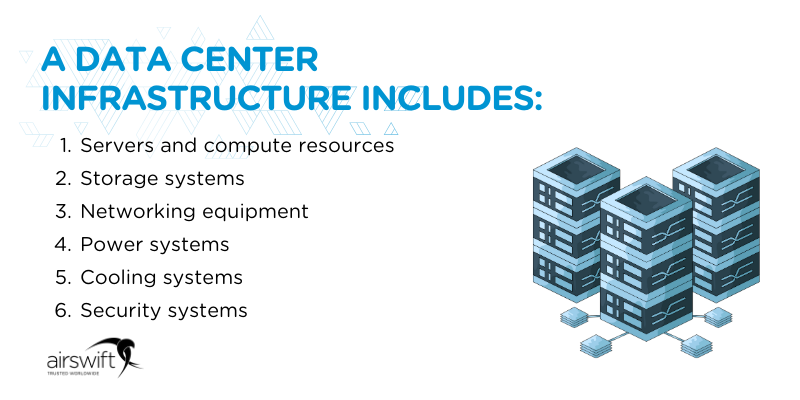
1. Servers and computer resources
Servers are essential for processing large volumes of data and delivering it across networks. Data centers use a variety of server types, including rack and blade servers, as well as specialised systems. Equipped with powerful processors, memory, and storage, these servers handle complex computing workloads efficiently.
2. Storage systems
Storage systems are responsible for storing and managing large volumes of data. These include hard disk drives (HDDs), solid‑state drives (SSDs), object storage, and network‑based solutions such as storage area networks (SANs) and network‑attached storage (NASs).
3. Networking equipments
Networking equipment enables communication across data center systems, connecting servers, storage, devices, and users. Key components include routers, switches, firewalls, and load balancers. To ensure high‑speed connectivity and efficient traffic flow, data centers rely on best‑available technologies at the time of construction, such as fibre‑optic cabling and 5G networking.
4. Power systems
Data center power systems are designed with redundancy to prevent disruptions. They typically include uninterruptible power supply (UPS) systems to provide immediate backup during utility outages, along with standby generators that sustain operations during extended power failures.
5. Cooling systems
Cooling systems are essential for protecting data center equipments, which generates significant heat during operation. Solutions range from traditional air‑conditioning systems to advanced liquid cooling technologies, all designed to prevent overheating and maintain reliable performance.
6. Security systems
Data centres require robust security to protect both physical infrastructure and digital assets. Physical measures include surveillance and access control, while cybersecurity systems defend against threats such as breaches and attacks. Digital security relies on tools like firewalls, encryption, and intrusion detection systems, all aligned with industry standards and regularly updated.
What are the most common data center types?
Data centers come in several forms, each designed to meet different operational, and performance needs. The main models include:
Enterprise data center
Enterprise data centers are owned and operated by a single organisation to support internal IT requirements. Commonly used by large enterprises and government agencies, they offer full control over design, security, and operations, making them ideal for specialised or highly regulated environments.
Colocation data center
Colocation data centres are shared facilities run by third‑party providers that supply space, power, and cooling to multiple customers. Organisations install and manage their own hardware in shared racks or private suites, benefiting from lower capital costs and reduced operational complexity.
Hyperscale data center
Hyperscale data centres are built for extreme scale and efficiency. Owned by global technology companies such as Amazon (AWS), Microsoft (Azure), Google, Meta, and Apple, they support cloud services and major digital platforms, processing vast volumes of data and compute.
Edge data center
Edge data centres are smaller, distributed facilities located close to end users or devices. By minimising data travel distance, they enable low‑latency performance and support use cases such as 5G, IoT, and real‑time applications.
Modular data center
Modular data centres focus on rapid deployment and flexibility. Built from prefabricated, often container‑based modules, they integrate power, cooling, and IT infrastructure, allowing capacity to scale quickly as demand grows.
Cloud-managed service data center
Cloud-managed data centre services combine dedicated infrastructure with cloud‑based management and operations. While servers are hosted in a data centre, often within a colocation facility, the provider handles monitoring, maintenance, security, and scaling through cloud platforms.
Data center construction phases
The construction cycle generally follows five key phases, with timelines influenced by factors such as project size, design complexity, and equipment lead times. From early planning through testing and commissioning, building a full data centre typically takes 18 to 30 months.
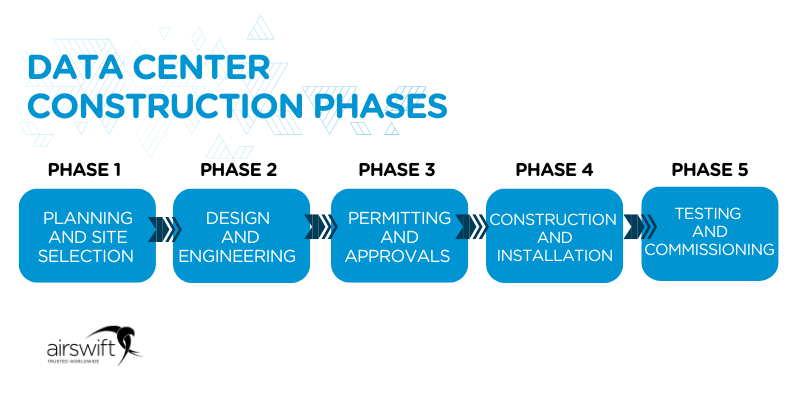
Phase 1: Planning and site selection
This phase focuses on selecting the optimal location by evaluating factors such as power availability, fibre connectivity, climate, land suitability, and regulatory conditions. Teams also assess projected IT load, scalability, and total cost of ownership to ensure the site aligns with long‑term business goals. Strong planning at this stage is critical to project success.
Phase 2: Design and engineering
Project requirements are translated into detailed architectural and engineering plans. This includes defining layouts for server rooms, power and cooling systems, and network infrastructure, as well as selecting the appropriate Tier level based on uptime and redundancy needs. The goal is to ensure performance, efficiency, and compliance with industry standards.
Phase 3: Permitting and approvals
Running alongside design, this phase involves securing zoning approvals, environmental clearances, utility connections, and building permits. Early coordination with local authorities and utility providers helps minimise delays that can impact the overall schedule.
Phase 4: Construction and installation
During this phase, the physical facility is built, and critical systems are installed. Civil works and shell construction come first, followed by the installation of mechanical, electrical, and plumbing (MEP) systems. Close coordination between contractors is essential to meet design specifications and prepare the facility for commissioning.
Phase 5: Testing and commissioning
Before operations begin, all systems are rigorously tested to confirm performance, safety, and reliability. This includes component‑level testing and fully integrated load simulations. The phase concludes with documentation, staff training, and formal handover to the operations team.
Discover 8 data center projects in the U.S. creating job opportunities
Job opportunities in data center construction
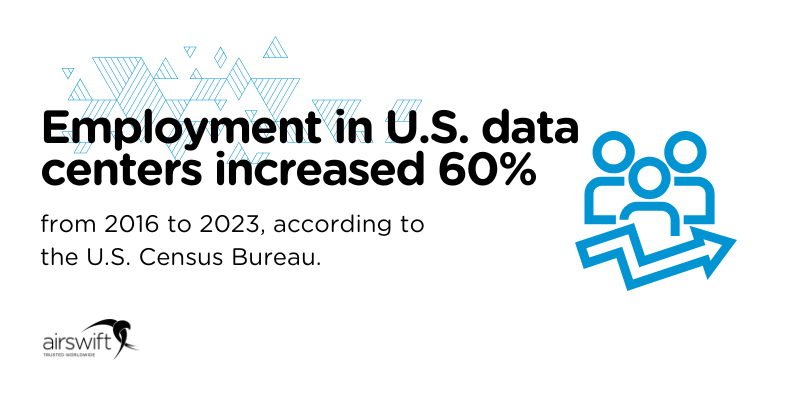
From 2016 to 2023, employment in U.S. data centers increased 60%, reports the U.S. Census Bureau. This is driven by the construction boom of new facilities to meet global demand.
Building a data center requires a wide range of skilled professionals, from planners and engineers to on‑site trades and specialists. On average, two workers are required per megawatt (MW) of data centre capacity. Large projects can involve up to 500 workers on site at peak, with thousands rotating through the project over one to two years.
According to The Wall Street Journal, professionals transitioning into data center construction can see pay increases of 25% to 30%, reflecting strong demand for specialised skills. Key positions are:
- Project managers: Coordinate between clients, design teams, contractors, and suppliers. They manage schedules, budgets, risks, and quality.
- Architects: Design the facility layout and structure, ensuring space and resilience for critical infrastructure.
- Electrical engineers: Design power systems, from utility connections and backup generation to rack‑level distribution.
- Mechanical engineers: Design cooling and ventilation systems, including chillers, HVAC, and airflow management.
- Network engineers: Plan structured cabling and connectivity to support high‑volume data flow.
- Construction managers and superintendents: Oversee site activities, coordinate trades, manage schedules, and enforce safety standards.
- Electricians: Install electrical infrastructure, including transformers, switchgear, generators, and power distribution.
- HVAC Technicians/Pipefitters: Install and maintain cooling systems, including chillers, cooling towers, ductwork, and piping.
- General construction crew: Build the physical structure, server halls, and supporting spaces.
- Telecom/Cabling Technicians: Install fibre and Ethernet cabling and set up network racks per design specifications.
- Fire Protection installers: Put in fire alarm systems and suppression as designed.
- Health and safety officers: Ensure compliance with safety regulations, conduct briefings, and oversee PPE and emergency procedures.
- Commissioning agents: Test and validate all systems to confirm performance and reliability before operations begin.
Data center operation jobs: From data center technician to security staff
Once commissioning is complete, the data center enters its operational phase. While construction requires large, rotating teams, ongoing operations rely on a smaller group of highly specialised professionals to keep the facility running 24/7.
Key operation roles include:
- Data center manager: Oversees site operations, uptime performance, maintenance planning, and incident response.
- Data center technician: Monitors and maintains servers, power, cooling, and building systems. In some organisations, this role also supports IT hardware. Average annual salary starts at $79.000.
- Network Engineer/IT Operations: Ensures network infrastructure meets bandwidth, performance, and reliability requirements.
- Security staff: Protect the facility through access control, surveillance, alarms, and physical patrols.
- Maintenance specialists: Carry out routine and preventative maintenance, including electrical and HVAC systems.
- Network Operations Center/Remote support staff: Monitor systems, respond to alerts, and coordinate on‑site responses when required.
Discover 15 data center job positions from construction to operations
What are the biggest data centers in the U.S.?
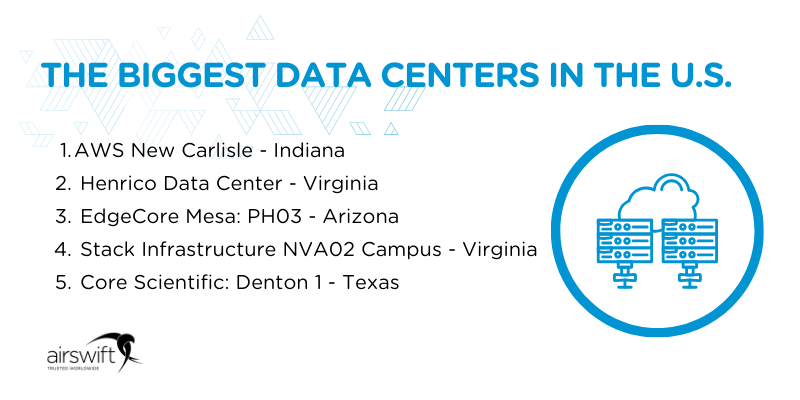
According to Cleanview, as of March 2026, these are the largest operating data centres in the United States by capacity:
1. IREN Childress (Bitcoin mining)
- Capacity: 750 MW
- Location: Childress, TX
- Developer: IREN
2. AWS New Carlisle - Phase 1
- Capacity: 525 MW
- Location: St. Joseph, Indiana
- Developer: Amazon
3. Henrico Data Center
- Capacity: 500 MW
- Location: Henrico, Virginia
- Developer: Meta
4. EdgeCore Mesa: PH03
- Capacity: 450 MW
- Location: Maricopa, Arizona
- Developer: EdgeCore
5. Stack Infrastructure NVA02 Campus
- Capacity: 420 MW
- Location: Prince William, Virginia
- Developer: Stack Infrastructure
Need help growing your data center workforce?
Partnering with a recruitment agency can help minimise the impact of talent shortages on your business. Airswift’s Talent Acquisition services support companies in finding, relocating, and onboarding professionals across engineering, technology, and science.
Contact us today to discover how Airswift can deliver tailored solutions to help you build a strong and qualified workforce.