
By
Nathalia Duarte
January 21, 2026
Updated
May 11, 2026
Demand for data center technicians is rising as rapid growth in cloud computing and artificial intelligence accelerates data center expansion. These professionals play a critical role in installing, maintaining, and supporting the hardware that powers modern digital infrastructure.
If you’re interested in becoming a data center technician, in this article, we explore the role’s key responsibilities, educational requirements, salary expectations, and relevant certifications.

What does a data center technician do?
A data center stores an organisation’s digital information using servers, storage system and networking equipment. Data center technicians are IT professionals who ensure the facility runs seamlessly. Their responsibilities include installing, maintaining and troubleshooting the infrastructure. They also collaborate with cybersecurity teams to prevent breaches and safeguard data.
Data center technician responsibilities include:
- Installing and configuring hardware
- Monitoring systems and troubleshooting
- Managing performance and security
- Maintenance and repairs
- Upgrade hardware and apply software updates
- Assist the network team
- Document procedures and write performance reports
- Oversee data center environment, such as temperature and humidity, power supply and ensuring physical security.
- Stay updated on new technologies
Watch the video below for what a day in the life of a Google data center technician looks like:
How much is a data center technician's salary
in the U.S?
According to the U.S. Census Bureau, employment in U.S. data centres increased by 60% between 2016 and 2023. For computer and IT occupations, the U.S. Bureau of Labor Statistics projects much faster growth between 2024 to 2034, with 317,700 openings each year, and data center technician is one of them.
Salaries for data center technicians vary by facility type, location and experience level. Entry-level roles typically focus on hardware installation and monitoring, while more experienced technicians take on advanced troubleshooting, system optimisation, and collaboration with network and cybersecurity teams, factors that directly influence compensation.
- Glassdoor reports an average annual salary of $79.000, with a range from $61.000 to $101.000.
- Salary.com lists an average of $74.310 annually, ranging from $60.959 to $91.919.
Location also plays a significant role in salary levels. States with a strong concentration of cloud providers, hyperscale data centers, and technology companies tend to offer higher pay to attract skilled talent.
Need to hire for your data center project? Uncover seven strategies to recruit and retain talent
Top 10 U.S. cities with the highest salaries, according to Salary.com:
- San Jose, CA - $93.727
- San Francisco, CA - $92.806
- Oakland, CA - $90.747
- New York, NY - $86.118
- Queens Village, NY - $85.561
- Paramus, NJ - $84.966
- Passaic, NJ - $84.892
- Bergenfield, NJ - $84.817
- Stamford, CT - $84.706
- Huntington, NY - $84.632
Learn the growing career paths in the data center industry
How to become a data center technician
While it’s possible to enter the IT field without a college degree, most data center technicians have some formal education beyond high school. That said, long-term career progression in this field depends largely on hands-on experience and industry-recognised certifications.
Education and transferable skills
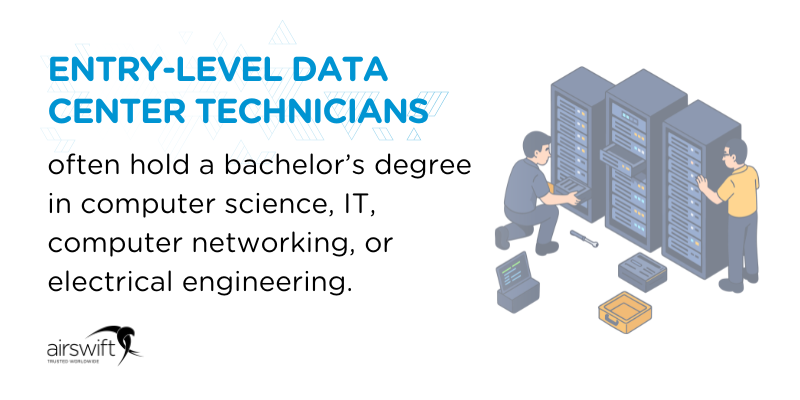
For entry-level data center technician roles, employers typically prefer candidates with a bachelor’s degree in computer science, information technology, computer networking, or electrical engineering.
However, professionals can still pursue this career by leveraging transferable skills gained in related roles. Experience in positions such as software engineering, technical program management, customer support, help desk support, network technician, or business technology analyst can provide a strong foundation for transitioning into data center operations.
Practical experience with computer hardware and networking is essential, especially for those entering the data center field without a degree. In addition, understanding the operational infrastructure, such as cooling and power systems, is highly valuable.
Data centers generate significant heat, and effective thermal and power management is critical to maintaining equipment performance and reliability. Familiarity with security, compliance, and operational standards can further strengthen a candidate’s profile.
Discover 8 data center projects in the U.S. creating job opportunities
Data center technician skill sets
A strong understanding of computer hardware and IT infrastructure is essential for entry-level data center technicians. In addition to technical expertise, the role requires soft skills that support performance in a high-risk, fast-paced environment, such as the ability to work under pressure and adapt quickly to change.
Technical skills
A data center technician typically needs proficiency in the following areas:
- Managing computer hardware and IT infrastructure, including server components, storage systems, and hardware replacement or repair
- Network infrastructure, such as LAN and WAN environments
- Scripting languages, including PowerShell and Python
- Virtualisation technologies, such as VMware, Hyper-V, or KVM
- Power and cooling systems, including UPS units, HVAC systems, power management tools, and disaster recovery protocols
- Safety, security, and operational procedures
Soft skills
Alongside technical knowledge, successful data center technicians demonstrate:
- Attention to detail
- Ability to work under pressure
- Clear communication and teamwork
- Problem-solving
- Adaptability
Data center technician certifications
Industry certifications can strengthen a technician’s skill set and improve career prospects. Common options include:- CompTIA Network+: Focuses on network installation, operations and troubleshooting
- CompTIA Server+: Covers server installation, management, and troubleshooting
- CompTIA Data+: Designed for early-career professionals learning to analyse, interpret, and communicate data
- Cisco Certified Network Associate (CCNA): Emphasises network installation and troubleshooting
- Certified Data Center Technician Professional (CDCTP): Prepares professionals to maintain and manage mission-critical data centers
Data center technician
career path
Entry-level technicians
Often referred to as Data Center Technician I or Junior Data Center Technician, entry-level professionals handle foundational tasks under supervision. Their responsibilities typically include replacing faulty hardware, running network cables, and monitoring system dashboards to ensure daily operations run smoothly.
Mid-level technicians
At the Data Center Technician II or III level, professionals take on greater independence and more complex responsibilities. This includes diagnosing advanced issues, leading small projects, and supporting system improvements. Many technicians begin to specialise at this stage, focusing on areas such as networking, storage systems, or infrastructure operations.
Senior technicians and leadership roles
Senior data center technicians move beyond reactive problem-solving to focus on prevention, optimisation, and operational efficiency. In addition to mentoring junior staff, they may oversee facility operations, plan capacity upgrades, design efficient layouts, and implement advanced monitoring systems. With experience, many transition into Data Center Operations Lead or Data Center Manager roles.
Looking to grow your data center career?
Partnering with an experienced recruitment agency can help you connect with the right companies and people.
Discover thousands of jobs by signing up to our candidate portal.