
By
Diyaa Mani
November 25, 2026
Updated
November 25, 2026
The oil and gas industry is not disappearing; it is transforming.
In a decarbonising world, companies are prioritising lower‑carbon barrels, digital efficiency, and stricter environmental standards, and that’s reshaping which roles are most in demand.
This article lists 14 oil and gas roles that will become essential in a decarbonising world.

Key takeaways
-
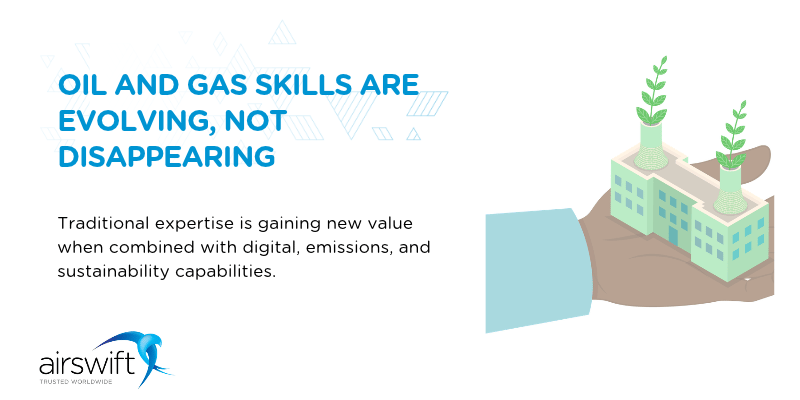
Oil and gas skills are evolving, not disappearing. Decarbonisation is increasing demand for professionals who can combine traditional technical expertise with emissions reduction, digitalisation, and sustainability knowledge.
-
Lower-carbon operations are becoming a core priority. Process optimisation, methane reduction, carbon capture and emissions monitoring are creating opportunities across engineering, HSE, and environmental disciplines.
-
Digital capabilities are increasingly valuable. Automation, data analytics, digital twins, and advanced instrumentation are helping operators improve efficiency, reliability, and environmental performance.
-
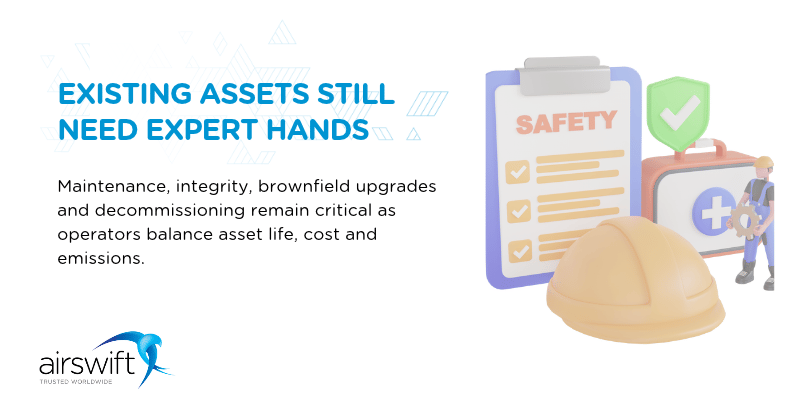
Existing assets still need specialist expertise. Maintenance, integrity, brownfield upgrades, and decommissioning remain essential as companies seek to extend asset life safely while reducing emissions and costs.
-
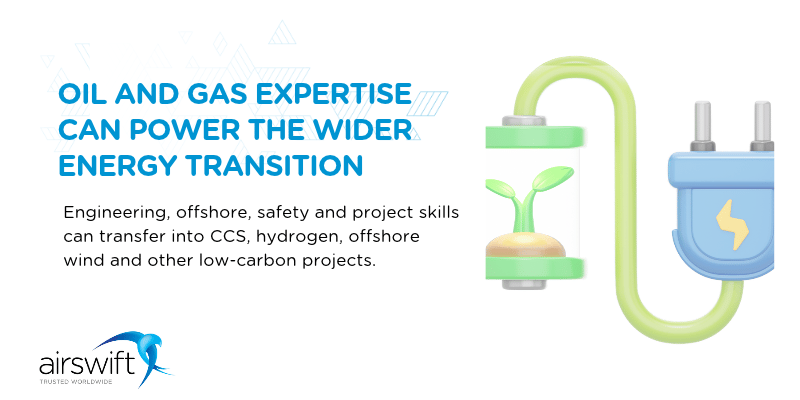
Transferable skills open doors across the wider energy transition. Oil and gas professionals with experience in project management, offshore operations, engineering, and safety are well-positioned to move into areas such as CCS, hydrogen, and renewables.
What oil and gas roles are indispensable to decarbonisation?
1. Process engineers
Process engineers remain core to upstream, midstream, and downstream operations, but their remit now includes cutting carbon as well as improving throughput. They work on debottlenecking, heat integration, and process optimisation to reduce energy use and emissions per barrel.
Skills in process simulation, energy and emissions optimisation, and brownfield modifications are particularly valuable as operators look to extend asset life while meeting stricter ESG targets. These engineers often collaborate with digital and sustainability teams to model scenarios that minimise flaring and fuel consumption.
2. Process safety and HSE specialists
Safety has always been non‑negotiable in oil and gas, but decarbonisation and new technologies add fresh layers of risk to manage. Process safety and HSE professionals design and oversee systems that prevent incidents while also supporting lower‑carbon operating practices.
They lead HAZOPs, risk assessments, and operability reviews, and help operators integrate new technologies such as carbon capture and advanced controls into existing plants without compromising safety. Their expertise is critical as assets are pushed to operate more flexibly, with tighter emission limits and more complex regulations.
3. Carbon reduction and emissions engineers
Decarbonisation is no longer a side project; it sits at the heart of many oil and gas strategies. Carbon reduction engineers focus on emissions measurement, monitoring, and mitigation, covering everything from flare optimisation to methane leak detection and re-injection practices.
These specialists assess carbon footprints across facilities, develop reduction road maps, and help implement technologies like CO₂ capture or energy‑efficient equipment upgrades. With growing investor and regulatory pressure, their ability to deliver measurable emissions reductions is directly tied to the asset's license to operate.
4. Subsurface and reservoir engineers
Even in a decarbonising world, demand for hydrocarbons continues, especially where assets can be produced more efficiently with lower emissions intensity. Subsurface and reservoir engineers who can maximise recovery while minimising energy use and flaring are in strong demand.
They use advanced modeling and data analysis to optimise well placement, reservoir management, and enhanced recovery methods that avoid unnecessary carbon output. Their work directly influences asset economics and how “future‑proof” a field is in a market that increasingly differentiates between high‑ and low‑carbon barrels.
5. Project managers and project controls specialists
Energy transition hasn’t reduced project activity; it has changed its profile. Brownfield upgrades, digital retrofit program, and new low‑carbon initiatives all require experienced project leadership. Project managers and project controls professionals keep these complex portfolios on time and on budget.
They coordinate multi‑disciplinary teams, manage contractor interfaces, and maintain oversight of scope, cost, and schedule, often across multiple geographies. In a capital‑constrained, ESG‑driven environment, their ability to deliver safe, compliant projects efficiently is a major competitive advantage.
6. Digitisation, data, and automation engineers
Digital skills are now central to how oil and gas companies reduce emissions and improve productivity. Roles in data engineering, automation, industrial IT/OT, and advanced analytics support everything from predictive maintenance to real‑time emissions monitoring.
These professionals build and manage digital twins, integrate sensor networks, and develop dashboards that allow operators to optimise energy use, reduce downtime, and cut flaring. As energy systems become more complex and interconnected, demand for talent that can bridge engineering and digital disciplines continues to grow.
7. Maintenance, reliability, and integrity engineers
Keeping existing assets running safely, efficiently, and for longer is a major decarbonisation lever. Reliability and integrity engineers focus on asset health, life‑extension strategies, and inspection regimes that prevent failures and unnecessary replacements.
They design maintenance program that minimise energy‑intensive shutdowns, optimise spare parts strategies, and ensure equipment upgrades align with carbon‑reduction objectives. Their work supports both safety and sustainability by reducing leaks, emissions, and unplanned outages across facilities and pipelines.
8. Environmental, ESG, and sustainability specialists
Oil and gas operators are under intense scrutiny from regulators, investors, and communities on environmental performance and disclosure. Specialists in environmental management, ESG reporting, and sustainability strategy translate technical performance into credible, verifiable metrics and narratives.
They manage permitting, environmental impact assessments, and ongoing monitoring, while helping shape decarbonisation road maps and ESG commitments. As sustainability reporting frameworks become more sophisticated, these roles are pivotal in aligning operational reality with corporate promises.
9. Decommissioning and late‑life asset specialists
As some fields reach maturity and economics shift, safe and responsible decommissioning is a growing focus. Engineers and project managers specialising in late‑life asset management and decommissioning plan and execute activities that minimise environmental impact and cost.
They coordinate plug and abandonment, subsea infrastructure removal, and site restoration, all under stringent regulatory oversight. Their expertise ensures that end‑of‑life decisions are integrated with broader decarbonisation and portfolio strategies, avoiding unnecessary emissions and liabilities.
10. Health, Safety, and Environment (HSE) advisors for new operating models
The shift toward remote operations, automation, and new fuel technologies (such as hydrogen blending or CCS integration) changes the risk profile of oil and gas assets. HSE advisors who understand both traditional risks and new decarbonisation technologies are highly sought after.
They update safety cases, training, and procedures to reflect new ways of working, including more digital and remote activities. By embedding safety and environmental considerations into every change program, they help companies innovate without compromising their duty of care.
11. Instrumentation, Controls, and Electrical (I&E) technicians
As facilities become more instrumented and automated, the demand for skilled I&E technicians only increases. These professionals install, calibrate, and maintain the systems that control process conditions, safeguard equipment, and measure emissions.
Their work underpins reliable data for digital optimisation and regulatory reporting, from flow measurement to emissions monitoring stacks. In a decarbonising context, accurate and robust instrumentation is essential to prove performance improvements and maintain compliance.
12. Supply chain, logistics, and procurement specialists
Decarbonising operations also means decarbonising supply chains: optimising logistics, choosing lower‑carbon materials, and improving contractor performance. Supply chain and procurement professionals with energy‑sector experience are key to achieving these goals.
They negotiate contracts that include ESG expectations, manage vendor performance across safety and sustainability metrics, and design logistics networks that minimise transport emissions. Their decisions directly influence the embedded carbon and cost profile of projects and operations.
13. Talent, training, and workforce transition specialists
The energy transition is as much about people as it is about technology. Talent and training specialists in oil and gas are increasingly tasked with upskilling existing workers in “green skills,” from emissions awareness to new digital tools.
They design programs that help engineers, technicians, and operational staff adapt to new standards and technologies, supporting internal mobility between traditional and emerging energy segments. This not only addresses skills shortages but also reduces recruitment costs by developing talent from within.
14. Cross‑sector “bridge” professionals (oil and gas to renewables)
Many of the most in‑demand roles sit at the intersection of oil and gas and low‑carbon or renewable projects. Professionals with strong oil and gas foundations, project management, marine/offshore operations, and subsea engineering who can apply their expertise to offshore wind, hydrogen, or CCS are especially valuable.
Oil and gas professionals are a vital talent pool for the broader energy transition thanks to their transferable skills in engineering, operations, and safety. These “bridge” professionals help organisations repurpose existing capabilities and assets for a lower‑carbon future while maintaining the safety and reliability standards developed in traditional hydrocarbons.
Launch your energy career with Airswift
The decarbonising world still needs oil and gas, but it needs it to be cleaner, safer, and smarter. Professionals who blend deep technical expertise with digital and sustainability awareness will remain at the centre of this evolving energy landscape.
Explore Airswift’s latest energy jobs and find where your skills could take you next. Browse our latest energy jobs or speak with one of our energy recruitment experts today.