
By
Nathalia Duarte
July 14, 2026
Updated
July 14, 2026
Chemical engineering is one of the highest-paid engineering disciplines.
In the United States, chemical engineers earn a median of about $121,860 a year according to the Bureau of Labor Statistics (BLS), and a higher median of roughly $160,000 in the 2025 American Institute of Chemical Engineers (AIChE) member salary survey.
According to Glassdoor, pay averages from around $80,000 for new graduates to more than $139,000 for senior engineers, and varies widely by industry, with petrochemical, oil and gas, pharmaceutical and battery roles paying the most.
This guide breaks down chemical engineering salaries by experience and sector, the main career paths, the job outlook, and how to enter the field.

Key takeaways
• Pay is high. The BLS puts the US median chemical engineer salary at about $121,860 (OEWS, May 2024); the 2025 AIChE member survey reports a median near $160,000.
• Experience matters. New graduates start around $79,000, mid-career engineers commonly earn $83,000 to $147,000, and senior engineers make $108,000 to 180,000.
• Industry drives pay. Petrochemical, oil and gas, pharmaceutical and battery manufacturing pay the most; food processing and commodity chemicals sit closer to the median.
• Demand is steady. The BLS projects about 3% employment growth through 2034, roughly 1,100 openings a year, and employers report qualified candidates are hard to find.
• Entry credential. A bachelor's degree in chemical engineering is the standard route; a Professional Engineer (PE) licence and specialisation raise earning potential.
What does a chemical engineer do?
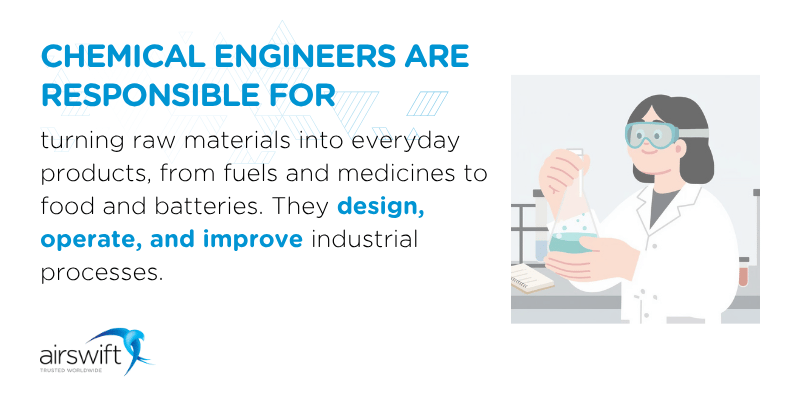
Chemical engineers apply chemistry, physics, biology and maths to design and run the processes that turn raw materials into useful products such as fuels, plastics, medicines, food and battery materials.
They work across the process lifecycle, from research and process design to plant operation, safety and optimisation.
Typical responsibilities include designing equipment and processes, scaling lab reactions up to full production, improving yield and efficiency, and keeping processes running safely and within environmental limits.
Most chemical engineers specialise over time, for example, in process design, production, or environmental and safety engineering.
 Chemical engineering salaries by experience level
Earnings rise steeply with experience. New graduate salaries median start at $80,000, and late career professionals earn around $139,000. The figures below are U.S. averages from Glassdoor. Treat them as ranges rather than fixed numbers, because pay depends heavily on sector and location.
| Career stage | Typical annual salary (USD) range - Glassdoor | Average annual salary (USD) - Glassdoor |
|---|---|---|
| New graduate/entry (0-1 years) |
$62,000 to $103,000 | $80,000 |
| Early career (1 to 3 yrs) | $70,000 to $118,000 |
$91,000 |
| Mid-career (4 to 6 yrs) |
$83,000 to $137,000 | $107,000 |
| Mid-career (7 to 9 yrs) | $92,000 to $147,000 | $116,000 |
| Senior (10 to 14 yrs) |
$100,000 to $164,000 | $128,000 |
| Principal (15+ yrs) | $108,000 to $180,000 | $139,000 |
Chemical engineering salaries by industry
Industry is the single biggest factor in chemical engineering pay. Energy and petrochemical employers, concentrated in Texas and Louisiana, sit at the top, along with pharmaceutical manufacturing and the fast-growing battery sector.
| Industry | Pay vs national median | Notes |
|---|---|---|
| Petrochemical / oil and gas | Highest | Texas and Louisiana demand; offshore and refinery roles |
| Pharmaceutical manufacturing | High | Regulated, highly specialised process roles |
| Battery / energy storage | High and rising | Growth from EV and grid storage |
| Specialty chemicals | Above median | Higher-value, technical products |
| Commodity chemicals | Above median | Large-scale, cost-driven production |
| Food and beverage processing | Around or below median | Stable demand, lower pay ceiling |
Which industries pay chemical engineers the most?
Data from the Global Energy Talent Index (GETI) 2026 report provides a regional and sector-level view of average permanent salaries in USD. According to the report, Australasia and North America offer the highest average pay across energy markets, while oil and gas and petrochemicals remain the strongest-paying sectors.
| Chemical engineer's permanent salaries by sector and region (GETI 2026) | |||||||
|---|---|---|---|---|---|---|---|
| Industry average | Africa | Asia | Australasia |
Europe |
Latin America | Middle East | North America |
| Oil and gas | 89,775 | 65,065 | 164,430 | 74,874 | 45,360 | 75,333 | 69,000 |
| Petrochemicals | 93,870 | 61,632 | 102,893 | 74,257 | 42,143 | 70,413 | 128,556 |
| Power |
66,554 | 67,051 | 80,805 | 83,611 | 42,688 | 72,145 | 72,176 |
| Nuclear | - | 66,382 | - | 70,301 | - | 62,670 | 82,741 |
Chemical engineering career paths
A chemical engineering degree opens a wide range of roles. Many engineers begin in process or production engineering and branch into design, project management, research, or environmental and safety work. Common paths include:
- Process engineer: Designs and optimises production processes.
- Project engineer/project manager: Runs capital projects from design to commissioning.
- Production/operations engineer: Keeps plants running safely and efficiently.
- Research and development engineer: Develops new products and processes.
- Process safety/HSE engineer: Manages risk and regulatory compliance.
- Sustainability or process engineer in renewable energy: A fast-growing, well-paid path.
With experience, engineers move into senior technical authority or management. Many pursue a Professional Engineer (PE) licence or postgraduate study to accelerate progression.
Job outlook and demand
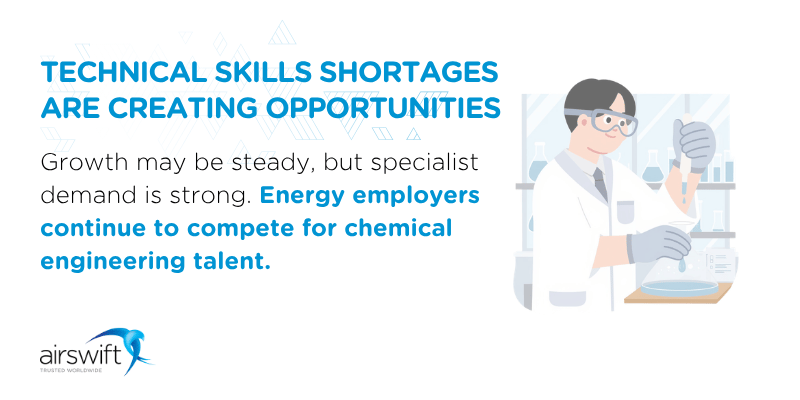
Employment of chemical engineers is projected to grow about 3% through 2034, with roughly 1,100 openings each year, according to the BLS. Headline growth looks modest, but demand is concentrated in energy-transition areas such as hydrogen, carbon capture, batteries and biofuels, where employers report that finding qualified engineers is one of their biggest hiring challenges.
That mismatch keeps salaries competitive and gives experienced engineers strong bargaining power. Workforce research, such as the Global Energy Talent Index (GETI), consistently finds technical skills shortages across the energy and process sectors.
How to become a chemical engineer
The standard route is a bachelor's degree in chemical engineering or a closely related field, accredited where possible (for example, by ABET in the U.S.). A typical degree takes four years and covers thermodynamics, fluid mechanics, reaction engineering, process design and control. From there:
- Earn an accredited bachelor's degree in chemical engineering.
- Gain practical experience through internships or co-op placements.
- Consider a Professional Engineer (PE) licence to qualify for senior and sign-off roles.
- Specialise in a high-demand area such as process safety, petrochemicals, or battery and renewable process engineering.
- Keep building experience; pay and responsibility rise quickly in the first ten years.
Demand for qualified chemical engineers is global, and many roles in the energy and process industries are filled through specialist talent acquisition partners and dedicated chemical engineering job boards.
FAQs
1. What does a chemical engineer do?
Chemical engineers design and run the processes that turn raw materials into products such as fuels, plastics, medicines, food and battery materials. They apply chemistry, physics, and math to design equipment, scale up reactions from the lab to full production, improve efficiency and yield, and keep processes running safely and within environmental limits.
2. How much does a chemical engineer make?
In the United States, chemical engineers earn a median of about $121,860 a year according to the Bureau of Labor Statistics (May 2024), while the 2025 AIChE member survey reports a higher median near $160,000. Pay typically runs from about $79,000 for new graduates to more than $150,000 for senior engineers, depending on industry and location.
3. Is chemical engineering a good career?
Chemical engineering is generally considered a strong career. It offers high pay relative to most professions, broad industry options from energy and pharmaceuticals to food and batteries, and steady demand for qualified engineers. The main trade-offs are a demanding degree and, in some roles, shift work or remote site postings.
4. What is the starting salary for a chemical engineer?
New chemical engineering graduates in the United States typically start between about $62,000 and $103,000, according to Glassdoor. The 2025 AIChE survey puts the median for new graduates near $79,000, and the BLS reports a 10th-percentile salary of about $78,520. Starting pay is usually highest in petrochemical, oil and gas, and pharmaceutical roles.
5. Which industries pay chemical engineers the most?
Petrochemical and oil and gas, pharmaceutical manufacturing, and the battery and energy-storage sector pay chemical engineers the most. These roles, many concentrated in regions such as Texas and Louisiana, sit above the national median, while food processing and commodity chemicals tend to pay closer to it.
6. How do you become a chemical engineer?
The standard route is a four-year bachelor's degree in chemical engineering, ideally from an accredited programme. Internships or co-op placements build practical experience, and a Professional Engineer (PE) licence is valuable for senior and sign-off roles. Many engineers then specialise in a high-demand area such as process safety, petrochemicals, or renewable process engineering.
Find your next energy job with Airswift
Whether you're a graduate chemical engineer or an experienced professional looking to advance your career, Airswift can connect you with employers across the energy, process, and industrial sectors. With a global network and deep industry expertise, we help chemical engineers find opportunities that match their skills, experience, and career goals.
From entry-level positions to senior and specialist roles, our recruitment experts can support you throughout your job search. Browse Airswift’s latest vacancies to discover new opportunities and take the next step in your chemical engineering career.