
By
Diyaa Mani
June 26, 2026
Updated
September 9, 2026
Landing a FIFO (fly-in, fly-out) job with no experience is possible, but it’s not as simple as sending a CV and waiting for a call.
In reality, FIFO hiring is all about readiness over experience. Employers don’t expect you to have years of on-site work, but they do expect you to meet strict safety, medical, and compliance requirements before you’re even considered.
Think of it this way: FIFO jobs aren’t hard to access, but they are highly structured. The candidates who succeed are the ones who understand the system and prepare accordingly.

Can you get FIFO jobs with no experience worldwide?
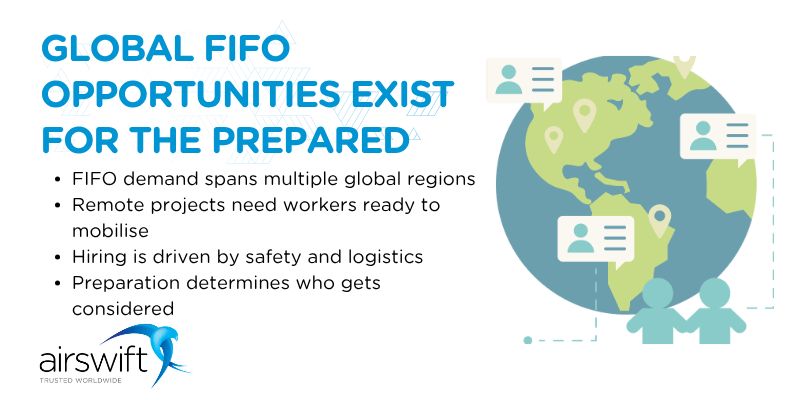
Yes. Entry-level FIFO jobs do exist globally in industries like mining, energy, and infrastructure, even for candidates with no previous site experience.
However, you must meet strict prerequisites, including safety certifications, medical clearance, and background checks, to be considered job-ready. Employers prioritise applicants who are fully prepared to start immediately, even without prior on-site experience.
FIFO opportunities exist across key regions
Here are some of the key regions known for FIFO jobs:
- Australia: One of the most mature FIFO markets, especially in mining.
- Middle East: Strong demand in oil and gas projects (often with tax-free packages).
- Africa: Ongoing mining and resource projects, frequently involving remote camps.
- North America: Remote industrial and energy sites, often project-based roles.
What connects all these markets is the hiring model. FIFO recruitment is logistics-heavy. Employers are managing remote sites, tight project timelines, and strict safety regulations. That’s why being job-ready matters more than experience on your CV.
What entry-level FIFO roles are generally hired for globally?
On global FIFO projects, entry-level hires tend to fill key support positions on project sites. These include roles like trade assistants, general labourers, camp services crew, warehouse support, and junior technicians.
Recruiters in energy and infrastructure focus on candidates who have the required certifications and can step in ready to work; readiness and compliance matter more than previous site experience.
Typical entry-level FIFO roles worldwide
Some of the more common entry-level FIFO roles inlude:
- Trade assistant (TA) roles: Supporting skilled trades such as electricians and mechanics. These positions are a common pathway into maintenance and engineering careers and offer a strong entry point if you have the right certifications.
- General labourers (construction and civil projects): Physical, hands-on work across infrastructure builds. Suitable for beginners with good fitness levels, and there’s a high demand for labourers on large-scale projects.
- Camp services / Utilities roles: Jobs in camp catering, cleaning, and housekeeping. Ideal for candidates with hospitality or service backgrounds, and a consistent entry point into FIFO environments.
- Warehouse and logistics support: Yard hands, materials handling, and inventory support positions. Having extra skills like a forklift licence can give you a competitive edge here.
- Entry-level technicians (with certifications): These are junior mechanical or electrical tech roles where some technical training is expected (even if formal experience is minimal). Often linked to short-term project deployments, they are more certification-heavy than experience-driven.
What qualifications do you need for FIFO jobs internationally?
Most entry-level FIFO jobs across countries require basic safety training certifications and other compliance steps.
At a minimum, you’ll need to complete the core safety courses (e.g. a general construction induction safety certification such as a White Card in Australia or country-equivalent).
Typically, Working at Heights and Confined Space Entry training are also required. Additional qualifications like a forklift licence or offshore safety training such as BOSIET (Basic Offshore Safety Induction and Emergency Training) can significantly improve your job prospects.
FIFO job requirements checklist
To be considered for most entry-level FIFO roles, you’ll need to have:
- General safety certification (e.g. White Card, or an equivalent construction safety induction card in your region).
- Working at Heights certification.
- Confined Space Entry ticket.
- Valid ID or passport.
- Work rights (appropriate visa or permit, country-specific).
- An updated CV tailored to FIFO roles.
- Medical clearance (pre-employment physical and drug/alcohol tests).
- Police check (clean background report).
If you’re missing key certifications or documents, your application is unlikely to move forward. Essentially, no certifications = no shortlist in the FIFO world.
Do you need a medical assessment for FIFO jobs?
Yes. All FIFO job often involve physically demanding work in isolated, remote locations under extreme weather conditions.
Therefore, a pre-employment medical assessment is often non-negotiable to ensure candidates can safely work. These check-ups typically include drug and alcohol testing, physical fitness evaluations, and role-specific health screenings
Employers must be confident you can safely handle the environment, so passing the medical exam (and ongoing random tests, in many cases) is a key step before you’re hired.
Do you need a police check for FIFO work?
Yes. Most FIFO employers will require a recent police clearance (background check) as part of site access and compliance. This is especially important for mining, energy, and government-backed infrastructure projects.
Police checks are part of broader site security protocols, particularly for remote or high-value operations. In practice, that means before you can go to the site, you’ll need to provide evidence of a clean criminal record. It’s a standard step to protect both the project and other workers on site.
The exact starter path: How to get a FIFO job with no experience
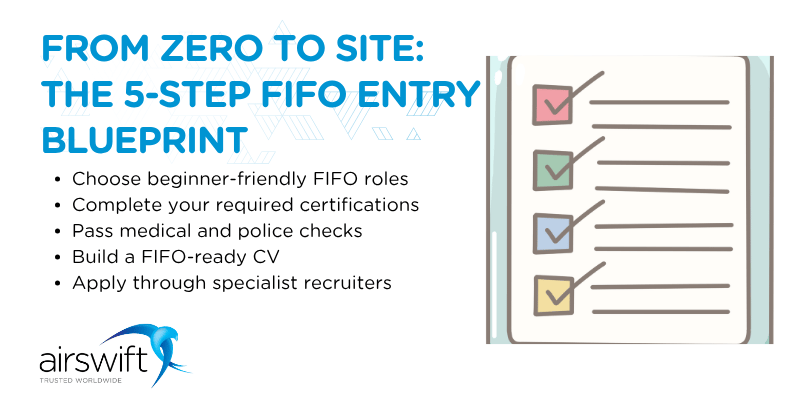
So, what does it actually take to land that first FIFO job? This is where most candidates either succeed or get ignored, based on how well they prepare. Follow these five key steps to make sure you’re in the best position to be hired:
Step 1: Choose the right entry-level role
Start with realistic positions like trade assistant, labourer, or camp services. Avoid applying for roles that clearly require prior experience — aim for those designed for newcomers.
Step 2: Get certified
No certifications, no shortlist. Prioritise getting your safety tickets first (the mandatory ones like White Card or other site inductions). Then add technical add-ons later (e.g. a forklift licence or any role-specific tickets). This is the single biggest factor that separates successful candidates from unsuccessful ones.
Step 3: Pass your medical exam and policy checks
Medical clearance and police checks are common failure points for many applicants. Be proactive: book your medical exam early, and ensure all documentation (ID, work permits, police clearance) is up to date. You want to have these passed and ready to present.
Step 4: Build a FIFO-ready CV
Your resume should highlight your certifications at the top, clearly show your immediate availability, and emphasise any transferable skills (e.g.: teamwork, physical work, reliability). FIFO recruiters often spend just seconds scanning applications, so make it extremely easy for them to see you tick all the requirement boxes.
Step 5: Apply through global recruiters
Rather than applying randomly to dozens of job ads, target specialist recruiters who understand FIFO hiring. Look for recruiters that offer:
- Access to global, project-based FIFO roles.
- Expertise in energy, mining, construction, and infrastructure hiring.
- Opportunities aligned with your certification-based entry profile.
What is the fastest way to get a FIFO job overseas?
The fastest way to get a FIFO job when you have no experience is to become fully job-ready before you start applying.
In practice, this means completing all required certifications, passing your medical and background checks, and then applying through specialist recruiters (like Airswift) with a targeted, FIFO-ready resume.
Speed in FIFO hiring doesn’t come from luck; it comes from preparation. Candidates who are ready before they apply are far more likely to secure interviews quickly.
Why do most FIFO job applications get rejected?
Most FIFO applications don’t fail at the interview stage; they fail before a recruiter even sees them. In many cases, candidates get filtered out early because they weren’t fully compliant or “job-ready” on paper.
Common reasons for rejection
Some of the most common reasons for rejection include:
- Missing required certifications.
- No medical clearance (or not mentioning you have one).
- Not listing valid work rights or visa status.
- A generic, non-targeted CV that isn’t tailored to FIFO requirements.
- No clear availability date (immediate availability is often expected).
FIFO hiring is highly filtered. If you don’t meet the baseline requirements up front, your application won’t move forward to any interview at all.
How much do entry-level FIFO jobs pay globally?
Entry-level FIFO salaries vary by region. As a rough guide:
- In Australia, new FIFO workers typically earn around AUD $70,000 to $100,000+ per year due to structured pay scales and often overtime.
- In the Middle East, compensation packages are usually tax-free and may include added benefits (flights, housing).
- In Africa, FIFO contracts often offer a base salary plus substantial allowances (for hardship, travel, etc.).
- In North America, entry-level FIFO earnings can be project-based with various incentives or rotational pay structures.
Your earning potential increases significantly once you gain experience or move into more specialised FIFO roles. But even at entry level, FIFO jobs tend to pay well to compensate for the remote locations and demanding schedules.
How long does it take to get a FIFO job with no experience?
Becoming “job-ready” for a FIFO role typically takes around 2 to 8 weeks, depending on how quickly you can complete your certifications, medicals, and application prep. In other words, you could meet all the baseline requirements in a month or two if you focus on it.
The actual hiring timeline after that varies based on demand and project availability. The timeline depends almost entirely on how fast you prepare, not how fast employers hire. Once you’re fully qualified and ready, you can jump on opportunities as they arise.
How to apply successfully for FIFO jobs with no experience
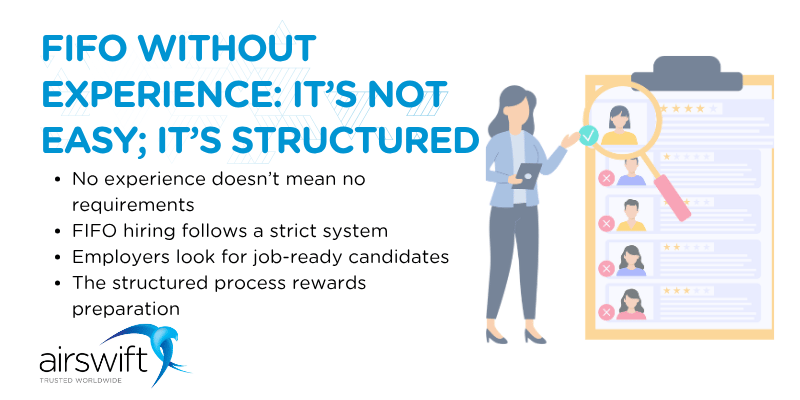
Getting a FIFO job with no experience isn’t about luck; it’s about being fully prepared before you apply. If you’ve completed your certifications, passed your medical and police checks, and built a FIFO-ready CV, you’re already ahead of most candidates. The next step is connecting with the right opportunities.
Airswift works with energy, mining, and infrastructure projects worldwide, helping entry-level candidates access FIFO roles where readiness matters more than experience.
Explore current FIFO job openings with Airswift, upload your CV, and take the first step into a global, high-demand career path.
Frequently Asked Questions (FAQs)
Q: What is a FIFO job?
A: FIFO stands for “fly-in, fly-out.” A FIFO job is one where employees are flown to a remote worksite for a set period (such as 2-4 weeks on), then flown back home for a break (e.g.: 1-2 weeks off). It’s common in mining, oil and gas, and other remote projects where the work site is far from towns or cities.
Q: Can I get a FIFO job with no experience?
A: Yes, it’s possible to start a FIFO career without prior on-site experience. However, you must be fully prepared. Employers expect you to have completed all the key requirements like mandatory safety training, a medical exam, and a background check so you can step into the job safely and immediately.
Q: What qualifications or tickets do I need to get a FIFO job?
A: Most entry-level FIFO jobs require a bundle of safety and compliance qualifications. This usually includes a general safety induction certificate (for example, a White Card in construction), Working at Heights training, and a Confined Space Entry certification. You’ll also need to pass a pre-employment medical and have a clean police check. Additional tickets (like a forklift licence or an offshore safety course) can give you an edge.
Q: Do FIFO jobs require a medical exam or drug test?
A: Absolutely. Virtually all FIFO roles demand that you pass a thorough medical exam and regular drug/alcohol screenings. Employers need to ensure you’re fit and healthy enough to handle physically demanding work in remote conditions. Failing the medical or drug test is a common reason candidates get screened out.
Q: Is a police check required to work FIFO?
A: Typically, yes. FIFO employers will ask for a recent police clearance (background check) before allowing you on site. This is a standard safety and security measure, particularly for high-value or sensitive projects. A clean record is usually necessary to move forward in the hiring process.
Q: What entry-level FIFO roles can I apply for as a beginner?
A: If you’re new to FIFO, look at support and service roles. Common starting positions include camp crew (catering, cleaning, housekeeping in the camp facilities), Trade Assistant roles (helping skilled tradespeople like electricians or mechanics), General Labourer on construction sites, or Warehouse/Logistics support (materials handling and inventory). These roles are open to candidates with no prior FIFO experience – as long as you have the required training and can handle remote work life.
Q: What’s the fastest way to get hired for a FIFO job?
A: Preparation is the fast-track. The quickest way to secure a FIFO job offer is to complete all requirements upfront. Get all your required certifications done, clear your medical and background checks, and prepare a strong, tailored FIFO CV. Then apply through a specialty FIFO recruiter or agency. By being 100% job-ready when you apply, you dramatically speed up the hiring process.
Q: How much can I earn in an entry-level FIFO job?
A: Entry-level FIFO jobs pay well relative to many other entry roles, though exact pay depends on location. For example, in Australia a first-time FIFO worker might earn about A$70k to over $100k in a year (including overtime). In other regions, pay structures differ; Middle East jobs often come with tax-free salaries, and some African or North American FIFO roles include extra allowances or project-completion bonuses.