
By
Nathalia Duarte
June 29, 2026
Updated
June 29, 2026
Canada’s strong economy and inclusive culture continue to attract professionals from around the world. However, navigating the Canadian work permit can quickly become complex.
With different permit types, employer requirements, and eligibility rules to consider, understanding the right pathway is essential. Some work permits require employer sponsorship and a Labour Market Impact Assessment (LMIA), while others offer more flexibility and do not require a job offer.
This guide explains the main types of Canadian work permits, how the application process works, which documents are required, and what both employers and candidates should expect before and after approval.

What types of work visas are available in Canada?
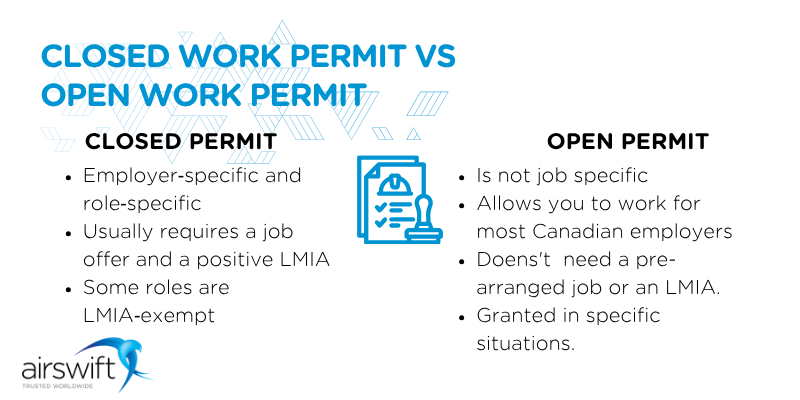
Employer-specific (closed) work permits
This permit is tied to a specific employer and role. In most cases, it requires a Canadian job offer and a positive Labour Market Impact Assessment (LMIA), confirming the need to hire a foreign worker.
Some employer-specific permits are LMIA-exempt under programmes such as intra-company transfers or international trade agreements.
Open work permits
This type of visa is not job-specific. It allows you to work for most Canadian employers without a pre-arranged job or an LMIA. It is only granted in certain situations, like post-graduation work permits, spousal open work permits, or youth exchange programs.
Check which one is right for you with a tool from the Canadian government.
Canadian work permit programmes: TFWP vs IMP
Most work permits fall under one of two federal programs:
Temporary Foreign Worker Program (TFWP)
The Temporary Foreign Worker Program allows Canadian employers to hire foreign workers to fill labour shortages when qualified local talent is unavailable.
Managed by IRCC and ESDC, most TFWP roles require a Labour Market Impact Assessment (LMIA), proving that no suitable Canadian worker could fill the position.
These permits are typically employer-specific, meaning the worker can only work for the approved employer.
International Mobility Program (IMP)
The International Mobility Program allows employers to hire foreign workers without an LMIA. Instead, the programme supports broader economic, cultural, or reciprocal benefits for Canada.
Common LMIA-exempt categories include:
- Post-graduation work permits (PGWP)
- Spousal open work permits (SOWP)
- CUSMA work permits
- Intra-company transfers
What is a Labour Market Impact Assessment (LMIA)?
.png?width=800&height=400&name=Labour%20Market%20Impact%20Assessment%20(LMIA).png)
A Labour Market Impact Assessment (LMIA) is a process used by the Canadian government to confirm that an employer needs to hire a foreign worker because no qualified Canadian worker is available for the role.
Most Employer-Specific Work Permits under the Temporary Foreign Worker Program require a positive LMIA before a worker can apply.
LMIA-based vs LMIA-exempt permits
An LMIA-based permit typically takes longer because the employer must:
- Advertise the role
- Apply for the LMIA
- Wait for government approval
These permits are usually tied to a specific employer and position.
LMIA-exempt permits are generally faster because they skip the LMIA stage. However, some still require employers to submit the job offer through IRCC’s Employer Portal and pay a compliance fee.
Open work permits do not require employer involvement.
What is an employer-specific work permit?
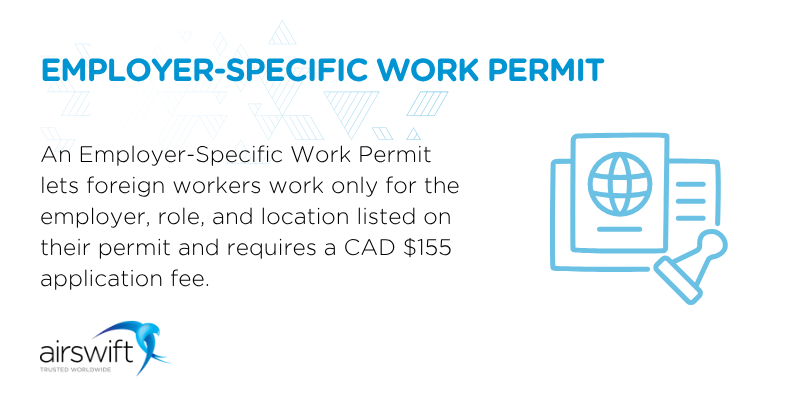
An employer-specific work permit allows you to work only for the employer, role, and location listed on your permit. It is the most common option for foreign workers with a Canadian job offer. Applicants must pay a CAD $155 work permit fee.
Application process and requirements
Employer’s steps
Before the worker applies, the employer must complete several steps.
For most positions, this includes obtaining a positive Labour Market Impact Assessment (LMIA) from Employment and Social Development Canada. The LMIA application fee is CAD $1,000 per position and must be paid by the employer.
If the role is LMIA-exempt under the International Mobility Program, the employer must instead submit the job offer through IRCC’s Employer Portal and pay a CAD $230 compliance fee.
Employee’s role
Once the employer’s steps are done, you apply to IRCC for your work permit. This step is usually online. You’ll need to pay the CAD $155 fee, provide the job offer or contract, LMIA confirmation number or Employer Portal offer ID, plus standard documents, such as passport, photos, etc.
Documents required:
- Work permit application forms
- Valid passport
- Proof of financial support
- Proof of qualifications and work experience
- Job offer documents
- Biometrics exam (CAD $85, if required)
- Medical exam (for certain occupations or stays longer than six months)
- Police certificates, if requested
Where to apply
Most applicants submit their work permit application online through IRCC. Some visa-exempt nationals, including many U.S. citizens, may also apply at a Canadian port of entry if they have all required documents.
Conditions and limitations of the employer-specific work permit
Employer-specific work permits come with clear restrictions.
- You can only work for the employer listed on the permit
- Changing jobs or employers requires a new work permit
- Permit validity is usually tied to the employment contract or LMIA duration
If your role, employer, or work location changes, you may need to apply for a new permit.
How long does the process take?
Processing times vary depending on the application type and whether an LMIA is required.
Standard processing may take several weeks to a few months. If an LMIA is needed, employers should also factor in additional processing time, which can add one to three months.
Applicants should always check IRCC’s latest processing timelines before applying.
What happens after your visa is approved?
If approved outside Canada, you will receive a letter explaining how to collect your work permit at the Canadian port of entry.
Once issued, you must follow all permit conditions, including:
- Employer restrictions
- Job limitations
- Work location requirements
- Expiry dates
Failing to comply with these conditions can affect your immigration status.
Foreign workers in Canada are also protected under the same labour laws and workplace rights as Canadian employees.
What happens if I need to extend my work permit?
Extensions are possible if you remain eligible. To avoid gaps in work authorisation, apply before your permit expires.
Depending on the situation, the employer may need to:
- Obtain a new LMIA
- Re-submit employment details through the Employer Portal
If you apply before expiry, you may continue working under maintained status while IRCC processes your application.
What is an open work permit?
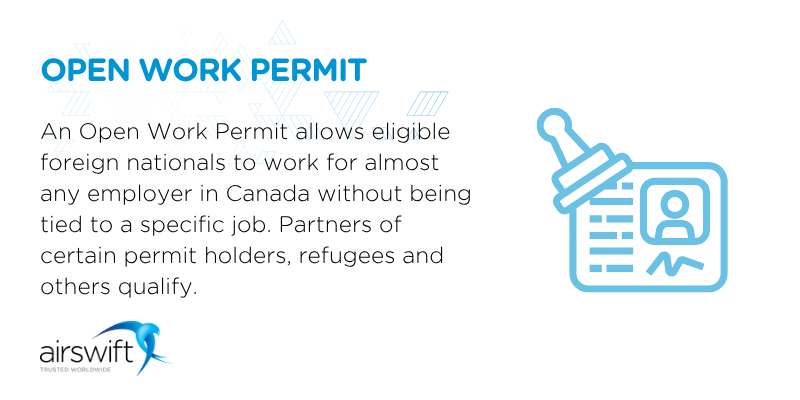
An open work permit lets you work for almost any employer in Canada and it’s not tied to a specific job. This flexibility is granted for spouses of certain permit holders, recent graduates, refugees and others who qualify.
In most of the cases, applications are made from inside Canada, and applicants must pay two fees: CAD $100 open permit holder fee and CAD $155 work permit fee. The amount can vary depending on the visa type.
Application process and requirements
No LMIA or job offer is needed. Since these permits are not employer-specific, your employer doesn’t need an LMIA or to be involved in your application. Open permits are only issued in specific scenarios. Common examples include:
- Post-graduation work permit (PGWP): for qualifying international graduates from Canadian institutions.
- Spousal open work permits: for spouses/common-law partners of certain international students or skilled workers in Canada.
- Working holiday visas (IEC): for youth from countries with reciprocal agreements.
How to apply for the open work permit?
Most open work permit applications are submitted from inside Canada, via the IRCC online portal. If you’re already in Canada as a visitor, student, or worker and become eligible for an open permit, apply online in Canada.
If you are outside Canada, you generally cannot get an open work permit, unless you qualify under an international program that allows it. The main example is the International Experience Canada (working holiday) program for youth from partner countries, which is applied from outside Canada.
Always check IRCC guidance for the eligibility rules that apply to your permit category.
Which documents are needed for the open work permit application?
Required documents vary depending on the permit type, but commonly include:
- Completed application form
- Valid passport copy
- Passport-sized photo
- Proof of eligibility for the permit category
- Proof of paid IRCC fees
Supporting documents may also include:
- Diploma and transcripts for PGWP applicants
- Marriage certificate and spouse’s permit for spousal applications
- Medical exam or police certificate, if required
Check the government’s page for full information on documents.
How long does it take for the work visa to be issued?
The processing time may vary by category. A post-graduation work permit (PGWP) might take a few weeks to a couple of months. Spousal work permits can take a few months, especially if tied to a sponsorship application.
Check IRCC for current timelines and submit early if possible.
What are the restrictions of the open work permit?
Although open work permits offer flexibility, some restrictions still apply.
For example:
-
Certain professions require Canadian licensing or certification
-
Without a medical exam, some permit holders may be restricted from working in healthcare, childcare, or teaching
Applicants are responsible for ensuring they meet the requirements for the jobs they accept.
What is the duration of the open work permit?
Open work permits can be valid for up to three years, depending on the permit category. For example, the post-graduation work permit (PGWP) validity is based on the length of the study programme. The spousal open work permits often match the duration of the spouse’s study or work permit.
Because validity periods vary, it’s important to monitor your permit expiry date and apply for an extension early if needed.
What happens after the approval?
If your application is approved from inside Canada, IRCC will send you an approval letter and mail your physical work permit directly to you. Once received, the permit is already active and can be used immediately for authorised work in Canada.
Can I extend my open work permit in Canada?
Extension eligibility depends on the permit category.
Examples include:
- Post-graduation work permit (PGWP): usually cannot be extended unless shortened due to passport expiry.
- Spousal open work permit: may be extended if the sponsor’s status remains valid.
- Bridging open work permit (BOWP): may be extended while permanent residence is still being processed.
- IEC working holiday permit: cannot be extended beyond the programme limit for your country.
How can Airswift support visas and work permits for Canada?
Managing visas and work permits can be complex, especially when hiring or relocating internationally. Airswift helps simplify the process by supporting work permit and employment visa applications in Canada and across global markets.
Whether you are pursuing an international career opportunity or hiring talent across borders, expert support can help reduce administrative pressure, improve compliance, and streamline workforce mobility.
For candidates
Planning to work abroad or need guidance on Canadian visa requirements?
Airswift supports professionals throughout the relocation process, helping them navigate immigration requirements and transition smoothly into new roles.
Explore international career opportunities and relocation support with Airswift.
For employers
Hiring internationally or expanding into new markets?
Airswift’s Employer of Record (EOR) services help companies hire compliantly without setting up a local legal entity in Canada. We support key employment processes, including:
- Work permits and visas
- Payroll management
- Employment compliance
- International workforce mobilisation