
By
Diyaa Mani
February 11, 2026
Updated
March 11, 2026
What is the biggest barrier to HR efficiency?
Most HR teams today are stretched thin. Instead of focusing on people, culture, and long‑term strategy, they’re often buried under time‑sensitive tasks like payroll, compliance, and immigration paperwork. All of which come with high risk if mishandled.
One of the most effective solutions is partnering with an Employer of Record (EOR).
An EOR takes on these labour‑intensive HR functions and also helps companies hire globally, test new markets, and scale remote teams, without needing to set up a local legal entity.

What does an Employer of Record do?
For many HR teams, the biggest barrier to strategic impact is the sheer volume of administrative tasks that must be handled while being compliant with local laws.
An Employer of Record solves this by acting as a legal employer of your workers in each country, while you maintain control of your employees' day-to-day responsibilities.
This removes the need for internal HR teams to develop country-specific HR expertise, especially in payroll, tax, benefits and compliance.
How this frees HR to focus on strategic priorities
By shifting routine HR administration to an EOR, internal teams can prioritise high-value work such as:
Tasks that an EOR can take off your plate include:
- Workforce and talent planning
- Leadership and capability development
- Employee engagement and retention
- Culture, wellbeing and organisational development
Six ways an Employer of Record supports HR in building and managing global teams
For HR teams tasked with supporting global growth, the challenges multiply fast: multiple new markets, unfamiliar labour laws, varying payroll systems, and the pressure to deliver a consistent employee experience across borders.
Below is a breakdown of the key ways an EOR strengthens HR efficiency across international markets.
Accelerate global market entry
.png?width=800&height=400&name=How%20do%20EOR%20solutions%20enable%20global%20hiring%20in%20days%20(1).png)
Expanding into a new country usually requires setting up a legal entity, a process that can take months and demand ongoing investment in legal, tax, HR, and finance capabilities. An EOR removes this barrier entirely.
With an EOR, HR teams can:
-
Hire talent in a new country within days
-
Avoid entity setup, registration, and compliance overhead
-
Support global roles faster and meet urgent project timelines
This gives business leaders a low-risk way to test markets, validate opportunities, and scale teams without long-term commitments.
Minimise global compliance risks
Every country has unique and frequently changing requirements around employment classification, working hours, benefits, taxation, and terminations. Keeping up with these rules is one of the biggest drains on HR capacity and one of the biggest sources of global risk.
EOR providers have in‑country specialists who monitor regulatory changes and ensure practices remain compliant.
Key risk areas an EOR protects against include:
-
Misclassification of contractors vs employees
-
Non-compliance with minimum wage, overtime, and statutory benefits
-
Errors in tax withholding and social security reporting
-
Incorrect termination processes or settlement calculations
Reliable multi‑country payroll management
Managing payroll across several jurisdictions requires navigating different tax systems, banking rules, pay schedules, reporting requirements, and languages.
An EOR centralises and standardises multi‑country payroll and saves your HR team from having to build internal payroll infrastructure in every new market.
Typical Employer of Record payroll support includes:
-
Gross‑to‑net calculations in line with local rules
-
Coordination of tax payments, social security, and year‑end statements
-
Management of salary payments using local banking channels
-
Integration with benefits, bonuses, and reimbursement processes
Supporting remote and distributed global teams
As remote work becomes increasingly normalised, HR teams must deliver fair and compliant employee experiences, even when workers sit in completely different countries.
A full-service EOR ensures remote employees are hired, onboarded, and supported correctly, no matter where they’re based.
Remote-focused EOR support includes:
-
Structured onboarding, orientation, and country-specific documentation
-
Access to locally compliant benefits packages
-
Local experts who can answer questions on leave rules and public holidays
-
End-of-assignment support, including tax clearance and immigration steps
Making global scaling faster and easier
Hiring needs can change rapidly, especially in industries like energy, engineering, and technology, where project timelines shift frequently. An EOR gives HR the flexibility to scale teams up or down without the constraints of entity management.
This is especially valuable for organisations expanding in phases or responding to market demands.
EOR-enabled scalability allows HR teams to:
-
Add new hires quickly in emerging markets
-
Support fixed-term or project-based roles compliantly
-
Adjust headcount without costly restructuring or entity closures
Improve cost transparency for global hiring
While EOR pricing includes a service fee, it can eliminate or reduce the major costs of international expansion. For early-stage expansion, this often results in significantly lower risk‑adjusted spend.
Cost-efficiency levers include:
-
Avoiding capital, registration, and compliance expenses for new entities
-
Reducing internal HR or legal headcount for low-volume markets
-
Consolidating payroll, immigration, and compliance under one provider
-
Gaining predictable total employment costs through transparent pricing models
EOR vs. local entity: Which is better for HR efficiency?
Here’s a simplified comparison HR leaders commonly consider:
| Dimension | Local Entity approach | Employer of Record approach |
|---|---|---|
|
Legal responsibility |
|
EOR becomes the legal employer, assuming day-to-day compliance and HR administration. |
|
|
|
Hiring can begin in days using EOR’s existing in-country entities. |
|
HR workload |
|
|
| Best for |
|
|
Integrating Employer of Record services into your global talent strategy
An Employer of Record should complement, not replace, overall talent and HR planning. Many organisations use EOR in early phases of expansion or for specific worker groups while maintaining entities in core markets for long-term operations.
Ways HR can strategically use EOR:
- Pilot new markets with a small team via EOR, then incorporate locally if the market proves successful.
- Use EOR for hard-to-reach or specialist talent in countries where full incorporation is not yet justified.
- Combine EOR with internal centres of excellence for talent management, learning, and leadership development.
How to choose the right Employer of Record partner for HR success
 The impact of EOR on HR efficiency depends heavily on the provider’s reach, expertise, and support model. Airswift’s experience in global STEM sectors (including energy, engineering, and technical roles) gives HR teams access to established country infrastructures and specialist compliance knowledge.
When evaluating EOR partners, HR leaders should look at:
- Geographic coverage and depth of local expertise for the markets you're expanding into
- In-house capabilities such as payroll, immigration, and compliance capabilities (rather than relying on multiple subcontractors).
- Employee experience, including benefits quality, local on-the-ground support, and responsiveness to queries.
- Transparent pricing that clearly outlines costs without hidden fees or inconsistent markups.
Practical steps to start maximising HR efficiency with an Employer of Record
Once HR teams recognise the value of an Employer of Record, the next question is usually:
“Where do we start without disrupting our existing HR operations?”
In most cases, a phased, low-risk rollout is the best approach.
Below is a simple starting roadmap:
-
Map global roles and future hiring needs by country, function, and timeframe.
-
Identify markets where you lack entities or local HR and where headcount will remain modest in the near term.
-
Engage EOR providers for consultations, proposals, and country-specific guidance on timelines and requirements.
-
Test the EOR model with a few hires in one or two markets, focusing on onboarding speed, accuracy and employee experience.
-
Define clear criteria for when to maintain EOR, expand EOR into additional countries or transition to a local entity.
Ready for global growth?
By combining an Employer of Record model with a clear talent strategy, HR leaders can streamline global operations, reduce risk, and create a scalable foundation for international growth.
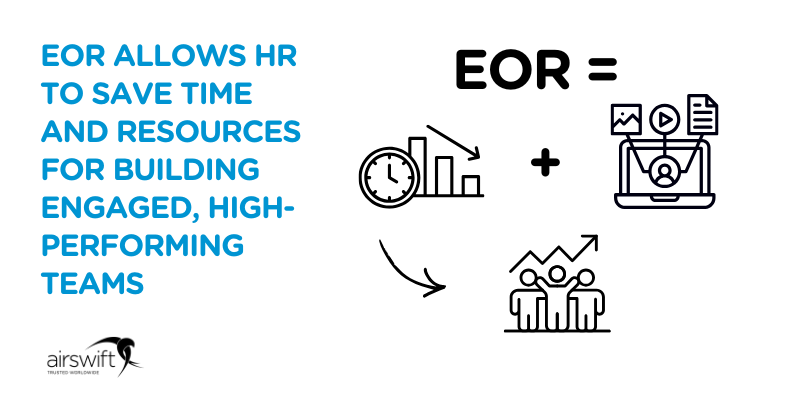
EOR allows HR to allocate time and resources to building engaged, high-performing teams that support theorganisation’s long-term objectives.
To find out how Airswift’s Employer of Record services can support your expansion plans, contact our team today. We’ll help you hire in new markets with speed, compliance, and total peace of mind.