
By
Nathalia Duarte
August 26, 2026
Updated
September 10, 2026
Do you often feel overwhelmed by a constant stream of new tasks? Are you regularly working beyond your scheduled hours just to stay on top of your workload?
These are common signs that workplace boundaries may be missing. Without them, it can be difficult to manage your time, protect your wellbeing, and maintain a healthy work-life balance.
In this article, you'll learn what workplace boundaries are, why they're important, and how to set them effectively, with examples that can help you create a healthier and more sustainable approach to work.

What is a boundary?
Boundaries are agreements around time, workload, communication, availability, meetings, and digital access. They help protect your wellbeing while enabling you to work effectively with others.
Setting boundaries is not about controlling others or avoiding collaboration. It is about taking responsibility for how you manage your work and personal limits, being an essential part of maintaining productivity, and building positive working relationships.
Why does setting boundaries matter?
Poor work-life balance can affect both mental and physical health.
According to SHRM's 2024 Employee Mental Health Research Series, 44% of 1,405 surveyed U.S. employees reported feeling burned out at work. Additionally, 45% felt emotionally drained, while 51% said they felt used up by the end of the workday.
Research from the International Labour Organization (ILO) and the World Health Organization (WHO) also found that people who work 55 or more hours per week have a 35% higher risk of stroke and a 17% higher risk of dying from ischemic heart disease compared with those working 35 to 40 hours per week.
Setting boundaries helps create healthy limits around work and makes it easier to mentally disconnect outside working hours. This can reduce exhaustion, improve wellbeing and sleep quality, and lower fatigue.
Eight signs you need to set boundaries
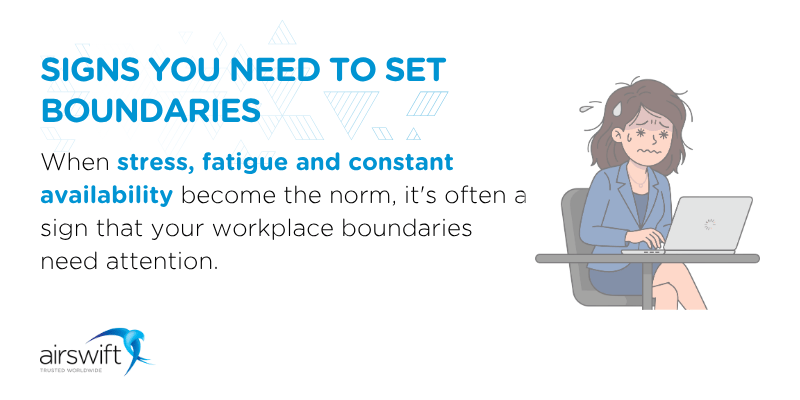
Your physical and emotional well-being can often signal when it's time to set better boundaries. Pay attention if you:
- Feel increasingly stressed or anxious
- Are always online and available
- Lack motivation or interest in activities you enjoy, at work or outside of it
- Struggle to stay productive
- Find it difficult to switch off after work
- Have trouble sleeping
- Feel constantly fatigued
- Have a packed calendar with little or no downtime
If your work-life feels out of sync, setting boundaries can help you create a healthier balance between work and personal life.
Remember, boundaries are not about putting in less effort. They are about protecting your wellbeing and staying true to your values. Without them, it is easy to become overly available to others and put your own needs last.
How to set boundaries at work
There are many types of workplace boundaries, but these three are a good place to start:
-
Emotional boundaries: Managing your emotions, avoiding overcommitment, and maintaining your mental wellbeing.
-
Time boundaries: Controlling your availability, response times, and how you handle requests.
- Physical boundaries: Personal space, workplace etiquette, and protecting your health and energy.
Start by reflecting on your role, responsibilities, and work environment. Identify situations that regularly cause stress or frustration and consider what changes could improve your wellbeing without negatively affecting your work or colleagues. For example, you may be frequently asked to work overtime or feel overwhelmed by your workload.
Once you have identified the issue, use the tips below to set effective boundaries.
Align your boundaries with your values and priorities
When you're new to setting boundaries, aligning them with your values and priorities can make them easier to maintain.
For example, if spending time with family is important to you but you regularly work overtime, you might set a boundary around finishing work on time and not responding to messages after 6 p.m.
Similarly, if you're uncomfortable with office gossip, your boundary could be politely leaving conversations when they turn to that topic.
Communicate your boundaries clearly
People cannot respect boundaries they do not know about. Communicate them clearly, respectfully, and confidently.
For example:
-
"I don't check emails after 6 p.m., but I'll respond first thing tomorrow morning."
-
"I'm happy to help with this project, but I can take it on once I finish my current task next week."
Avoid over-explaining
It's normal to feel guilty when you first start setting boundaries, especially if you're worried about how others will react. However, protecting your wellbeing does not require lengthy explanations. State your boundary respectfully and keep the conversation focused on expectations.
Respect your own boundaries
Setting boundaries is only the first step. You also need to maintain them consistently.
There will be times when others push back or when you're tempted to make exceptions out of guilt. If you're used to always saying yes, this can feel uncomfortable at first. However, the more consistently you reinforce your boundaries, the more effective they become in protecting your wellbeing and preventing burnout.
Practical boundary examples for a healthier work life
Setting boundaries doesn’t involve making major changes in your life. It’s all about small, consistent actions to help you protect your time, energy, and wellbeing.
1. Respect your working hours
Avoid staying late, regularly checking emails, or responding to messages outside your agreed working hours. Protecting your personal time helps prevent burnout and supports a healthier work-life balance.
When approached, try using these phrases:
-
"I'll pick this up first thing tomorrow morning."
-
"I'm offline for the day, but I'll respond during working hours."
-
"I'd be happy to help, but I'll need to look at this tomorrow."
2. Ask for help prioritising tasks
When your workload becomes overwhelming, speak with your manager about priorities. Understanding what is most important can help you focus your energy where it has the greatest impact.
Whenever you feel needed, try these examples:
- "I'm currently working on several priorities. Which task would you like me to focus on first?"
- "I can support this, but I'll need guidance on what should take priority."
- "Given my current workload, could we discuss which deliverables are most urgent?"
3. Learn to say no respectfully
You do not have to accept every request that comes your way. If you lack capacity, explain your situation clearly and offer alternatives where appropriate.
Use the following examples when appropriate:
- "I'd like to help, but I don't have the capacity to take this on right now."
- "I won't be able to give this the attention it deserves at the moment."
- "Unfortunately, I can't commit to this right now, but I may be able to support at a later date."
4. Block out focus time in your calendar
Schedule uninterrupted time for deep work. This helps reduce distractions, improve productivity, and ensure important tasks are completed.
If someone tries to reach you during this time, you can use the examples below:
- "I've blocked some time this afternoon to focus on a deadline, so I may be slower to respond."
- "I have dedicated work time scheduled then. Could we meet later in the day?"
- "To stay on track, I'm protecting this time for focused work."
5. Minimise interruptions
Set expectations around when you are available for questions, meetings, or messages. Limiting unnecessary interruptions can help you stay focused and productive.
If you feel interrupted during a task, try using these phrases:
- "I'm in the middle of something right now. Can we discuss this in an hour?"
- "Could you send me the details in a message? I'll review them once I finish this task."
- "I'd like to give this my full attention. Is it okay if we discuss it later today?"
6. Use one-to-one meetings to discuss your needs
Regular check-ins with your manager are a valuable opportunity to raise concerns, discuss workload, and talk openly about the support you need.
Use the examples below to open the conversation or ask for help whenever needed:
- "I'd like to talk about my current workload and where I might need additional support."
- "I'm finding it difficult to balance all my responsibilities and would appreciate your guidance."
- "I want to make sure my workload remains sustainable while meeting expectations."
7. Manage your time intentionally
Use tools such as task lists, time blocking, or prioritisation frameworks to stay organised and make better use of your working day.
Implement the examples below when a new task arrives:
- "To meet this deadline, I'll need to postpone some lower-priority tasks."
- "I've planned my week around existing commitments, so I may need extra time before taking on something new."
- "Let me review my schedule and come back with a realistic timeline."
8. Avoid multitasking
Switching constantly between tasks can reduce productivity and increase stress. Focus on one task at a time whenever possible to improve both efficiency and quality.
Whenever a person is asking for your attention while you are busy, try these phrases:
- "I'm currently focused on another priority. Once that's complete, I can give this my full attention."
- "To ensure quality, I prefer to finish one task before starting the next."
- "I'm working through a few key priorities and want to avoid splitting my focus too much."
Find opportunities that support healthy workplace boundaries
In conclusion, setting boundaries at work is not about doing less. It is about protecting your time, energy, and wellbeing so you can perform at your best, both professionally and personally. By recognising the signs of poor work-life balance and taking steps to establish healthier limits, you can reduce stress, prevent burnout, and create a more sustainable and fulfilling career.
At Airswift, we understand that a healthy work environment goes beyond compensation and career progression. The right employer should support employee wellbeing, encourage open communication, and respect healthy workplace boundaries. That's why we connect professionals with organisations that value work-life balance and empower their people to thrive.
Explore our available opportunities and discover STEM roles with employers who recognise that sustainable performance starts with supporting their workforce.