By
Richard Halewood
February 20, 2026
Updated
February 20, 2026
Floating Liquefied Natural Gas (FLNG) facilities and Floating Production Units (FPU) are becoming central to meeting the world’s energy needs as we transition to cleaner fuels. Many of these complex projects are being fabricated in Asian shipyards, underscoring Asia’s pivotal role in delivering next-generation energy infrastructure.
This article highlights major FLNG, FPU, and LNG construction projects currently underway.
From groundbreaking FLNG vessels in Indonesia and Nigeria to deepwater production hubs in the Gulf of Mexico, these projects demonstrate how Asian yards in Singapore, South Korea, and China are enabling global energy developments.
Click here to read part one on FPSO projects
Genting Kasuri FLNG (Indonesia) - Genting Oil and Gas
Scope and status
Indonesia’s first floating LNG facility with 1.2 million tonnes per annum (MTPA) capacity. Built by Wison (China) under a $1 billion EPCIC contract awarded in 2024. Will be moored offshore West Papua to process ~230 million cubic feet per day of gas from the Kasuri block (Asap, Merah, Kido fields). Construction is underway (first steel cut mid-2024) with first LNG expected by late 2026.
Sustainability features
- Captures all produced gas as LNG or for local industry (feedstock to an onshore ammonia-urea plant), eliminating routine flaring.
- Provides cleaner energy domestically, helping displace coal and diesel fuel.
- Supports local economic development by utilising gas for value-added products (fertilisers).
Notable tech
- Modular FLNG design (single 1.2 MTPA liquefaction train on a 279 m vessel) integrating gas treatment, liquefaction, and LNG storage onboard.
- Leverages proven technologies (mixed refrigerant liquefaction, marine LNG offloading) in a first-of-its-kind application for Indonesia.
UTM Offshore FLNG (Nigeria) - UTM Offshore and NNPC
Scope and status
West Africa’s first FLNG unit, sized for 1.5 MTPA of LNG plus 0.3 MTPA of LPG. To be moored off Akwa Ibom State, tapping gas from the Yoho oilfield that is currently flared. FEED completed in late 2023 (by JGC and Technip); FID expected in 2025. Fabrication planned with COSCO (China) as part of the EPCIC team, aiming for first LNG by 2028.
Sustainability features
- Transforms flared associated gas into LNG and LPG, significantly reducing CO₂ emissions and wasteful flaring.
- Dedicates ~0.3 MTPA of LPG for domestic use in Nigeria, lowering reliance on wood and charcoal for cooking (improving indoor air quality).
- Aligns with Nigeria’s gas flare reduction policies and creates value from gas that would otherwise be wasted.
Notable tech
- Utilises Black and Veatch’s PRICO liquefaction process; a compact, marine-proven LNG technology.
- High-capacity floating plant (total ~2.0 MTPA of product) with integrated gas treatment, liquefaction, and storage systems on one vessel.
- Execution by an international consortium (JGC, Technip Energies, KBR, and COSCO), bringing together global LNG and shipbuilding expertise for Nigeria’s debut FLNG.
Delfin FLNG (USA) - Delfin Midstream
Scope and status
A novel LNG export solution in the U.S. Gulf of Mexico, using up to four floating LNG vessels (~3–3.5 MTPA each) instead of an onshore terminal. These FLNGs will be moored ~70 km off Louisiana, connected to the existing UTOS offshore gas pipeline.
The project received a federal Deepwater Port License in 2025 (a first for LNG), paving the way for FID on the first unit. Samsung Heavy Industries (Korea) is lined up to construct the FLNG hulls and topsides. First LNG is projected around 2028.
Sustainability features
- Offshore location and use of existing pipeline infrastructure minimise new construction and environmental impact onshore.
- LNG exports enable coal-to-gas switching in importing countries, cutting CO₂ emissions roughly in half for equivalent energy output.
- Incorporates efficient aeroderivative gas turbines and waste heat recovery to reduce fuel consumption and emissions during liquefaction.
Notable tech
- First floating LNG project in U.S. waters, requiring unique regulatory and technical solutions (e.g., deepwater offloading under a MARAD license).
- Modular liquefaction train approach on each vessel for flexibility and ease of maintenance.
ADNOC Ruwais LNG (UAE) - ADNOC Gas
Scope and status
A new onshore LNG mega-project in Abu Dhabi’s Ruwais industrial city. Consists of two large trains totalling 9.6 MTPA capacity, slated to start up in 2028. FID was announced in 2024 with a $5.5 billion EPC contract awarded to a Technip Energies-JGC-NPCC consortium. This facility will more than double the UAE’s LNG export capacity and features cutting-edge electrification.
Sustainability features
- First LNG plant in the Middle East to use all-electric drive for compressors, powered by the UAE grid (including nuclear and solar), drastically cutting operational emissions.
- Advanced design includes high-efficiency equipment and digital monitoring to minimise methane leaks and optimise energy use.
- Supports the UAE’s net-zero 2045 initiative by delivering LNG with significantly lower carbon intensity for global markets.
Notable tech
- Massive 75 MW electric motors replace traditional gas turbines to drive the liquefaction refrigeration cycles.
- Incorporates state-of-the-art AP-C3MR liquefaction technology adapted for electric operation and extreme Gulf climate conditions.
- Emphasises modular construction and AI-driven control systems for improved safety, reliability, and performance.
Rio Grande LNG (USA) - NextDecade
Scope and status
A 27 MTPA LNG export terminal under construction at the Port of Brownsville, Texas, with Phase 1 (17.6 MTPA, 3 trains) underway following FID in 2023.
Bechtel is the EPC contractor, and the first LNG is expected by 2027. This project has drawn international investment (including Asian and Middle Eastern partners) and is notable for an integrated carbon capture program.
Sustainability features
- Designed to capture and sequester ~5 million tonnes of CO₂ annually (via CCS), greatly reducing greenhouse gas emissions from operations.
- Comprehensive environmental management plan, including wetlands preservation and habitat restoration to offset construction impacts.
- Produces LNG to help countries transition from coal to cleaner natural gas, contributing to global emissions-reduction goals.
Notable tech
- Uses proven large-scale liquefaction trains (Air Products AP-C3MR process) at ~5.9 MTPA each, among the largest in the industry.
- Integrates one of the world’s first utility-scale carbon capture systems at an LNG plant (amine-based CO₂ removal and compression for geological storage).
- Employs advanced modularisation and record-setting project financing to accelerate construction while maintaining cost efficiency.
Woodside Trion FPU (Mexico) - Woodside and Pemex
Scope and status
A deepwater oil development in the Gulf of Mexico (offshore Mexico). Features a semi-submersible Floating Production Unit in ~2,500 m water depth, paired with a Floating Storage and Offloading vessel. The FPU will process up to 100,000 barrels of oil per day (plus ~150 million cubic feet of gas per day). FID was reached in 2023; the FPU is being built by Hyundai Heavy Industries (Korea) for first oil in 2028.
Sustainability features
- No routine flaring; associated gas will be used for power or reinjected into the reservoir, minimising emissions.
- Designed for low carbon intensity (target ~12 kg CO₂ per barrel), achieved through efficient power generation and heat recovery systems.
- Strict environmental safeguards (spill prevention, protection of marine ecosystems) as the first deepwater project in Mexican waters, aligning with global best practices.
Notable tech
- Employs advanced 15,000-psi subsea production systems and multi-zone well completions to maximise output from thick, high-pressure reservoirs.
- Large integrated topsides (~25,000 tons) assembled on a four-column semi-submersible hull, showcasing HHI’s mega-fabrication capabilities.
- Uses digital twin and remote operation technologies to enhance safety and optimise performance in real time.
BP Kaskida FPU (USA Gulf of Mexico) - BP
Scope and status
An ultra-high-pressure deepwater project in ~1,800 m of water (Keathley Canyon area). Involves a new semi-submersible FPU (80,000 barrels per day capacity) developing the Kaskida field with 6 initial wells. Sanctioned in 2024; first oil is expected in 2029. The FPU is being engineered and built by Seatrium (Singapore), reflecting the reliance on Asian yards for Gulf of Mexico megaprojects.
Sustainability features
- Plans for gas reinjection to eliminate routine flaring, using produced gas to enhance oil recovery and cut emissions.
- Standardised design (leveraging lessons from BP’s Argos platform) improves efficiency and reduces materials waste.
- High-performance wells with advanced completions mean fewer wells are needed, limiting the environmental footprint for the amount of oil recovered.
Notable tech
- Among the first deployments of 20,000-psi subsea production equipment (a result of BP’s Project 20K initiative).
- Four-column semi-sub FPU with a single topsides module - similar to existing designs but upgraded for extreme pressure operation.
- Serves as a hub for future developments: designed with tie-in points to connect additional fields (like BP’s Tiber discovery) without building new floating platforms.
BP Tiber FPU (USA Gulf of Mexico) - BP
Scope and status
A twin high-pressure development to Kaskida, approved in 2025 to exploit the Tiber and Guadalupe fields using a copy of the Kaskida FPU design (~85% identical). Will have ~80,000 barrels per day capacity and tie back both fields to one platform. Fabrication by Seatrium (Singapore) will be synchronised with Kaskida’s build. First oil is targeted around 2030.
Sustainability features
- Replicating an existing platform design expedites delivery and reduces redundant engineering, saving energy and materials.
- One shared infrastructure for two fields minimises additional seabed disturbance and avoids duplicative offshore installations.
- Maintains no-flaring operations and deploys high-end monitoring systems to ensure safe, environmentally responsible production.
Notable tech
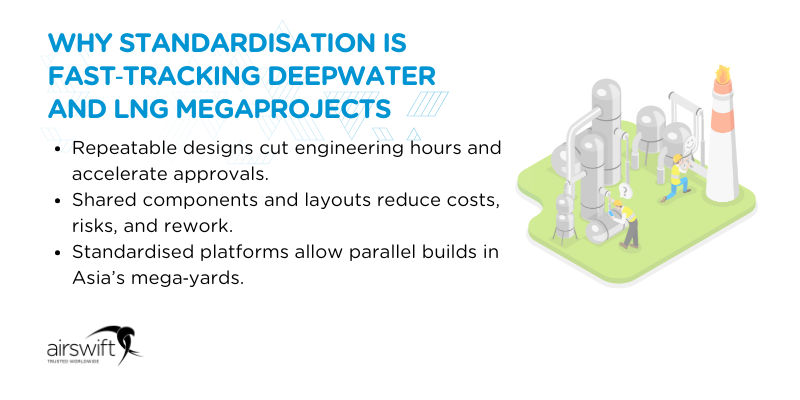
- Essentially a carbon-copy of the Kaskida 20K FPU, demonstrating fast-track project execution through standardisation.
- Utilises long-distance subsea tiebacks (Guadalupe to Tiber hub) with flow assurance technology to handle multi-field production.
- Parallel construction of two identical FPUs at an Asian yard (Seatrium), an innovative approach that improves efficiency for large deepwater projects.
These eight projects underscore the vital role of Asian fabrication yards and engineering expertise in advancing global energy infrastructure. This next generation of projects, enabled by world-class Asian fabrication, is setting new benchmarks for what’s possible in the energy transition, reinforcing Asia’s central position in the industry’s future.
How Airswift can support your fabrication yard project
Airswift helps global companies confidently execute fabrication work across Asia by delivering seamless workforce solutions tailored to complex, multi‑location projects.
With a long history supporting the energy, infrastructure, and engineering industries, we make it easier for organisations to mobilise talent, remain compliant, and maintain workforce continuity.
Our solutions span every stage of mobilisation and project delivery, including:
- Complete workforce mobility services, covering immigration processing, visa coordination, and compliant payroll management
-
Employer of Record (EOR) solutions, enabling you to engage and payroll talent in-country without setting up a local entity
- Rapid access to our global talent network spanning structural fabrication, piping, mechanical assembly, quality control, and heavy‑lift operations
- Regional presence and dedicated local teams in key fabrication hubs such as Singapore, Thailand, Indonesia, China and South Korea,