By
Natalie Colvin
April 22, 2026
Updated
August 11, 2026
A Professional Development Plan (PDP) is meant to define how a role evolves over time: the skills an employee builds, the responsibilities they take on, and the impact they are expected to deliver as they progress.
Why the PDP gap is a hiring problem
In theory, PDPs provide clarity, motivation, and direction. In practice, they are often introduced after a hire is made, added during onboarding or annual reviews, once role expectations, job design, and workload are already fixed. By that point, development becomes reactive rather than intentional, and career progression is framed as a future conversation rather than a built‑in outcome.
This disconnect is what many organisations are now experiencing as the PDP gap, and it doesn’t originate in learning and development. It starts much earlier, at the point where roles are defined, approved, and brought to market.
When career development is treated as a post‑hire initiative rather than a priority, even well‑intended PDPs struggle to gain traction. Role scope is already locked in, success is measured against immediate delivery, and progression remains vague or informal. Over time, this fuels dissatisfaction, slows time‑to‑impact, and increases retention risk.
Recruitment Process Outsourcing (RPO) models address this issue by redesigning the hiring process itself; embedding progression, skills logic, and future success definitions before hiring begins. The result is a shift from vacancies being filled to roles being designed for momentum.
The GETI insight: PDPs are missing where they matter most
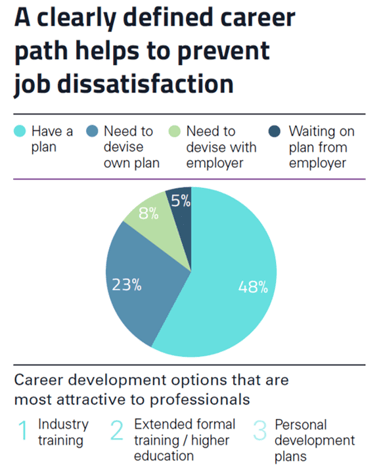
The Global Energy Talent Index (GETI) 2026 highlights just how closely career clarity and retention are linked, and how limited PDP adoption still is across the workforce.
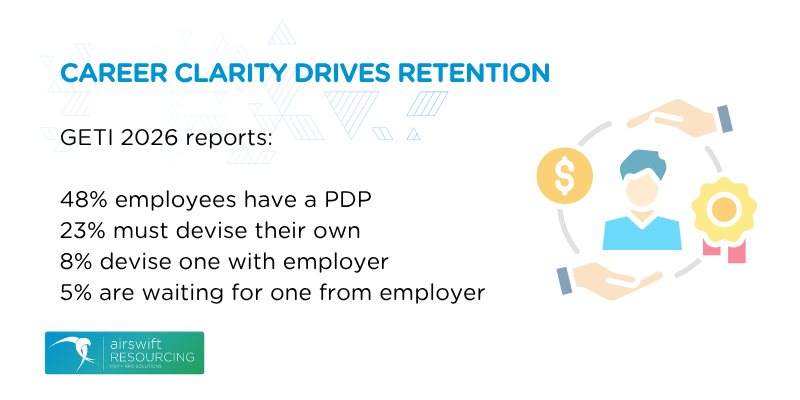
2025 GETI established that a lack of a clear career path was the main reason for role dissatisfaction. This year’s survey found that only 48% of professionals have a plan, 23% need to devise their own plan, 8% need to devise one with their employer, and 5% are waiting for one from their employer.
Several signals stand out:
- Career development remains the number one priority for professionals.
- Only 48% of professionals report having a PDP, with the remainder lacking clarity, ownership, or employer support.
- A significant portion of the workforce is either improvising their own development or waiting for direction.
The message is clear; where progression is undefined or inconsistently communicated, dissatisfaction follows, often long before performance issues become visible. In tight labour markets and skills‑constrained sectors, this dissatisfaction translates directly into early attrition and stalled capability building.
Why PDP failure starts at the requisition
Career development strategies rarely fail because organisations lack frameworks, intent, or investment. They fail because role design, hiring execution, and development planning are not governed as one system.
PDPs are undermined when:
- Roles are approved and marketed without a clear view of how they should evolve, leaving development to be retrofitted later.
- Learning and development teams are asked to create PDPs without clear assumptions about progression, skills adjacency, or future capability requirements.
- Job descriptions focus on fixed tasks rather than evolving outcomes, anchoring employees to the present role instead of enabling momentum.
- Hiring urgency forces managers to prioritise immediate delivery over long‑term capability design.
Once a role is defined narrowly and filled under pressure, development becomes optional and dependent on individual managers, budget cycles, or future headcount approvals. Even robust career frameworks often break down when faced with the realities of live hiring.
This is the structural root of the PDP gap; the development is expected to compensate for role design decisions made months earlier under entirely different constraints.
Why RPO changes the equation, and frameworks alone do not
Many organisations recognise this problem, but few are able to solve it consistently.
Internal HR teams, consultancies, and technology platforms can all define career pathways and progression frameworks. However, these constructs often struggle to survive once urgency, volume, regional variation, and hiring manager discretion come into play.
What differentiates RPO‑designed role frameworks is not aspiration; it is repeatability under pressure.
RPO models are structurally positioned to embed progression into hiring because they:
- Own both role definition and hiring execution, allowing development logic to persist through approval, attraction, assessment, and onboarding.
- Operate across roles, projects, and regions, bringing consistency where internal processes often fragment.
- Apply governance at the requisition stage, making progression a design requirement rather than a discretionary outcome.
- Sit at the intersection of workforce insight and real‑time hiring data, grounding role evolution in market reality rather than theoretical models.
While internal teams and advisors can design progression frameworks, RPOs are uniquely positioned to ensure those frameworks show up in every hire, not just priority roles or leadership tracks.
In this model, career development fails less often not because organisations suddenly have better intentions, but because development logic is embedded where it can no longer be bypassed.
What changes when hiring becomes development‑aware
When progression is built into hiring, the entire operating model shifts, from how roles are defined to how success is discussed.
Role architectures replace static job descriptions
Rather than treating roles as fixed snapshots, RPOs design role architectures that define how scope, influence, and responsibility are expected to grow over time. This creates visible pathways rather than implied promises.
Skills are differentiated by timing, not just presence
RPOs distinguish between skills required on day one to perform effectively, and adjacent skills that signal readiness for progression and future impact.
This ensures hiring decisions support both immediate delivery and long‑term capability building, reducing the need for premature external hiring down the line.
Success is defined beyond the first 90 days
Hiring managers are aligned around what success looks like at six, twelve, and twenty‑four months, not just at the point of onboarding. This creates shared expectations across recruitment, HR, and delivery teams.
Candidates gain clarity before they accept
Progression stops being a vague benefit and becomes a tangible part of the opportunity. Candidates understand how the role evolves, what growth looks like, and how they will be measured.
By embedding progression, skills logic, and time‑bound success metrics into hiring, RPOs turn career development from an abstract ambition into a measurable driver of performance.
The outcome is a shift from vacancy to velocity, accelerating time‑to‑impact while strengthening retention.
What this looks like in practice
When development logic is embedded into hiring, it shows up consistently across the employee lifecycle.
- Requisitions are written around role evolution, explicitly describing how the role expands in capability and impact over time.
- Interview frameworks are designed to assess learning agility, problem‑solving potential, and readiness for adjacent skills — not just alignment with today’s tasks.
- Early tenure feedback loops between hiring managers and new hires reinforce expectations set during the recruitment process, sustaining momentum from the first months.
- Development conversations feel continuous, rather than introduced as a corrective measure once performance stalls.
Importantly, progression no longer depends on post‑hire reinvention; it becomes the logical continuation of what was designed at the outset.
The business impact: Lower attrition, faster impact, stronger capability
The connection between unclear progression and dissatisfaction is well established. GETI 2026 reinforces that when career pathways are poorly defined, retention risk rises, even when compensation and project quality remain attractive.
At the same time, organisations are facing persistent skills shortages in critical roles, increasing pressure to future‑proof teams amid technological and regulatory change, and growing complexity in multi‑region hiring, where consistency is difficult to sustain.
Hiring managers are rarely given the time or structure to solve these challenges alone.
RPO models provide the missing link by embedding governance, workforce insight, and execution discipline into the hiring process itself. Progression is no longer reliant on individual capability or best‑case behaviour; it is built into the system.
The result is a repeatable approach to hiring that reduces early attrition driven by unmet expectations, shortens time‑to‑productivity by clarifying success from day one, and builds capability internally rather than continually returning to the external market.
Turning hiring into a long‑term talent advantage
RPO‑designed role frameworks integrate progression into the point where careers actually begin, at the requisition.
By governing role design, hiring execution, and development logic as one system, RPO models transform career development from an aspiration into a repeatable outcome, creating faster impact, stronger retention, and sustained momentum long after the vacancy is filled.
For organisations re‑examining how roles are designed, filled, and sustained over time, RPO‑designed role frameworks offer a way to bring progression earlier into the hiring conversation. Airswift Resourcing’s RPO approach illustrates how development logic can be incorporated at the point of hire, helping organisations create clearer momentum from day one.