By
Sam Bennett
August 17, 2026
Updated
August 18, 2026
Saudi Arabia has become one of the world's most closely watched expansion destinations, attracting record levels of foreign investment as Vision 2030 enters its final phase.
From mega-projects and energy investment to AI infrastructure and business-friendly reforms, the Kingdom is creating new opportunities across engineering, technology, infrastructure, and energy sectors.
However, opportunity is only one side of the equation. Businesses entering Saudi Arabia must also navigate workforce localisation requirements, hiring regulations, and market-entry strategies. This article explores the key drivers behind Saudi Arabia's growth and what employers need to know to build a successful workforce there.

Why are businesses expanding rapidly into Saudi Arabia?
1. Vision 2030's final phase is codified reform
The Kingdom is now aligning long-term financial planning with regional development strategies under a National Investment Strategy that targets the private sector reaching 65% of GDP, FDI hitting 5.7% of GDP, and non-oil exports rising from 16% to 50% of non-oil GDP.
FDI stock has expanded 13% to approximately SR1.1 trillion ($293.3 billion), roughly five times 2017 levels.
For expansion leaders, this matters because the reform trajectory is now backed by measurable, published targets, not just political intent.
2. A giga-project pipeline in execution
The Public Investment Fund's portfolio of eleven giga-projects (NEOM, Red Sea, Qiddiya, Diriyah, ROSHN, AMAALA, AlUla, New Murabba and others) continues to represent one of the largest single construction programs in the world.
Crucially, 2026 is the year of recalibration and delivery, not announcement. Qiddiya opened its Six Flags park in December 2025, Diriyah has 50,000 workers on site ahead of Expo 2030, ROSHN's first Alarous handovers begin in Q3 2026, and NEOM's Green Hydrogen plant is over 90% complete and moving into commissioning.
Some projects have been trimmed (NEOM's THE LINE was reduced and paused), but for EPC, engineering, and infrastructure firms, that recalibration is a sign of a market maturing into disciplined delivery, not one pulling back.
3. Traditional and clean energy are scaling in parallel
This is where Saudi Arabia's uniqueness sits for core sectors. Aramco has guided 2026 capex of $50 to 55 billion, with 72% of upstream spending flowing into gas programs and anchored by the Jafurah unconventional gas field and expansions at Marjan, Berri, and Uluf.
Downstream, the Amiral petrochemical complex and Satorp refinery expansion in Jubail are among the largest active construction programs in the Kingdom.
At the same time, the NEOM Green Hydrogen Company plant - the world's largest utility-scale green hydrogen facility- has moved past 90% completion and is targeting 2026 startup, producing up to 600 tonnes per day of carbon-free hydrogen converted into green ammonia.
Few markets globally are expanding hydrocarbons and hydrogen simultaneously at this scale.
4. The RHQ program, 100% ownership, and 30-year tax relief
The commercial arithmetic for setting up in Saudi Arabia has fundamentally changed. Under the Regional Headquarters (RHQ) program, licensed multinationals receive a 0% corporate income tax rate and 0% withholding tax rate on qualifying activities for 30 years, renewable. That incentive sits alongside the standard 20% corporate rate that continues to apply to non-RHQ foreign entities.
The tax relief is paired with a market-access lever: since January 2024, Saudi government entities have generally been barred from awarding contracts to multinationals without a Saudi RHQ.
Over 700 companies have now taken up RHQ licenses across technology, financial services, energy, healthcare, and professional services. For any firm bidding on government or PIF-linked work, the RHQ has moved from optional to close to mandatory
5. The "Year of AI" and a digitally ambitious economy
Saudi Arabia has declared 2026 the Year of Artificial Intelligence, backed by a national strategy with roughly $9.1 billion in committed AI investment and the launch of HUMAIN, the PIF-backed AI champion tasked with building sovereign compute capacity.
That matters even to expansion leaders in traditional sectors, because the buildout is happening in the physical world: data centre construction, industrial AI in oil and gas operations, autonomous field engineering, and grid-scale automation.
For technology and engineering firms alike, Saudi Arabia in 2026 is one of the few markets where AI infrastructure and heavy-industry demand are converging on the same expansion timeline.
How Saudization impacts international employers?
What is Saudization?
Saudization, delivered through the Nitaqat program, is Saudi Arabia's workforce localisation policy. It is administered by the Ministry of Human Resources and Social Development (HRSD) and classifies every private-sector employer by the ratio of Saudi nationals it employs versus a sector- and size-based quota.
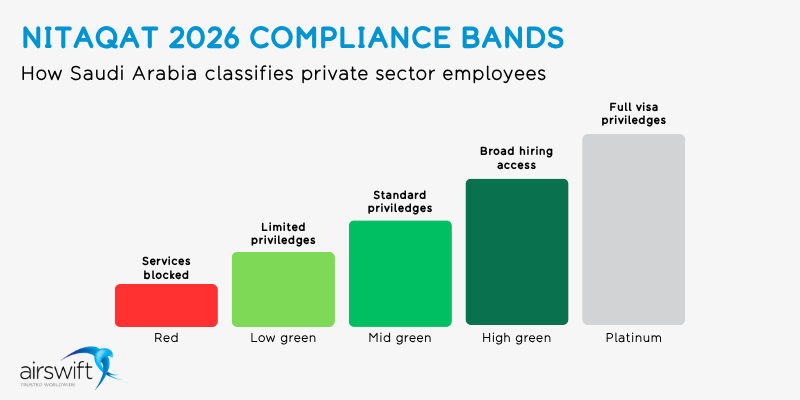
That ratio places the employer in a colored band - Platinum, High Green, Mid Green, Low Green, or Red - and the band controls the government services the employer can access.
What changed in 2026
A new three-year Nitaqat cycle rolled out between late 2025 and early 2026 with three important shifts.
First, the Yellow band was eliminated - there is no longer a buffer between Green and Red. Second, a Saudi employee now only counts toward the Saudization percentage if their contract is electronically documented on the Qiwa platform, and only if their insured salary reaches SAR 4,000 (with partial credit between SAR 3,000–4,000).
Third, sector quotas have been raised; administrative support extended to 100% Saudization on 69 additional professions from 5 April 2026, marketing and sales lifted to 60% from 19 January 2026, and a 30% Saudization rate applied to 46 engineering professions from 30 June 2026 for firms with five or more workers in scope.
What Nitaqat actually controls
The band determines whether an employer can issue new work visas, renew work permits, transfer sponsorship, or even retain existing expatriate staff. A Red-band employer faces frozen visas, blocked renewals, and restricted government services - a genuine business-continuity risk for any project on a mobilisation deadline.
A growing, motivated Saudi talent pool
The other side of Saudization is that the local labour market has meaningfully deepened. Saudi unemployment has dropped to 7.2% in Q4 2025, its lowest recorded level, with overall workforce participation at 67.4% and female participation at 36.3%. Meeting Saudization targets is no longer a token compliance exercise; it is a real competition for talent that expanding businesses need to plan for from day one.
How global businesses can enter the Saudi Market
For most expansion leaders, the market-entry decision comes down to five practical routes. Each carries different Saudization, tax, and speed-to-market implications.
| Route | Best-suited for | Setup time | Saudization exposure |
| Wholly-owned subsidiary (MISA license) | Long-term operations, government contracting, physical assets |
6 to 12 months to be operational |
Direct. You are the employer of record |
| Regional Headquarters (RHQ) | Multinationals bidding for Saudi government contracts | 12 to 18 months | Direct, plus 30-year 0% CIT & WHT |
| Branch office / joint venture | Sector-specific work with a Saudi partner | 6 to 12 months to be operational | Direct |
| Special Economic Zone entity | Manufacturing, logistics, tech, advanced industry | 6 to 12 months to be operational | Zone-specific rules |
| Employer of Record (EOR) | Testing the market or bridging to entity setup | Days to weeks | Indirect. You inherit the EOR's Nitaqat band |
A few points are worth calling out.
First, a foreign company cannot sponsor a Saudi work permit without a local employing entity and a Qiwa file - direct cross-border hiring is not an option.
Second, RHQs quietly become a de facto prerequisite for winning government and PIF-linked contracts. Third, the standard minimum wage for Saudi private-sector workers is SAR 4,000 per month, working weeks are capped at 48 hours over five days, and employer social insurance contributions range from 2% to 11.75% depending on the employee's nationality.
The Ministry of Investment (MISA) has published clearly defined incentive pathways for priority sectors, meaning the entity route is more structured than it was even three years ago.
However, it still takes months, and giga-project mobilisation windows are rarely that patient. That timing mismatch is where Employer of Record solutions have become part of the mainstream expansion toolkit.
The Role of Employer of Record (EOR) in Saudi Arabia expansion
When an EOR fits in your Saudi expansion plans
EOR is genuinely useful in three scenarios:
-
Mobilising engineering or project talent onto a Saudi contract faster than a MISA license timeline allows.
-
Testing a market with a country manager or business-development lead before committing to entity setup.
Bridging the gap while a wholly-owned entity is being registered.
The setup timeline is days to weeks rather than months, while shifting employment liability to a compliant local partner.
What an EOR does not solve?
Credibility here matters. An EOR does not replace a MISA license, commercial registration, or a Saudi RHQ for firms that need to sign local contracts, deliver regulated services, bid on government tenders, or hold physical assets.
Your Saudization exposure also flows through the EOR's Nitaqat band, not your own, meaning it should be treated as a bridge with a defined exit, not a permanent substitute for a Saudi entity.
Used well, EOR compresses the mobilisation phase of an expansion without over-committing before the commercial case is proven.
Frequently asked questions about business expansion into Saudi Arabia
Can a foreign company hire in Saudi Arabia without a local entity?
No. A foreign company cannot sponsor a Saudi work permit without a local employing entity and a Qiwa file. The most common workaround is engaging an Employer of Record with a licensed Saudi entity.
What is the Nitaqat program in 2026?
Nitaqat is Saudi Arabia's Saudization enforcement program. It classifies private-sector employers into five bands (Platinum, High Green, Mid Green, Low Green, and Red), based on the ratio of Saudi to total employees. The Yellow band was eliminated in the 2026 cycle.
What sectors are driving Saudi Arabia's FDI growth?
Energy (traditional and green hydrogen), petrochemicals, technology and AI, tourism and hospitality, healthcare, and infrastructure linked to Vision 2030 giga-projects.
What is Saudi Arabia's Regional Headquarters (RHQ) program?
The RHQ program requires multinationals bidding for Saudi government contracts to base their MENA headquarters in Riyadh. Approved RHQs receive a 30-year 0% corporate income tax and withholding tax rate on qualifying activities.
Expand into Saudi Arabia quickly and efficiently with an Employer of Record
Saudi Arabia is not short of reasons to expand into it. The harder question is how to hire well once you are there, a question that lives in Qiwa contracts, Nitaqat bands, MISA files, and the timing of your first Saudi contract award.
Airswift's teams across the region work with energy, engineering, technology, and infrastructure businesses navigating exactly these decisions - hiring, mobilization, EOR structures, and workforce planning under Saudization.
Contact our Saudi Arabia Employer of Record specialists to learn more about how we can support your expansion.