
By
Callum Donaldson
February 10, 2026
Updated
July 3, 2026
Launched in 2017, the Global Energy Talent Index (GETI) Report tracks emerging trends across the global energy workforce. Drawing on insights from thousands of energy professionals, GETI offers a clear view of how the energy landscape is evolving, helping organisations refresh skills and retain talent.
This year’s report examines career development planning among energy professionals, the options they value most, and the impact of AI adoption.
Below are the key trends for the petrochemicals and oil and gas sectors, grouped under Traditional Energy.
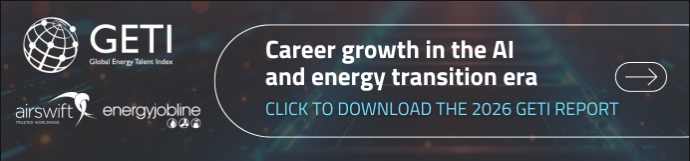
Salary increases for the traditional energy sector
The 2026 GETI report shows that pay rose in 2025 for 50% of professionals and 60% of hiring managers. While salary confidence remains strong, momentum has slowed. Looking ahead, 67% of professionals expect a pay increase next year, down from 71% in 2025.
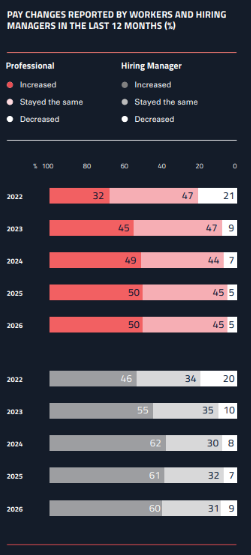
Among hiring managers, 60% report higher pay levels, though only 33% saw increases above 5%, a one-point decline year on year. Meanwhile, 9% say pay has fallen, with 6% reporting decreases of more than 5%.
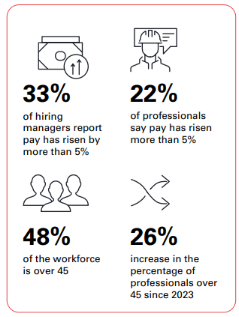
The workforce continues to skew older. Professionals aged over 45 now make up 48% of the workforce, while those aged 25 to 34 account for just 19%, continuing a downward trend.
James Allen, CEO at Airswift, observes:
“The ageing workforce challenge is becoming increasingly urgent to address as traditional energy organisations are struggling to make hires with the right technical expertise and experience”.
Global mobility in the traditional energy sector
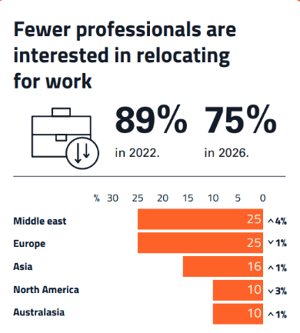
The report highlights a continued decline in global mobility, with just 75% of traditional energy professionals now willing to relocate for work, down from 80% in 2025 and 89% in 2022. Destination preferences have also shifted: the Middle East and Europe now share the top spot at 25% each, while interest in Asia remains steady at 16%.
Jayden Wallis, President ASPAC & Airswift Resourcing at Airswift, adds:
“The Middle East is investing trillions of dollars to diversify their economies and are lowering barriers to entry so that organisations can secure the talent they need to deliver an ambitious pipeline of projects.”
AI adoption and career development
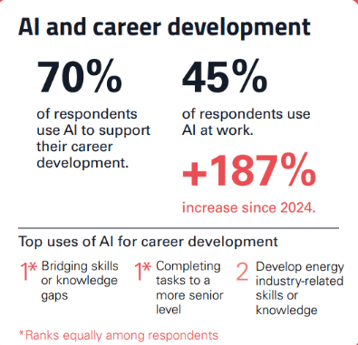
AI has had a growing impact on the energy industry over the past three years. Today, 45% of traditional energy professionals use AI in their roles, a 187% increase from 24% in 2024. Despite this progress, 30% of professionals still do not use AI to support their career development.
Despite concerns that AI could replace some engineering and technical roles, hiring managers continue to face significant shortages. Half say these are the hardest roles to recruit for.
In response, hiring managers are adapting their approach. Nearly half are strengthening learning and development programmes, while 45% are using AI and automation to build the skills their organisations need.
Jayden Wallis says:
“Hiring managers are increasingly struggling to recruit experienced professionals, while a smaller percentage of younger talent is entering the workforce. [...] Investing in retention and attracting younger generations will be essential for closing the gap and securing the talent needed for the future.”
Attracting and retaining traditional energy talent in 2026
Demand for talent remains high, with 81% of professionals approached about a new role this year, in line with 82% last year. Fewer professionals experienced repeated outreach: 11% were contacted 16 or more times, down from 14%, while 32% were approached more than six times, compared with 34% in 2025.
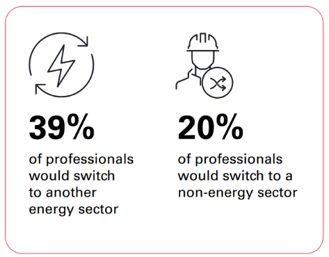
Willingness to change roles remains strong, though slightly lower than last year. Most professionals (84%) would consider switching roles, down from 86%. Of these, 60% would move within their current energy sector, while 39% would consider another energy sector.
Interest in roles outside energy continues to decline, with 20% open to leaving the industry, down from 26%. Renewables remains the most attractive destination at 67%, followed by power at 36%.
LEARN MORE: 10 things oil and gas workers want from employers (besides salary)
Download the full GETI 2026 report
Would you like to learn more about power employment trends expected to shape the sector in 2026? Get all the latest insights and information on trends across the rest of the energy industry when you download the 2026 GETI report.