
By
Diyaa Mani
January 22, 2026
Updated
January 22, 2026
Coal mining is an industry that still employs millions of people worldwide, even as it changes and shrinks over time.
From the miners who dig out coal to the engineers and safety experts who keep mines running, coal mining offers a variety of jobs. However, it’s also an industry facing decline due to automation and the shift toward cleaner energy.
How many jobs are in coal mining?
As of 2025, coal mining continues to be a major source of employment for around five million people across the globe. This vast workforce highlights the industry's enduring role in supporting livelihoods, particularly in regions where coal remains a key part of employment, with mining communities demonstrating resilience and adaptability.
As the global energy landscape evolves, the skills and experience of coal workers are increasingly recognised as valuable assets, opening up exciting opportunities for growth, retraining, and transition into emerging sectors such as renewable energy and infrastructure development.
Where are these coal mining jobs?
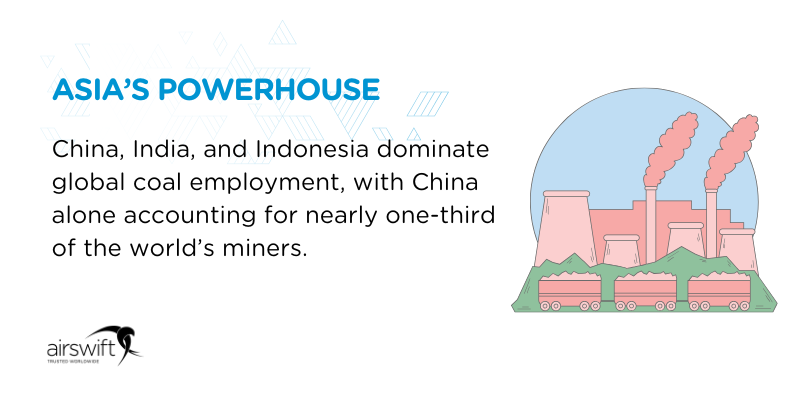
Mostly in Asia. A few countries dominate coal mining employment:
China
China’s coal industry employs over 1.5 million people, which is roughly one-third of all coal miners in the world.
India
The second-largest coal producer, India officially has around 337,000 people working in coal mines. However, this count doesn’t include many contractors and informal workers. Coal India, the government-owned company, alone has over 248,000 employees and is one of the world’s largest mining employers.
Indonesia
Indonesia is a major coal exporter and has a large mining workforce. Estimates put Indonesia’s coal mining jobs at around 200,000–250,000 people.
United States
Coal mining employment in the US has dropped sharply over decades. Now, only about 40-45 thousand Americans work in coal mines.
Global Energy Monitor data show about 2.2 million of the world’s coal miners are in Asia. By contrast, developed countries like the US and those in Europe now have relatively few coal miners.
What are the different jobs in the coal mining industry?
Coal mining isn’t just one job; it’s an industry with a wide range of job types. Here are some of the main categories of jobs found in the coal mining operation:
Underground miner
Works in tunnels to extract coal using drills or explosives. Installs roof supports for safety. Requires high school education and specialised mine training; no degree needed.
Surface miner / Heavy equipment operator
Operates large machinery in open-pit mines to remove soil and extract coal. Needs equipment training or certification, but not a college degree.
Mining engineers
Design mine layouts and plans extraction methods. Ensure safety, efficiency, and environmental compliance. Requires a degree in mining or related engineering field.
Geologist
Analyses coal seams and rock formations to guide mining operations and identify hazards. Typically holds a geology degree.
Maintenance and repair crew
Includes mechanics, electricians, and technicians who keep mining equipment running. Requires vocational training or apprenticeships.
Safety officer / inspector
Ensures compliance with safety regulations, conducts training, and inspects mine conditions. Often has mining experience and safety certifications.
Coal processing plant operator
Runs equipment that cleans, sorts, and prepares coal after extraction. Requires a high school diploma and on-the-job training.
Support roles (various)
A coal mine, especially a large one, has many other support positions that keep the whole operation running smoothly. For instance:
- Supervisors/foremen: Lead teams of miners or operators during each shift, ensuring tasks are completed safely and efficiently.
- Mine surveyors: Map tunnels and pit progress to guide operations and maintain safety boundaries.
- Emergency response crew: Specially trained miners or staff ready to handle accidents and provide first aid or rescue.
- Blasters: Certified experts who handle explosives for controlled blasting in both surface and underground mines.
- Administrative staff: Includes roles like clerks, office admins, and security personnel who support daily operations.
- Environmental technicians: Monitor environmental compliance, including water discharge, dust levels, and land restoration.
Each job comes with its own skill requirements, but teamwork is critical in every case. Coal mining jobs tend to be in remote locations and the work is often done in crews.
How much do coal mining jobs pay?
Coal mining jobs often pay higher-than-average wages for the regions where they are located, but the pay varies a lot by country and by job role. Generally, mining is considered relatively well-paid manual labour because it can be dangerous and is often in remote areas. Here is a break down of coal mining salaries:
Global differences
A coal miner’s income in a wealthy country can be 10 times (or more) what a coal miner earns in a developing country. For example, an average coal miner in the United States makes around $75,000-$80,000 per year (roughly, that’s about $35-$40 per hour).
In contrast, an average coal miner in India might earn the equivalent of only about $9,000 per year. In China, a typical coal miner’s annual salary is around ¥158,000 yuan, which is roughly $22,000 USD.
So there’s a huge gap: miners in the US, Canada, Australia, or Europe make a comfortable middle-class income, whereas miners in countries like China, India, or Indonesia make much less in dollar terms (though their wages are still relatively good by local standards). (Source: bls.gov)
Salary by country (rough averages)
| Country | Annual STEM Graduates |
|---|---|
|
United States |
$78,000 USD . Coal miners in the U.S. often earn between $50k and $100k, depending on experience and overtime. This is high compared to the national average wage. |
|
China |
¥158,000 CNY, about $22,000 USD. Chinese coal miners earn more than the average worker in China. |
|
India |
₹750,000 INR (Indian rupees), roughly $9,000-$10,000 USD. |
|
Australia |
A$100,000 AUD, which is about $65,000 USD. Australian coal miners are well-paid; some reports show averages ranging from A$90k to A$120k depending on the region and role. Overtime and remote location allowances can push individual earnings well above A$100k. |
|
South Africa |
R230,000 ZAR (South African rand), roughly $12,000-$15,000 USD. South African miners’ wages vary by skill and experience, but an underground worker might make around that range, which is fairly high compared to South Africa’s average income. |
|
Poland |
80,000 PLN (Polish złoty), roughly $20,000 USD. Polish coal miners, many of whom work in deep mines, have historically had decent wages and strong unions. As mines close, remaining skilled miners still earn a solid wage by local standards. |
Different jobs, different pay
Within a mine, not everyone earns the same. Skilled trades and professionals tend to earn more than general mine labourers. For instance:
- Entry-level miners or truck drivers: Start around $20-$25/hour (approximately $50,000/year in the U.S.), with potential for raises and overtime.
- Experienced operators: Can earn $40+/hour; with overtime, annual pay can exceed $100,000.
- Electricians and mechanics: Skilled trades often earn equal to or more than miners; certified electricians in the U.S. can make $90,000+.
- Supervisors/foremen: Earn 20-30% more than the miners they oversee.
- Engineers and geologists: Salaried roles; typically earn $70,000-$100,000+ depending on experience.
- Managers/directors: Senior roles can earn six-figure salaries and above.
Other compensation
Health insurance, pensions, and bonuses are common, especially in unionised mines.
- Remote site perks: Housing allowances, “living-out” benefits (e.g., South Africa), or subsidised housing, schools, and clinics (e.g., China, India).
- Hazard pay: Extra compensation for high-risk roles (e.g., deep underground or high-methane areas).
Work hours and overtime
- Long shifts (10–12 hours) and rosters like “7 on, 7 off” are common.
- Overtime is a major income booster, especially in remote or fly-in/fly-out (FIFO) roles in places like Australia.
Cost of living
- High salaries in countries like the U.S. or Australia often offset higher living costs or dual-household expenses.
- In lower-cost regions (e.g., rural India), even modest salaries can support families comfortably.
What training or qualifications do you need for coal mining jobs?
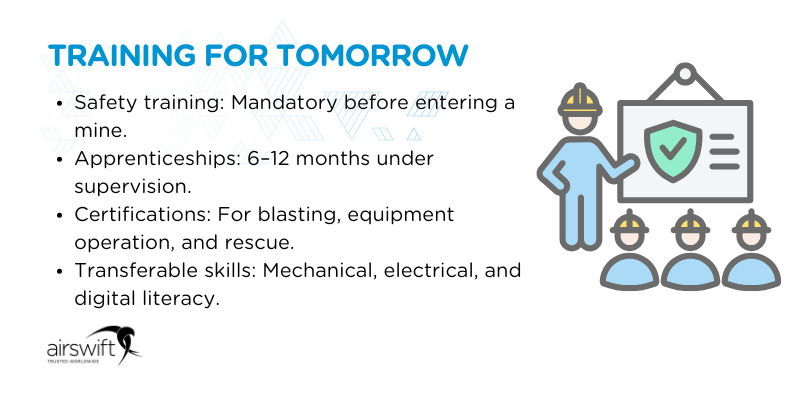
Working in a coal mine is not like a typical job; it has specific legal requirements and training for safety. Here’s a breakdown in plain terms:
Minimum requirements
- Must be at least 18 years old (legal requirement in most countries).
- High school diploma or equivalent is typically required.
- No college degree needed for entry-level roles.
- Basic reading, writing, and math skills are important.
- Physical fitness is essential; mining can be physically demanding.
- Must pass a medical exam (vision, hearing, general health) before starting.
Basic safety training
- Mandatory safety training before entering a mine.
- Covers hazard awareness, protective equipment, and emergency procedures.
- Ends with a test or certification.
- New hires often start as “trainee” or “green” miners under supervision.
Apprenticeship / On-the-job training
- After classroom training, new miners work under experienced mentors.
- This phase typically lasts 6 months to 1 year.
- Builds hands-on experience and confidence in real mining environments.
Role-specific training and licenses
Depending on your role, you may need extra certifications:
- Blasting license for handling explosives (includes special training and exams).
- Equipment operator certifications for hoists, trucks, or other machinery.
- Electricians need general and mine-specific electrical certifications.
- Mine rescue team members receive emergency response training.
- Foremen/supervisors must pass exams and meet experience requirements.
Continuous (refresher) training
- Annual refresher courses are required by law in most regions.
- Regular safety meetings and drills are part of daily operations.
Physical and mental preparedness
- Mental resilience is key; mining environments can be tough.
- Teamwork and communication are essential for safety and efficiency.
Transferable skills and modern needs
- Basic computer literacy is increasingly valued (for operating digital equipment).
- Trades skills (mechanical, electrical, welding) are a strong foundation.
- Many skills gained in mining are transferable to other industries like construction, manufacturing, and renewable energy.
Supporting your next step in the evolving energy landscape
Coal mining has long been a cornerstone of global industry, providing millions of jobs and powering economies. Today, it continues to offer rewarding careers with strong wages and valuable skills.
As the energy landscape evolves, coal workers are uniquely positioned to lead the way into new opportunities, whether through upskilling, safety leadership, or transitioning into fast-growing sectors like renewables and infrastructure.
At Airswift, we’re here to support that journey. Whether you're exploring your next role or looking to pivot your career, our global network and industry expertise can help you take the next step.